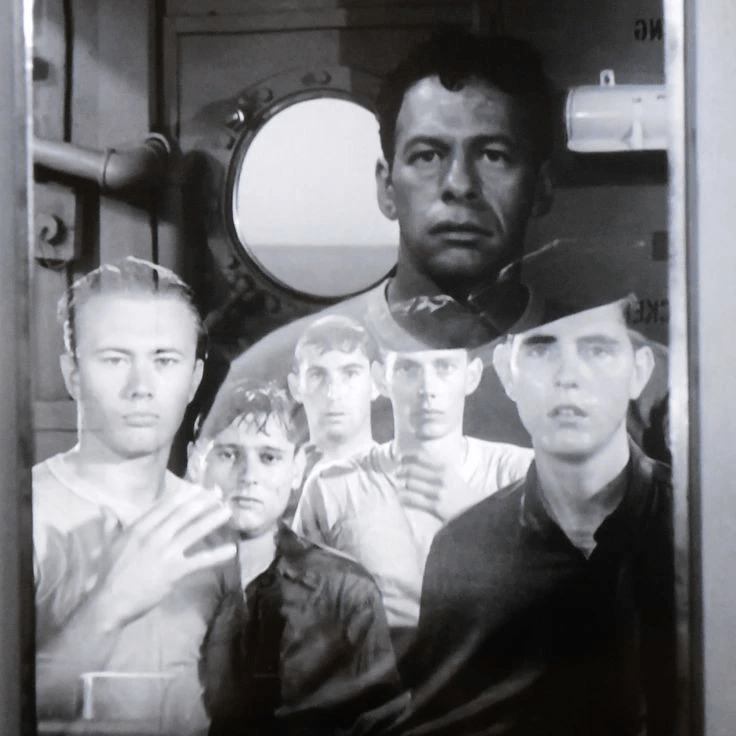
The mixture of a submarine movie and a ghost story is what we get in “Thirty-Fathom Grave,” the second episode in the fourth season of The Twilight Zone.
This was a solid episode with an intriguing plot dealing with a sunken submarine discovered by a ship because there sounded as if there were a metallic tapping echoing through the water.
Meanwhile, one of the crew members, Chief Bell, begins to have a nervous breakdown despite a long and successful career in the Navy.
There did seem to be too much episode for the story being told here. There were a bunch of scenes that were repeated (not sure how many times we needed to see the diver going down to the stranded submarine or how many scenes of moving the ship) that could have been edited out to make the episode tighter. Unlike the first episode of the season, this did feel like it was hurt by the expansion from 30 minutes to an hour.
Still, the overall episode was very good, with a great performance from Mike Kellin, playing Chief Bell, and displaying his combination of survivor’s guilt and PTSD.
One of the members of the crew was played by Bill Bixby, another future star that I recognized in Twilight Zone episodes.
“Valley of the Shadow”
The Twilight Zone’s third episode of season four was called “Valley of the Shadows” and it made me think a lot about a comic series from the last few years called “Stillwater,” by Chip Zdarsky.
Stillwater was the story of a small town whose residents could not die and did not age. It was a secret that the leaders of Stillwater kept hidden from the outside world and they prevented people from leaving their town. This is very much similar to Valley of the Shadows, where there was technology that allowed these people to have basically anything that they wanted, but who had to stay isolated in fear of what the outside world may do with that tech.
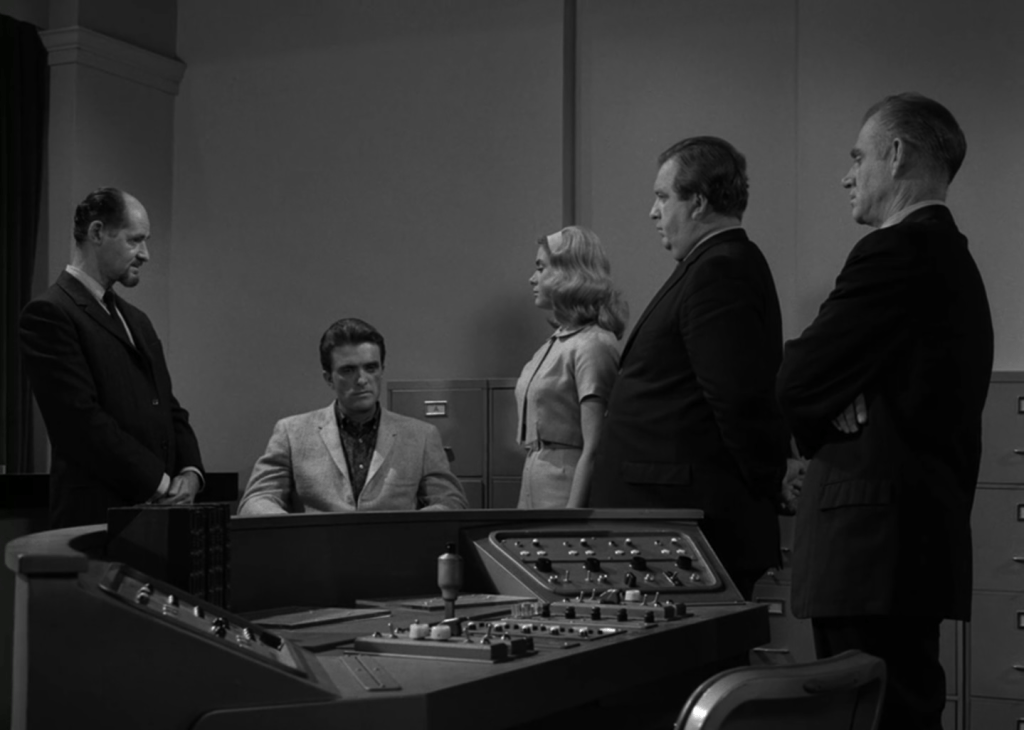
When the reporter Phillip Redfield is lost and drives into Peaceful Valley by accident, he realizes that things are weird. Actually, it was because of his dog, who wound up chasing a cat and a little girl made the dog disappear with a handheld machine.
When Redfield demands answers from the council, they decide that he needed to be held captive to protect the town’s secrets.
There was an argument in the episode about whether these secrets should be shared with the world. How there were people dying from hunger every day of the year and how this could help people. The council believed that this machine that could do about anything would be used for bad things by the outside world. It was an interesting debate and one that I am not sure of which side I would come down upon.
“You’ve seen them. Little towns, tucked away far from the main roads. You’ve seen them, but have you thought about them? Have you wondered what the people do in such places, why they stay? Philip Redfield thinks about them now and he wonders, but only very late at night, when he’s between wakefulness and sleep in the Twilight Zone.”
Stillwater was an excellent series from Image Comics. You could give it a try.
Season four kicked off with a big change in format for The Twilight Zone. This season, there are only 18 episodes, but these were an hour in length. It will be a curious season to dive into since the half and hour format had been so successful. I do think there were a few episodes from season 1-3 that could have benefitted from being a tad longer so we’ll have to see if the writers take advantage of the extra time to develop characters and the story in a greater detail. If the first episode is an example, then this season will have some solid stroytelling.
The episode started with a scene that was a fascinating intro, but does not really work with the remainder of the episode. When Alan tossed that lady into the oncoming train, there was not much of a trigger. I assume that it was just meant to show how dangerous Alan was.
Alan went to his fiancé, Jessica, and they were preparing to go to Alan’s childhood hometown to meet his aunt. There is no references to the murder in the opening scene. Alan and Jessica seem very content. However, when he arrived in the town, things were different and his aunt’s house was owned by someone else.
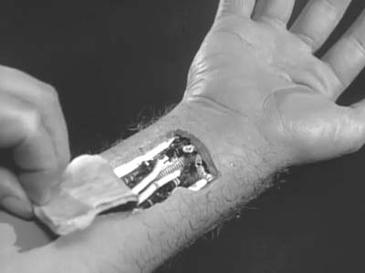
Alan was having all kinds of troubles and made Jessica leave him alone when he started to hear the same sounds that he heard when he had killed the woman in the subway. After she leaves, Alan gets hit by a car and he discovered that he had a mechanical arm.
Alan is able to trace himself back to Walter Ryder, the man who created Alan in his own image, in an attempt to create the perfect man. Walter showed Alan his laboratory and the previous attempts at creating “Alan.” With the violence being a design flaw, Alan flipped out and attacked Walter, who fought back.
We see Walter showing up at Jessica’s door, pretending to be Alan, as Alan the robot was laying destroyed in the lab.
“In a way, it can be said that Walter Ryder succeeded in his life’s ambition, even though the man he created was, after all, himself. There may be easier ways to self-improvement, but sometimes it happens that the shortest distance between two points is a crooked line – through the Twilight Zone.”
The ending was kind of creepy as Walter seemingly is replacing Alan in his relationship with Jessica, which kind of takes her choice out of the matter.
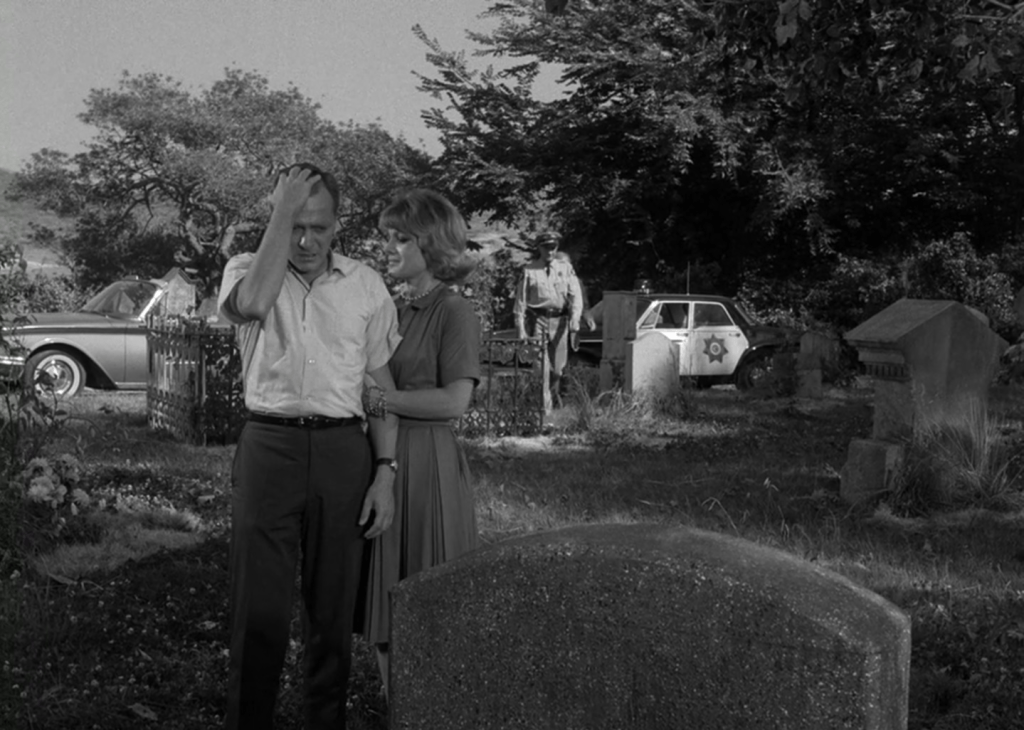
I did enjoy the longer episode as it was able to give more background for Alan. I am not sure about a couple of details from the graveyard, specifically, but the story is a twist on the Frankenstein story and it worked fairly well.
These bring a close to season three of The Twilight Zone.
“Young Man’s Fancy”
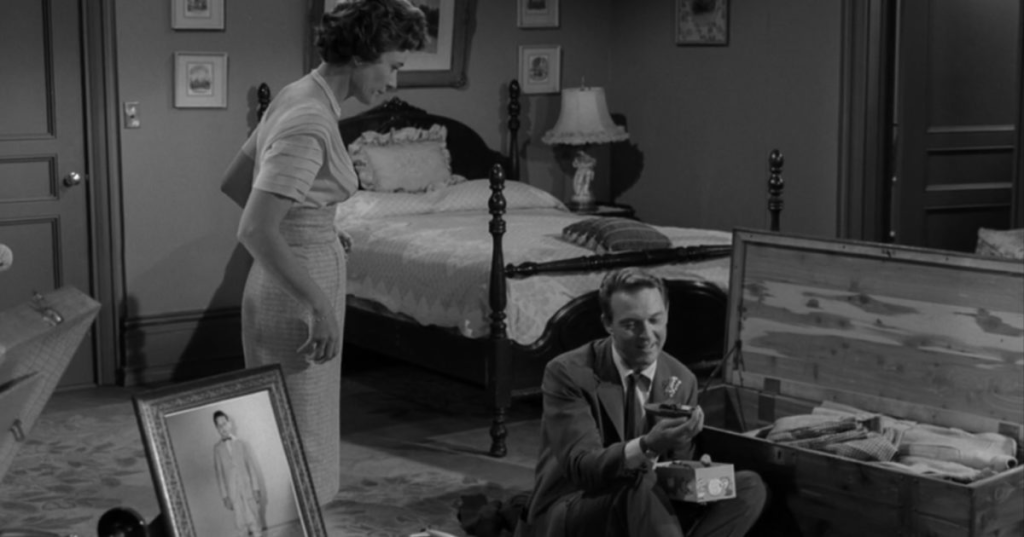
“Young Man’s Fancy” or “what a Mama’s Boy” is the next Twilight Zone episode. While I found this one interesting, I did think the ending was fairly predictable and one has to wonder what the wife was thinking by marrying this loser.
That may be too harsh.
“You’re looking at the house of the late Mrs. Henrietta Walker. This is Mrs. Walker herself, as she appeared twenty-five years ago. And this, except for isolated objects, is the living room of Mrs. Walker’s house, as it appeared in that same year. The other rooms upstairs and down are pretty much the same. The time, however, is not twenty-five years ago but now. The house of the late Mrs. Henrietta Walker is, you see, a house which belongs almost entirely to the past, a house which, like Mrs. Walker’s clock here, has ceased to recognize the passage of time. Only one element is missing now, one remaining item in the estate of the late Mrs. Walker: her son, Alex, thirty-four years of age and, up till twenty minutes ago, the so-called perennial bachelor. With him is his bride, the former Miss Virginia Lane. They’re returning from the city hall in order to get Mr. Walker’s clothes packed, make final arrangements for the sale of the house, lock it up and depart on their honeymoon. Not a complicated set of tasks, it would appear, and yet the newlywed Mrs. Walker is about to discover that the old adage ‘You can’t go home again’ has little meaning in the Twilight Zone”
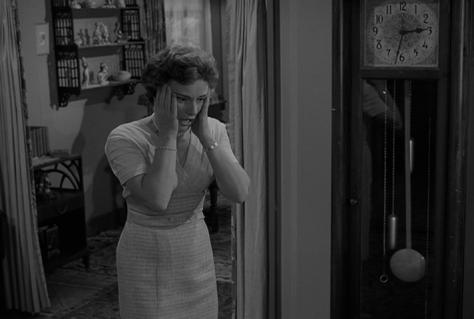
I do believe this is one of the episodes that I had seen before because, although I was not sure of what was the main plot, I do remember something about that haunted grandfather’s clock.
Mrs. Walker also seemed to give up pretty quickly considering she had started it all with her comments to the mother before any of the haunting began. Something about ‘claws.’ Still, you would think that you would understand about the deep-seeded connection to his mother Alex held before she married him. Discovering this unhealthy aspect of his character before the honeymoon feels like a mistake on her part as much as his.
“I Sing the Body Electric”
Mary Poppins meets A.I. in this sentimental episode of The Twilight Zone that just felt like there was something missing for me.
Larry Tate (er… I mean David White, the actor who played Larry on Bewitched) returned to the Twilight Zone as a busy widowed father with three kids that he has apparently been ignoring. They find an advertisement for an artificial intelligence that could be a nanny.
“They make a fairly convincing pitch here. It doesn’t seem possible, though, to find a woman who must be ten times better than mother in order to seem half as good, except, of course, in the Twilight Zone”
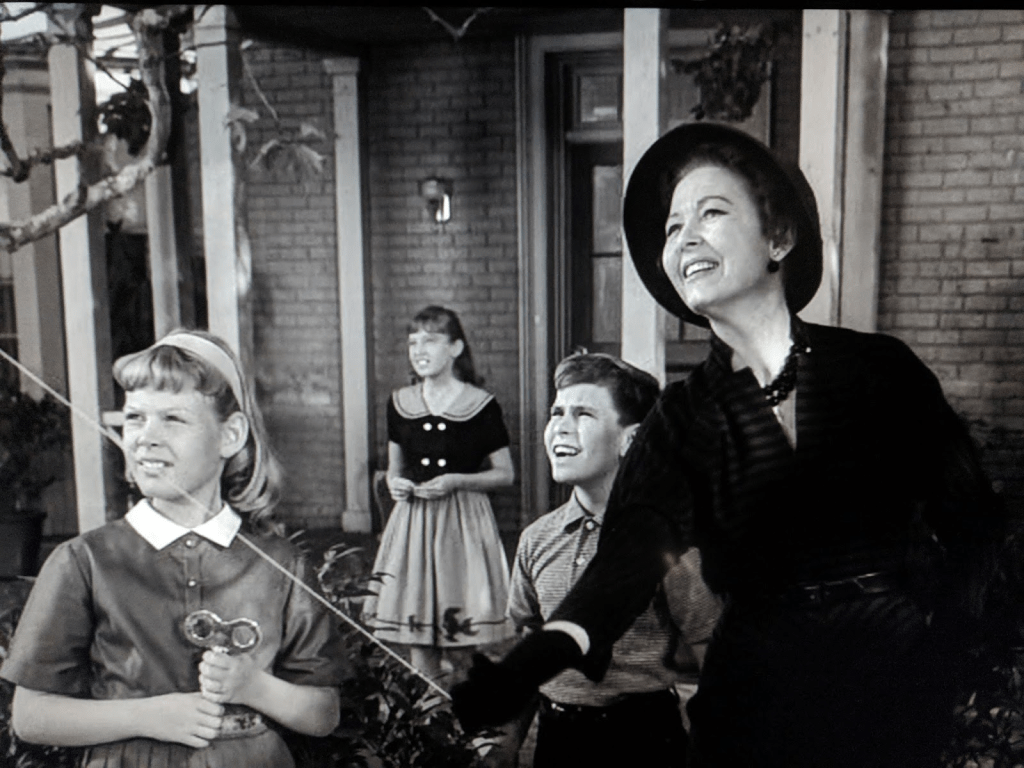
So it is Mary Poppins as a robot. They even go as far as having a kite scene. However, the movie Mary Poppins came out in 1964 while this episode was shown in 1962. Maybe this episode was inspired by the Mary Poppins book by P.L. Travers which was written in the later 30s.
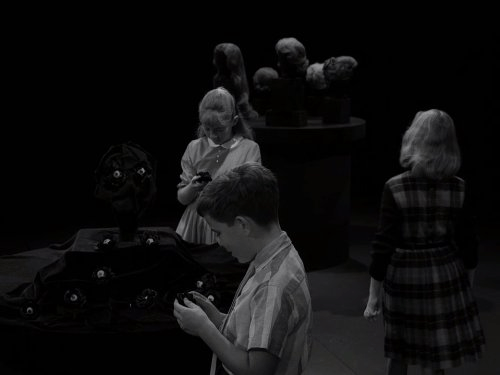
There were some intriguing character moments here, especially with Anne, one of the little kids, but things resolve too quickly and wrap up so saccharine sweet that it did not feel like the Twilight Zone. Admittedly, the scene where the kids run around the Facsimile Ltd. factory picking out body parts for the robot was unbelievably creepy (which I do not think it was meant to be). Plus, robot, that they called Grandma- also creepy- did not have the hair that the boy picked out. What a rip off!
“Cavender is Coming”
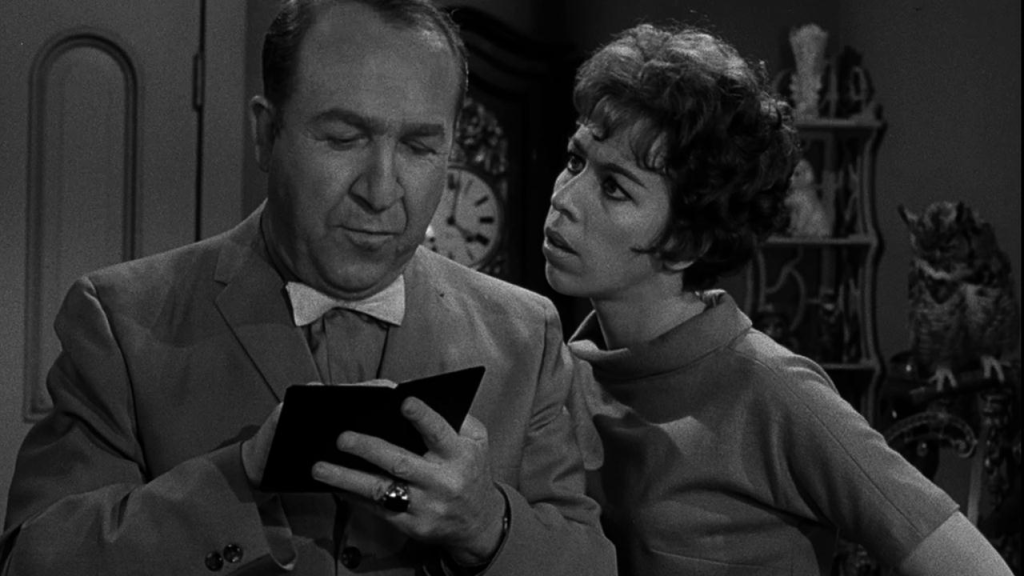
You would think that an episode of The Twilight Zone featuring EYG Hall of Famer Carol Burnett would not be after three full seasons my least favorite episode of the series. But you would be wrong.
Another example of how comedy has been one of The Twilight Zone’s Achilles’ Heel, this episode is just features so many unfunny things and a story so bad that it can only be saved (somewhat) by the charm of Carol Burnett.
This is yet another homage to “It’s A Wonderful Life” as Cavender is a guardian angel trying to get his wings by helping out clumsy Carol. The slapstick does not work as the episode never fully commits to it, and when it does, it just does not hit. The Twilight Zone seems to insist on adding silly sound effects to their comedic episodes that just do not aid anything.
There is a nice message of the episode about not needing wealth to be happy, but the execution just is not there. The angels in heaven scenes are like a high school production they are so amateurish.
“A word to the wise now to any and all who might suddenly feel the presence of a cigar-smoking helpmate who takes bankbooks out of thin air. If you’re suddenly aware of any such celestial aids, it means that you’re under the beneficent care of one Harmon Cavender, guardian angel. And this message from the Twilight Zone: Lotsa luck!”
Season four is next. Only 18 episodes, but they expand to an hour long.
Once again, Prime’s playing of the Twilight Zone episodes are not in the same order as the listings for the series. This episode was the 34th of the season on Prime, but, in actuality, should be the 37th of season three. I am listing it as its actual number.
Spoilers
“The Changing of the Guard”
This episode felt a little more personal than some of the other episodes of The Twilight Zone for me.
“Professor Ellis Fowler, a gentle, bookish guide to the young, who is about to discover that life still has certain surprises, and that the campus of the Rock Spring School for Boys lies on a direct path to another institution, commonly referred to as the Twilight Zone.”
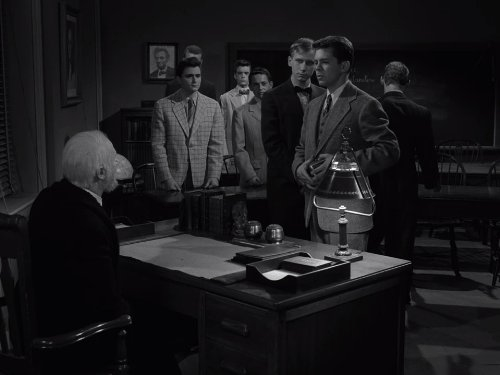
Getting on in age, Professor Ellis Fowler sends his latest class to Christmas break with his typical bravado and flair. However, he is unaware of what awaited him. His contract was not being renewed, he would be ‘terminated’ from his position because it was believed that a younger voice needed to be given the position.
Unsure what he would do next, Professor Fowler went home and retrieved a gun, with the implication that he had nothing left in life, that he wasted his time by teaching these kids nothing of value, and that he would kill himself. However, the stalwart teacher was visited by the ghosts of past students who had died and who spoke to him of the ways that he inspired them. Fowler decided against suicide and moved happily into retirement.
“The Changing of the Guard” is kind of a combination of “It’s a Wonderful Life” and “A Christmas Carol” as this was also set during the Christmas holiday.
As a teacher, you some times do not understand how much you affect the lives of the students that you are working with. There are times that you may even feel as if you are doing no good for anyone. Just recently, I had a parent come over and talk to me at a baseball game letting me know how grateful she was for everything that I had done for her children over the years. Hearing that was a wonderfully kind thing and I was very appreciative. It goes to show how much of an impact teachers can have even if they feel unappreciated at times or that they have not been able to accomplish what they had hoped.
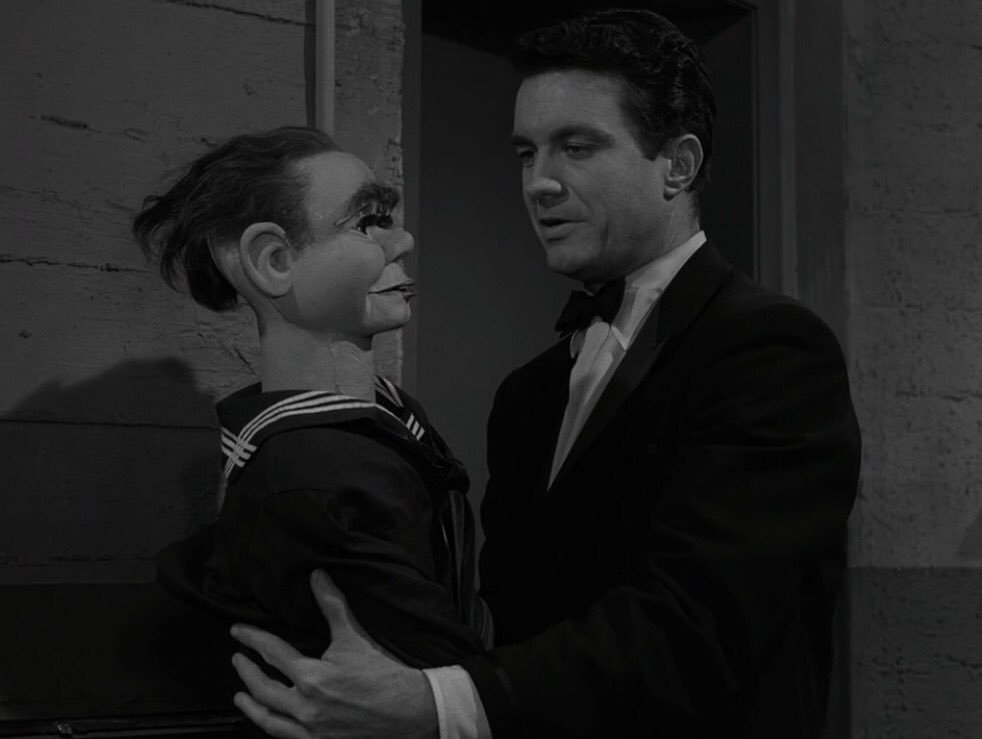
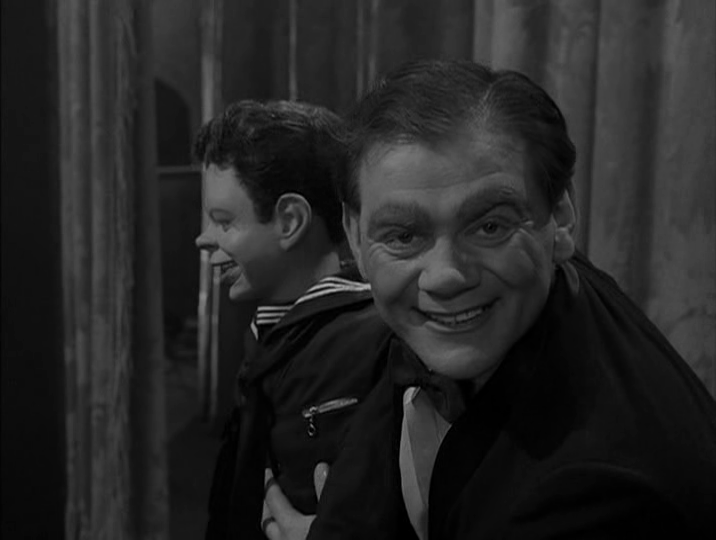
Ventriloquist dummies can be creepy. And that is even before they start talking and moving on their own.
“You’re watching a ventriloquist named Jerry Etherson, a voice-thrower par excellence. His alter ego, sitting atop his lap, is a brash stick of kindling with the sobriquet ‘Willy.’ In a moment, Mr. Etherson and his knotty-pine partner will be booked in one of the out-of-the-way bistros, that small, dark, intimate place known as the Twilight Zone.”
I really enjoyed this episode. I liked how there is still some question about whether Willy was real or whether Jerry was simply hearing voices and was out of his mind. Even with the bizarre ending of switching places, I can see how this could be dealing with mental illness on the part of Jerry.
“What’s known in the parlance of the times as the old switcheroo, from boss to blockhead in a few uneasy lessons. And if you’re given to nightclubbing on occasion, check this act. It’s called Willy and Jerry, and they generally are booked into some of the clubs along the ‘Gray Night Way’ known as the Twilight Zone”
Cliff Robertson, Uncle Ben from Sam Raimi’s Spider-Man, was our lead actor here and he does a wonderful job of showcasing the anxiety, the fear and uncertainty of this situation.
Paranoia is a major feel in The Dummy as Jerry is never 100% sure what was happening. The way Willy would move ever so slightly as it sat in the dressing room emphasized this to the audience.
Am awesome episode. One of the best of season three so far.
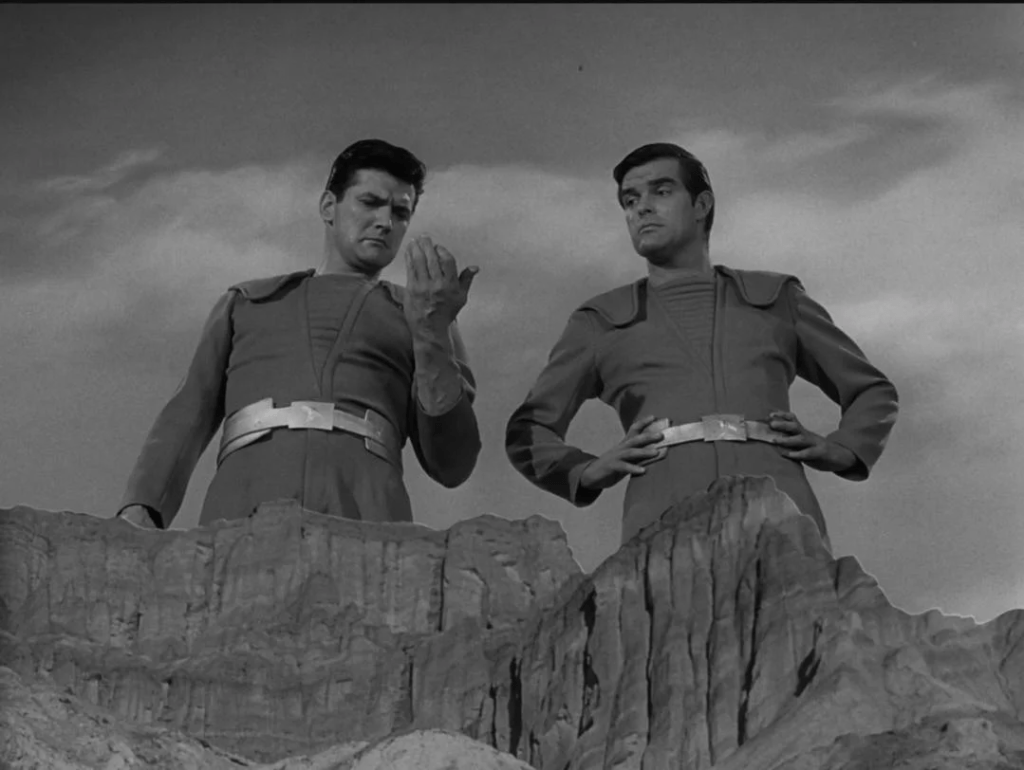
So when two men land their spaceship on this planet, they discover a bizarre surprise.
“The time is the space age, the place is a barren landscape of a rock-walled canyon that lies millions of miles from the planet Earth. The cast of characters? You’ve met them: William Fletcher, commander of the spaceship; his copilot, Peter Craig. The other characters who inhabit this place you may never see, but they’re there, as these two gentlemen will soon find out. Because they’re about to partake in a little exploration into that gray, shaded area in space and time that’s known as the Twilight Zone.”
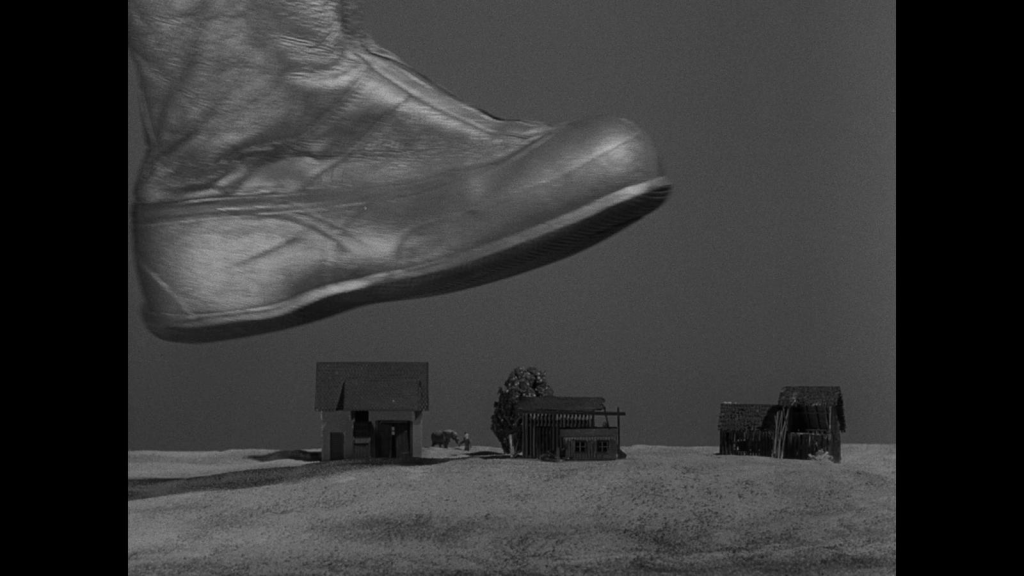
The land where they landed contained natives who were tiny, Lilliputian-type people. And Peter Craig found his gigantic size a major advantage. So much so that he started to consider himself a god to these people, going as far as to crushing these people’s homes with his foot.
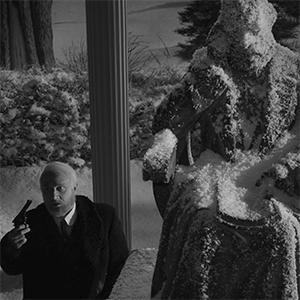
When the ship was repaired, Fletcher tried to get Peter to come with him, but he would refuse, pulling a gun and demanding that Fletcher leave him alone. Peter had convinced the little people to build a statue in his honor.
However, the power would be fleeting as another ship landed on the rock and this was a race of people who were much large than Peter. In fact, they grabbed Peter and crushed him in their hands. When they left, the little people pulled down the statue upon the dead body of Peter.
“The case of navigator Peter Craig, a victim of a delusion. In this case, the dream dies a little harder than the man. A small exercise in space psychology that you can try on for size in the Twilight Zone.”
“Four O’Clock”
One of the straight up villains of The Twilight Zone, Oliver Crangle was played by Theodore Bikel with a glorious zeal unlike we have seen to this point.
“That’s Oliver Crangle, a dealer in petulance and poison. He’s rather arbitrarily chosen four o’clock as his personal Götterdämmerung, and we are about to watch the metamorphosis of a twisted fanatic, poisoned by the gangrene of prejudice, to the status of an avenging angel, upright and omniscient, dedicated and fearsome. Whatever your clocks say, it’s four o’clock, and wherever you are it happens to be the Twilight Zone.”
Oliver Crangle is like the Q of our time. Going out of his way to do his battle with those he perceived as ‘evil’ in the world. He did not see himself as evil though, as most great villains do. They see themselves as the hero of their story.
Crangle was certainly a bit crazy. His overall plan to make all people he deemed evil two-feet tall is super-villain plots at the best. I also enjoyed the twist ending with Cringle becoming two-feet tall himself, revealing that he was, in truth, evil.
How did this happen? That is never mentioned. Could there have been more depth to this character? Sure. Still, I found the performance of Theodore Bikel to be over-the-top goodness.
“Hocus-Pocus and Frisby”
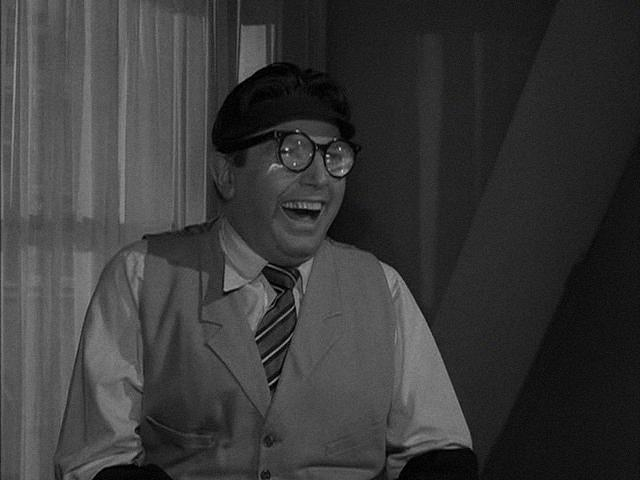
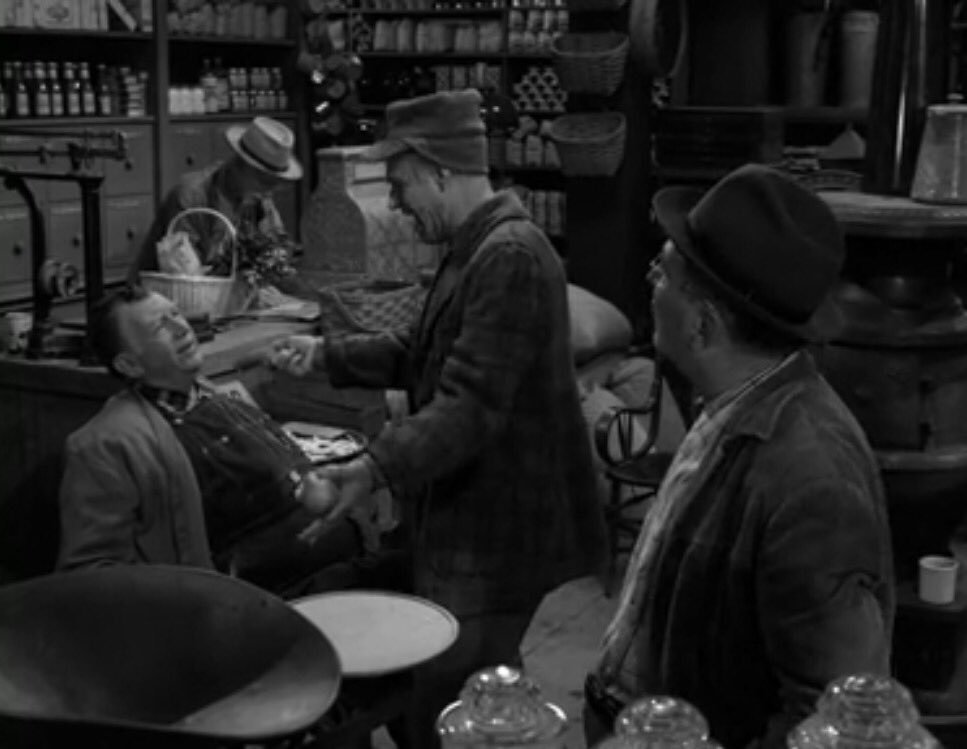
Hey, there was Floyd, from Mayberry!
Mr. Frisby is the ultimate liar. That might be too unfair. He is certainly a ‘tall tale’ teller.
“The reluctant gentleman with the sizable mouth is Mr. Frisby. He has all the drive of a broken camshaft and the aggressive vinegar of a corpse. As you’ve no doubt gathered, his big stock in trade is the tall tale. Now, what he doesn’t know is that the visitors out front are a very special breed, destined to change his life beyond anything even his fertile imagination could manufacture. The place is Pitchville Flats, the time is the present. But Mr. Frisby’s on the first leg of a rather fanciful journey into the place we call the Twilight Zone.”
With the theme of ‘boy who cried wolf’, Mr. Frisby, who has a tale to tell about his exploits that are, at best, inaccurate, was abducted by aliens because the aliens were looking for specimens that were the most impressive and knowledgeable of their kinds and they did not understand the idea of lying. So, obviously, with Mr. Frisby’s continued hyperbole and outright fibs, they thought they found the best human going.
Mr. Frisby is able to escape by playing his harmonica, which was a sound that was dangerous to the aliens, and, ironically, when Mr. Frisby was telling the story that was actually true to his friends at his store, they did not beleive him.
This was fine, but a little bit of Mr. Frisby went a long way. It did become somewhat annoying after awhile.
“The Trade-Ins”
“Mr. and Mrs. John Holt, aging people who slowly and with trembling fingers turn the last pages of a book of life and hope against logic and the preordained that some magic printing press will add to this book another limited edition. But these two senior citizens happen to live in a time of the future where nothing is impossible, even the trading of old bodies for new. Mr. and Mrs. John Holt, in their twilight years, who are about to find that there happens to be a zone with the same name.”
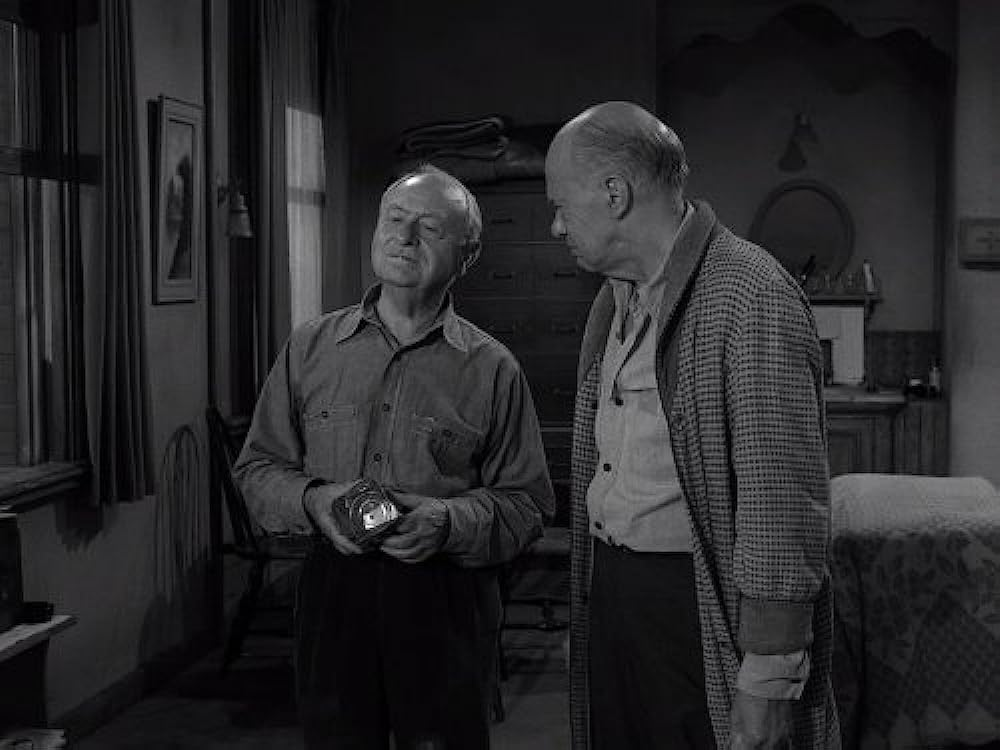
This story was a love story featuring the couple of Mr. and Mrs. John Holt, who had been married for fifty years, but whose bodies were feeling the stress of age. Fortunately, there was a technology that allowed them to switch from their old bodies and trade them in for younger versions.
Unfortunately for the Holts, the process cost $10,000 dollars, and they only had half of that. This created the conflict in the episode as Mr. Holt tried to go about finding the extra money, but failing to make it in a high stakes poker game.
In the end, Mr. Holt had the process done, but decided to take up the return policy because he could not see himself living the life of a young man without the love of his life.
Sweet and romantic. It was a decent episode with a message that showed the positive side of humans, which we do not see as often in The Twilight Zone.
The strange numbering comes from Amazon Prime/Paramount +. For some reason, they had the episode “The Gift”, which is listed as episode 32 everywhere else I looked, was in at number 28. I am not sure the reason it is in a different order on Prime even though it had never been in an incorrect order as of yet. So I am listing it as the order is supposed to be, not the one on Prime.
“Person or Persons Unknown”
He is David Gurney… or is he?
“Cameo of a man who has just lost his most valuable possession. He doesn’t know about the loss yet. In fact, he doesn’t even know about the possession. Because, like most people, David Gurney has never really thought about the matter of his identity. But he’s going to be thinking a great deal about it from now on, because that is what he’s lost. And his search for it is going to take him into the darkest corners of the Twilight Zone.”
David woke up after a night of drinking and, without warning, his wife did not recognize him. He thought of this as a joke, but when the people at work did not know him either, things get harder for him.
He desperately tries to find proof of his existence, failing at every turn. The performance by Richard Long was solid, though he did take a while to really grasp what was going on. You would think that he would have come around earlier than what he did.
Then, The Twilight Zone pulled a switch much like they did in “The Midnight Sun”. David wakes up again, understanding that everything he had gone through was a dream. However, his wife Wilma was not the wife he knew, looking completely different.
I feel as if this was another Twilight Zone episode that started strong, with a really good premise, but that did not deliver an equally potent conclusion.
“The Gift”
As I mentioned earlier, this was out of order on Prime, but I did not realize it until it was underway so I decided to leave it as is. I am still referring to it as episode 32, though.
This was not a very good episode. Performances were weak or uninspiring and the story, which was meant to be a parable tied to the story of Jesus Christ, it misses its mark badly.
“The place is Mexico, just across the Texas border, a mountain village held back in time by its remoteness and suddenly intruded upon by the twentieth century. And this is Pedro, nine years old, a lonely, rootless little boy, who will soon make the acquaintance of a traveler from a distant place. We are at present forty miles from the Rio Grande, but any place and all places can be the Twilight Zone.”
Pedro was one of the weakest child actors we have seen in The Twilight Zone. His performance was very wooden and lacking any sort of depth. I do not like calling out child actor’s performances, but when one is such a vital piece of the story, I can’t ignore it.
The gift given by the alien was, of course, something that we all wish we would have had and it shows the way fear and hatred can cause problems in the world today. The message is good, but the delivery of the message felt heavy-handed and lacking the sufficient subtlety to make this sci-fi story worthwhile.
This was a weird episode that was intended to be a sweet one, but lent itself into something less than sweet.
“It’s been said that science fiction and fantasy are two different things: science fiction, the improbable made possible; fantasy, the impossible made probable. What would you have if you put these two different things together? Well, you’d have an old man named Ben who knows a lot of tricks most people don’t know and a little girl named Jenny who loves him — and a journey into the heart of the Twilight Zone.”
Ben and Jenny are friends. Ben can do amazing things, such as shapeshift and other magical tricks. Trouble is that Ben is being pursued by two men who appear to be from the police.
Jenny is staying with her aunt Agnes, played by Nancy Kulp, most well known as Ms. Hathaway of the Beverly Hillbillies. Aunt Agnes was pretty mean, always yelling at Jenny and wanting Ben to go away forever.
The relationship between Jenny and Ben was meant to be sweet, but it really felt odd to me and was a drawback to the episode. That made this a weird installment of The Twilight Zone. Ben was revealed as an alien who was a king of his planet and the two police were actually subjects trying to bring him back. There were a lot of this episode that just did not work well for me.
“Little Lost Girl”
“Little Lost Girl” is a fascinating episode with some cool special effects creating a bizarre dimension, showing how different the they can be.
“Missing: one frightened little girl. Name: Bettina Miller. Description: six years of age, average height and build, light brown hair, quite pretty. Last seen being tucked in bed by her mother a few hours ago. Last heard: ‘ay, there’s the rub,’ as Hamlet put it. For Bettina Miller can be heard quite clearly, despite the rather curious fact that she can’t be seen at all. Present location? Let’s say for the moment… in the Twilight Zone.”
An opening between dimensions appears in the bedroom of Bettina Miller and she falls into it. Crying out for her parents, Chris and Ruth, they come to her room. They can hear her, but they cannot find her no matter where they look. When Mack the dog runs under the bed and disappears as well, they know that something weird was going on.
Fortunately, Chris has a friend named Bill who is, coincidentally, a physicist. He comes up with the alternate dimension theory and tells Chris that the dog was the key. The dog is trying to lead Bettina out from the dimension. Chris, however, winds up falling inside the portal too.
The special effects in the dimension was really cool, making everything feel unsettling and oft balance.
Chris is instructed that he must not move and that Mack had to lead Bettina to him. Chris kept calling his daughter and the dog and finally they came to him. Bill is able to pull them free of the dimension and back into their house.
Bill lets Chris know that the portal was closing and that Chris was actually just partially inside the dimension. Bill was worried that the portal would shut before Chris was out, leaving half of him in each dimension.
Bill and Mack the dog were clearly the MVPs of this episode. It just goes to show you that it is always a good idea to make friends with a physicist and have him on speed dial for those middle of the night dimensional emergencies.
My friend Todd told me that this was his favorite episode of The Twilight Zone and that I would love it. I know that the expectations were high for the episode as it is considered one of the iconic episodes of the entire run.
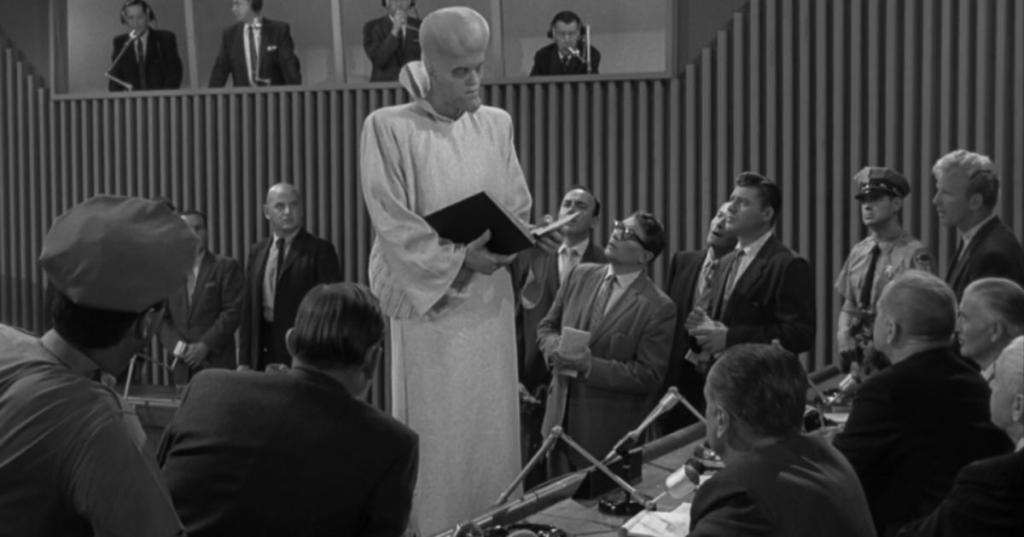
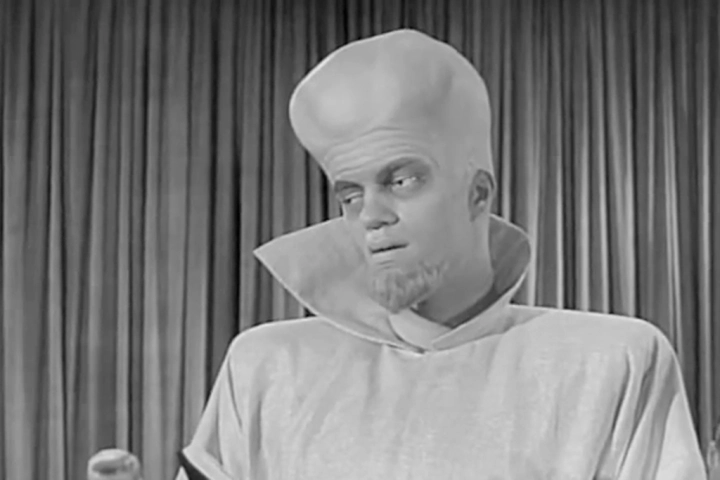
“Respectfully submitted for your perusal — a Kanamit. Height: a little over nine feet. Weight: in the neighborhood of three hundred and fifty pounds. Origin: unknown. Motives? Therein hangs the tale, for in just a moment, we’re going to ask you to shake hands, figuratively, with a Christopher Columbus from another galaxy and another time. This is the Twilight Zone.”
I enjoyed the way the episode started, with Michael Chambers locked inside a room by himself as instructions came over the speakers. It immediately places the audience on their guard. With his own narration used, it set a new feel for the episode since typically all we get for narration is Rod Serling at the beginning and the end of episodes.
The Kanamit aliens looked great, using their telepathy to talk is a really cool idea too. I see that Richard Kiel was the actor who played the giant aliens. Kiel also became famous for his role as Jaws in several James Bond movies.
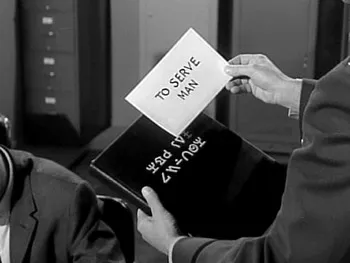
Now, I did figure out the twist early in the episode. When I first thought about it- the fact that the Kanamits were actually doing everything for the humans because they were preparing them as food to eat- it seemed like a joke, a Soylent Green-esque moment. However, as the episode continued and when the cover title was deciphered, I had a pretty good idea that my guess was indeed the correct one.
I did love the twist and I am sure that it was sensational to the people of 1962 when this first aired. This was based on a short story of the same name by Damon Knight from 1950.
“The recollections of one Michael Chambers, with appropriate flashbacks and soliloquy. Or, more simply stated, the evolution of man. The cycle of going from dust to dessert. The metamorphosis from being the ruler of a planet to an ingredient in someone’s soup. It’s tonight’s bill of fare from the Twilight Zone.”
Todd was right again. I did love this episode. I kind of wish that I did not figure out the twist so early because I can see that line “It’s a Cookbook!” being a great horrific reveal.
This was actually the worst stretch of five episodes that I have seen from the series, with a couple of okay ones and a couple really low ones.
Spoilers
“The Hunt”
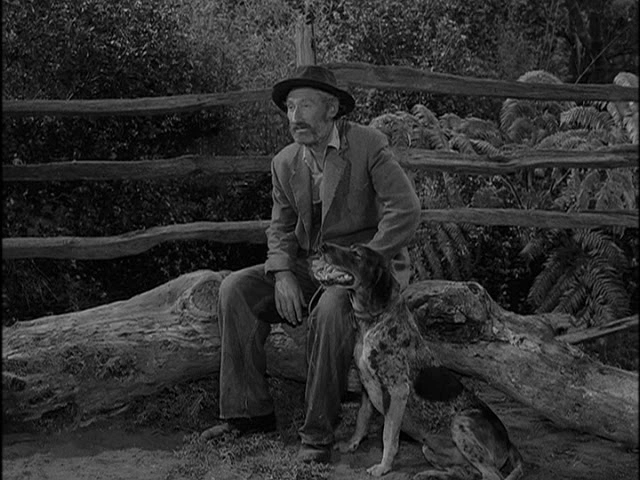
This was the best of the five episodes during this stretch. A good old country mountain man and his dog. He rather go coon huntin’ than much of anything else.
“An old man and a hound-dog named Rip, off for an evening’s pleasure in quest of raccoon. Usually, these evenings end with one tired old man, one battle-scarred hound dog, and one or more extremely dead raccoons, but as you may suspect, that will not be the case tonight. These hunters won’t be coming home from the hill. They’re headed for the backwoods — of The Twilight Zone.”
Hyder Simpson and his dog Rip went out hunting raccoon despite his wife Rachel’s objections. Rachel’s premonition came true as Rip chased the raccoon into the water and was drowning. Simpson dove in after his beloved dog, but neither came up.
Hyder awoke in the woods and returned to his home only to realize that no one could hear him and that he and Rip was dead. He found a fence that shouldn’t have been there and followed it, finding a gate where a man sat. The man said this was the gate to heaven but Hyder could not take Rip in with him. Hyder refused and decided to keep walking down the road for eternity.
Soon he came across another man who knew who he was and told him that the other guy was on the gate to Hell. This was actually the path to heaven. Hyder asked about the coon hunting in heaven.
An episode for dog lovers everywhere. I found it funny that the dog’s name was Rip (rest in peace).
“Showdown with Rance McGrew”
One of the dumbest episodes I have seen so far.
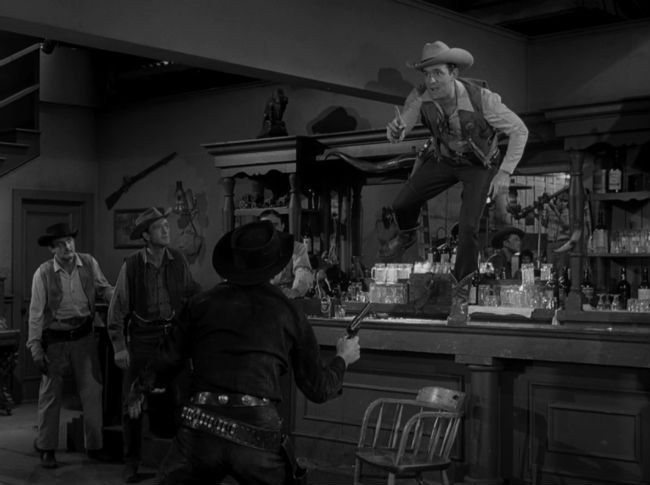
It appeared to be another Western episode. However, it was a Western TV series being filmed and the star of the show was Rance McGrew, arrogant, pompous, demanding.
“Some one-hundred-odd years ago, a motley collection of tough mustaches galloped across the West and left behind a raft of legends and legerdemains, and it seems a reasonable conjecture that if there are any television sets up in cowboy heaven and any one of these rough-and-wooly nail-eaters could see with what careless abandon their names and exploits are being bandied about, they’re very likely turning over in their graves—or worse, getting out of them. Which gives you a clue as to the proceedings that will begin in just a moment, when one Mr. Rance McGrew, a 3,000-buck-a-week phoney-baloney discovers that this week’s current edition of make-believe is being shot on location—and that location is the Twilight Zone.”
Like several other episodes, Rance found himself transported to the past in the actual saloon like the show was taping at, but the crew was gone. The real Jesse James (who was the villain in the episode) was looking to make Rance pay. Apparently, Jesse was able to watch Rance on TV and knew all about the career path of the actor.
This got even stupider as well as Jesse wound up back in the present with Rance as his new “agent” and insisted on changes to the script to make the real life Western characters look better.
More comedy attempted. There have been very few comedic episodes of The Twilight Zone that worked.
“Kick the Can”
A nice little episode of the wish for youth and the cliché that you are only as old as you act/feel.
“Sunnyvale Rest, a home for the aged – a dying place, and a common children’s game called kick-the-can, that will shortly become a refuge for a man who knows he will die in this world, if he doesn’t escape into – The Twilight Zone.”
While the episode was harmless and did carry a decent message, there was not much to it as it carried on. The end was fairly expected and the way the staff treated these old people, especially Charles was shameful. The idea that Charles was considered senile because he wanted to stay young by finding the magic in a kid’s game was mean-spirited. The fact that his best friend Ben did not support his friend was quite off too. Admittedly, I did like the end with Ben losing out on the magic.
“A Piano in the House”
Speaking of mean-spirited, the episode ‘A Piano in the House’ is one of the most mean-spirited episodes of The Twilight Zone I have seen. I’m not sure the ending was sufficient of comeuppance for the cruelty shown by lead character, Mr. Fitzgerald Fortune.
“Mr. Fitzgerald Fortune, theater critic and cynic at large, on his way to a birthday party. If he knew what is in store for him he probably wouldn’t go, because before this evening is over that cranky old piano is going to play ‘Those Piano Roll Blues’ with some effects that could happen only in the Twilight Zone.”
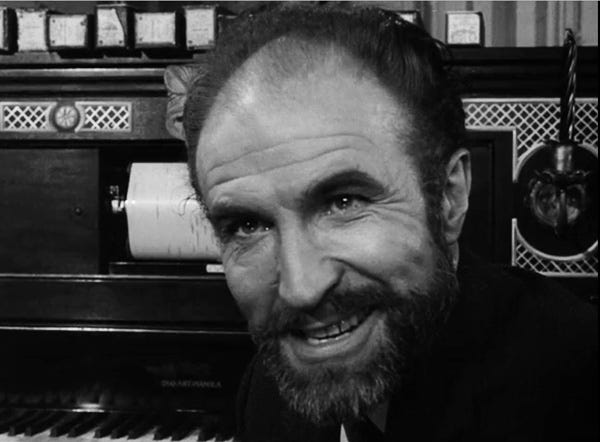
Fortune had purchased a player-piano for his young bride’s birthday. Fortune discovered that the music played by the piano had strange effects on the listeners and he planned on using it during the party on some of his guests.
I especially felt bad for Marge Moore, played wonderfully by Muriel Landers, as the piano made her do things intended to humiliate her (and the whole crowd laughed). I am not sure why Fortune targeted Marge outside of simply sadism.
“The Last Rites of Jeff Mytlebank”
Roscoe P. Coltrane is back once again!
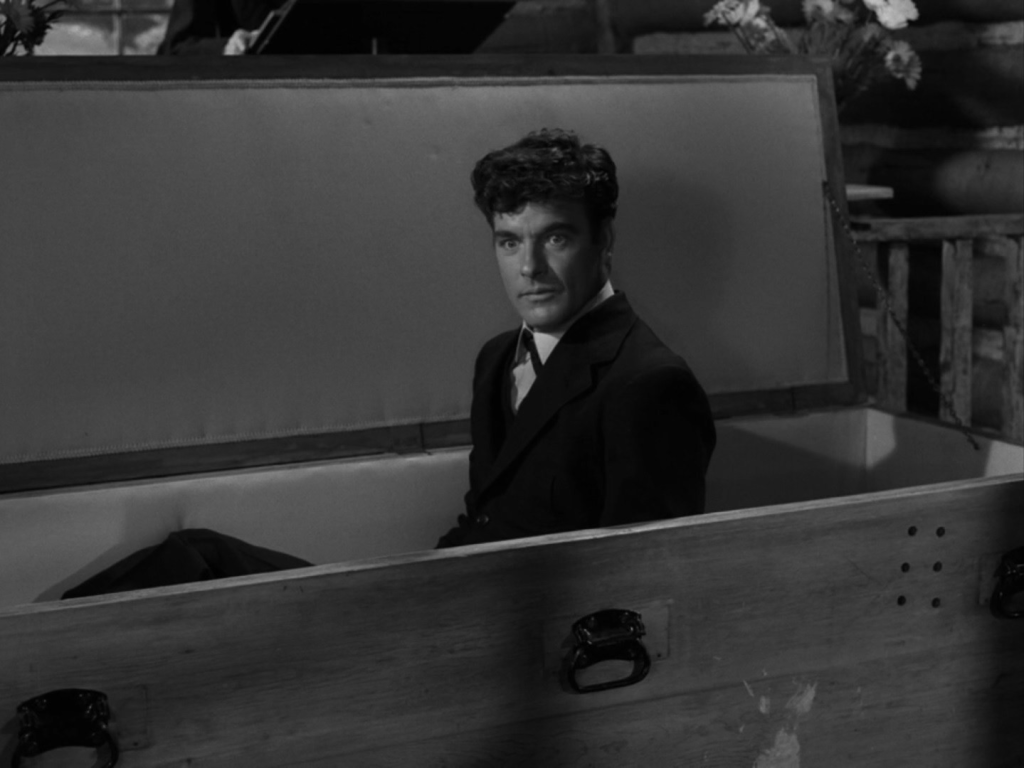
That is James Best is back as our titular character, a man who died and, during his funeral, sits up and is apparently alive… two days later!
“Time, the mid-twenties. Place, the Midwest, the southernmost section of the Midwest. We were just witnessing a funeral, a funeral that didn’t come off exactly as planned, due to a slight fallout from the Twilight Zone.”
This episode seemed to be hinting at the fact that people can get themselves riled up and lose common sense when confronted with rumors and speculation, especially when they are not necessarily the brightest of people (that is a relevant comment for today’s political world too).
There was a lot of exposition here, particularly at the very end when Jeff was being confronted by the town people about him being a demon that had taken over the dead body of Jeff. The ending was somewhat lackluster and lacking. This concept felt like it could have been much ore than what it turned out to be.
“An old woman living in a nightmare, an old woman who has fought a thousand battles with death and always won. Now she’s faced with a grim decision—whether or not to open a door. And in some strange and frightening way she knows that this seemingly ordinary door leads to the Twilight Zone.”
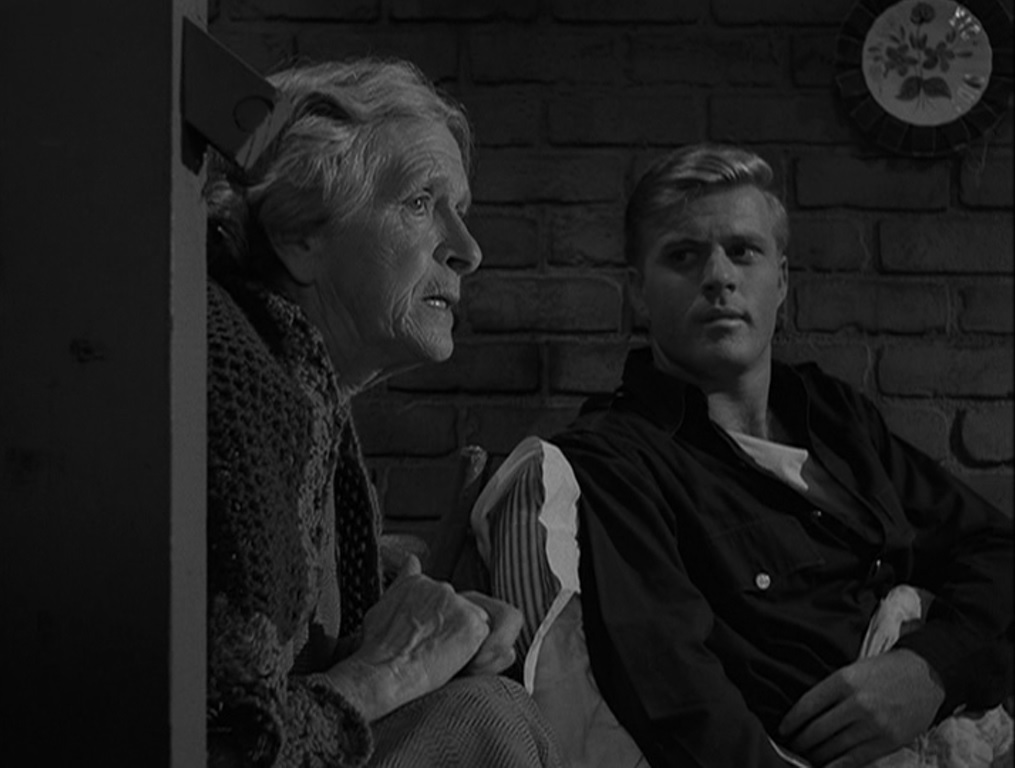
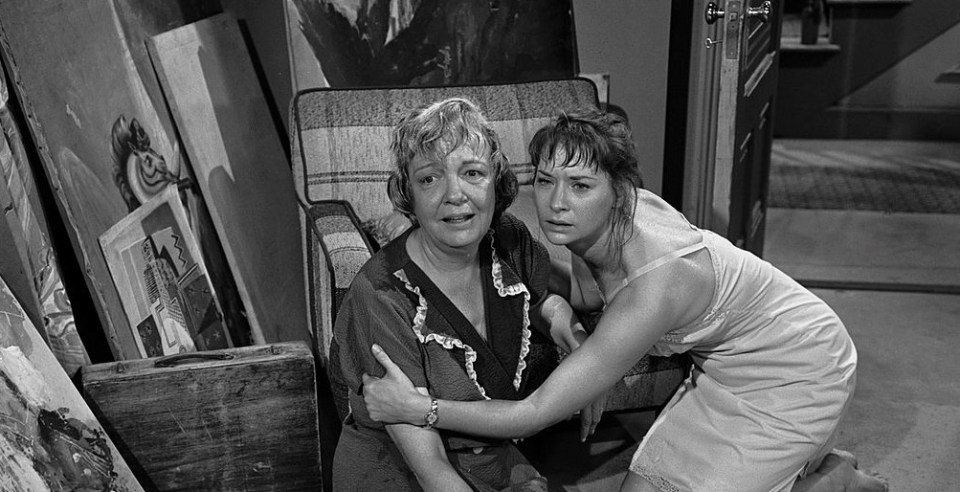
Wanda Dunn has been hiding away from Mr. Death for years. She has seen him when others have died and it has led her to shut herself inside a condemned building and not leave the premises. When a police officer is shot outside her door, she opens it up to help him.
However, everything was not as it seemed, as is common in The Twilight Zone. When another man comes to try and convince Wanda to leave because the building has to be torn down, she realized that that man could not see the injured police officer in the room.
Turns out that the police officer was Mr. Death, offering Wanda a chance to come with him. He shows Wanda her own dead body, which lies on the bed in the room.
Well acted episode and the dialogue between Robert Redford and Gladys Cooper, who played Wanda, was a highlight.
“One More Pallbearer”
Not sure how the purpose of this episode. Was it meant to be a revenge tale or simply a practical joke meant to teach the subjects an abject lesson?
Either way, I did not like this.
“What you have just looked at takes place three hundred feet underground, beneath the basement of a New York City skyscraper. It’s owned and lived in by one Paul Radin. Mr. Radin is rich, eccentric and single-minded. How rich we can already perceive; how eccentric and single-minded we shall see in a moment, because all of you have just entered the Twilight Zone.”
Paul Radin held grudges from his life and he is looking for a way to save face. He pretends that he has called back three people form his past who have treated him poorly and he pretends that the world is going to be destroyed in a nuclear bombing. He provides them safety in his bomb shelter but he asks for apologies. None of the ‘victims’ want to stay. They all prefer to go to their homes and loved ones and die together if they must. This drives Paul crazy.
None of this makes any sense and it is just filled with exposition and nonsense.
“Dead Man’s Shoes”
The shoe is on the other foot, literally.
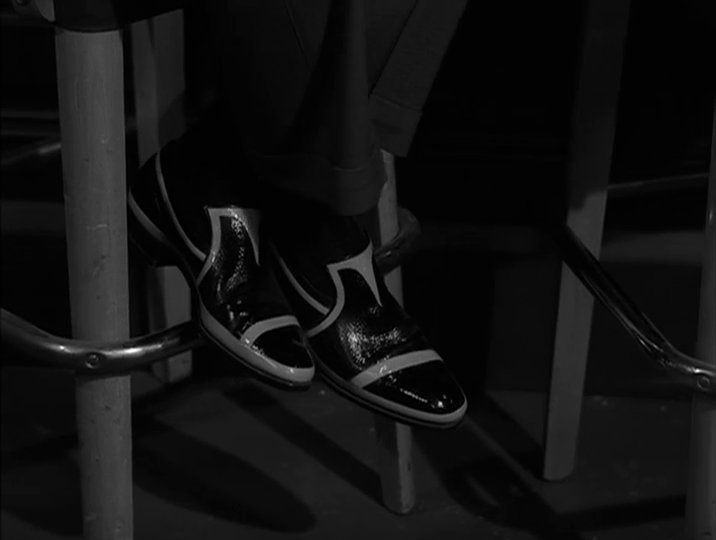
Another weaker episode of the show, as it follows poor hobo Nathan Bledsoe as he finds a dead body and steals that body’s new shoes.
“Nathan Edward Bledsoe, of the Bowery Bledsoes, a man once, a specter now. One of those myriad modern-day ghosts that haunt the reeking nights of the city in search of a flop, a handout, a glass of forgetfulness. Nate doesn’t know it but his search is about to end, because those shiny new shoes are going to carry him right into the capital of the Twilight Zone.”
The shoes belonged to a gangster named Dane, whose spirit then possessed Nathan in an attempt to gain revenge on the gangster that killed him.
However, Dane shows himself not very smart as he winds up dead again and dumped in another alley (this time, it being poor Nathan). Another hobo takes the shoes and apparently starts the circle all over again.
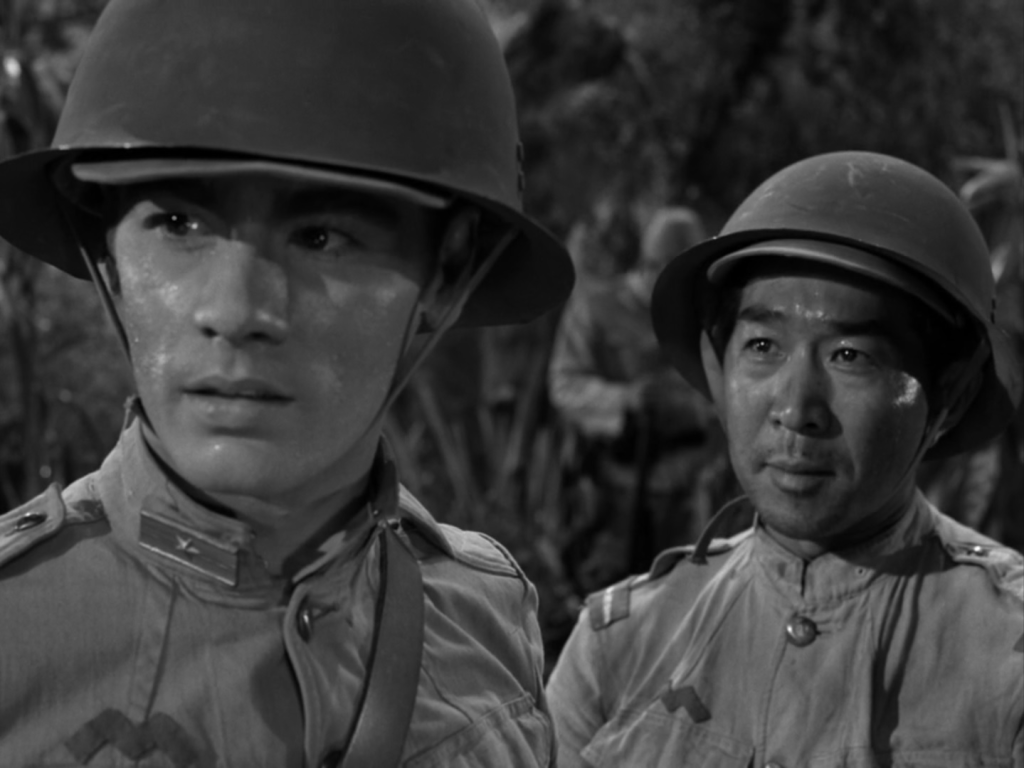
I hardly recognized Dean Stockwell when he first came on the screen with the American army during “A Quality of Mercy” episode from season three. I had seen this episode low on lists of Twilight Zone lists, but I did not think it was that bad. However, I could tell what it was docked for. It’s the same thing that I am going to dock it for.
Dean Stockwell played Lieutenant Katell, a young officer during World War II (the last day actually) who arrived with a platoon that had lost its last two leaders. They had a group of Japanese trapped in a cave, but they were not sure what they were going to do. Katell showed up, ready to rush the cave and kill all the enemy soldiers.
The the Twilight Zone took over.
Katell found himself in the body of one of the Japanese soldiers, but earlier in the war, and the man in charge was acting the same way he did when arriving with the Americans. He was able to see how mercy could go a long way.
The problem? Stockwell had face paint, eyes done up and a horrendous Japanese accent. I do not know why it was decided that Stockwell perform this in such a stereotypically racial manner, but this choice ruined the scenes for me and really weakened an otherwise strong episode.
EYG Hall of Famer Leonard Nemoy was in the episode too as one of the American soldiers.
This evening, I went for five season three episodes and we got all kinds of variety.
“The Midnight Sun”
Whoa, what a hopeless feeling episode this was. Apocalyptic, twice within.
The earth’s orbit has been changed and it is now moving toward the sun and the temperatures on earth were getting hotter and hotter. Two women, Nora and Mrs. Bronson, were the only people remaining in their apartment building, trying to stay cool and survive the heat.
Water, looters, their own minds all were struggles they needed to face. As the news gets worse, the two women get closer to the end. Mrs. Bronson succumbs to the heat and Nora seems to be ready to go as well.
Then we learn that Nora was actually in a fever dream and that none of what we saw was real. However, we learn from Mrs. Bronson and the doctor that was attending Nora that the world was off its orbit but going away from the sun. The very opposite was happening, the planet was freezing to death.
This episode could certainly be used today as a metaphor for climate change, I’m not sure that would have been the basis for the idea back in 1961. The episode gives us a picture of how the human race would react to such an event, with a lot of anger, frustration and selfishness. Even though there would also be some good people as well.
“Still Valley”
Civil War conflict mixed with the occult and the devil… good times.
Not sure how to feel about this one.
“This is Joseph Paradine, Confederate cavalry, as he heads down toward a small town in the middle of a valley. But very shortly, Joseph Paradine will make contact with the enemy. He will also make contact with an outpost not found on a military map—an outpost called the Twilight Zone.”
Paradine wound up in the town, but he found all the Union troops frozen still. Not dead. Not asleep. Just standing still. He did not know how this happened, but… he would find out.
An old man was there and he claimed to have used black magic to freeze the Yankees. He did so by reading spells out of a book labeled ‘witchcraft.’ By doing so, he said that he had to align himself with Satan. The old man was dying and gave the book to Paradine, who returned to his camp and explained what happened, proving that he had this power.
The end was strange because Paradine was uncertain if he should continue to use the book because he had to renounce God as well as align with the devil. He ends up throwing the book into the fire.
Not the best episode I have seen. The characters were inconsistent and choices did not make much sense. Why did Paradine suddenly realize that he had to renounce God when he already used the book to freeze a troop of Union soldiers off camera? And these soldiers were meant to go to Gettysburg after this.
Not a very good episode.
“The Jungle”
“The carcass of a goat, a dead finger, a few bits of broken glass and stone, and Mr. Alan Richards, a modern man of a modern age, hating with all his heart something in which he cannot believe and preparing – although he doesn’t know it – to take the longest walk of his life, right down to the center – of The Twilight Zone.”
Alan Richards and his wife Doris have just returned from Africa where Alan was on a business trip. He was apparently cursed by some natives and his wife was really superstitious. She snuck all kinds of good luck charms, including a lion’s tooth, into their home and his pockets.
He leaves the tooth behind at a bar. Can you guess what happened next? I bet you can.
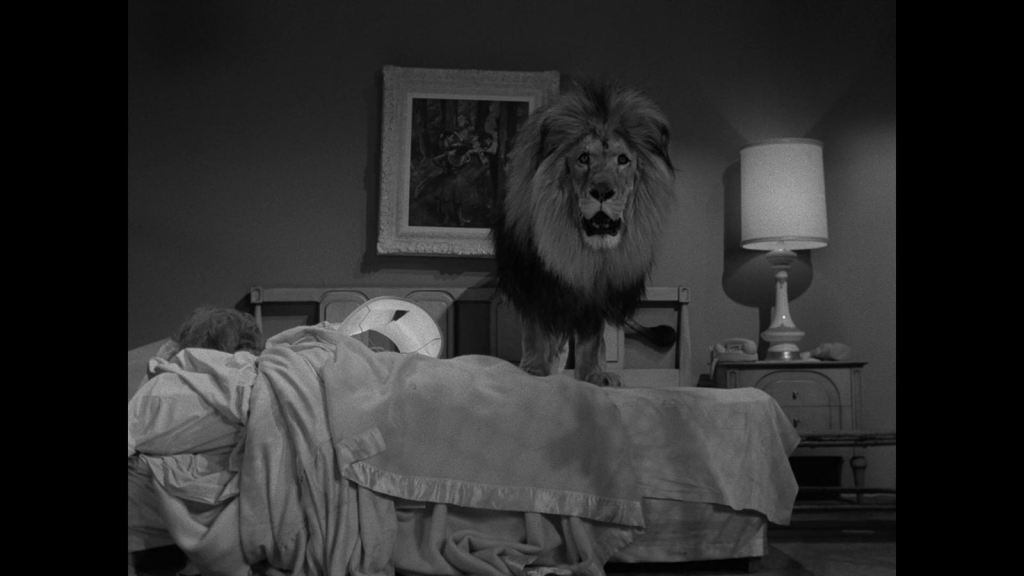
This one was dumb. Alan kept hearing drums and animal sounds as he tried to get home, only to be mauled by a lion that was on his bed (perhaps after already eating Doris?).
The animal sounds were unintentionally funny and the things that happened to Alan along the way were more and more ridiculous. And where was Doris?
“Once Upon a Time”
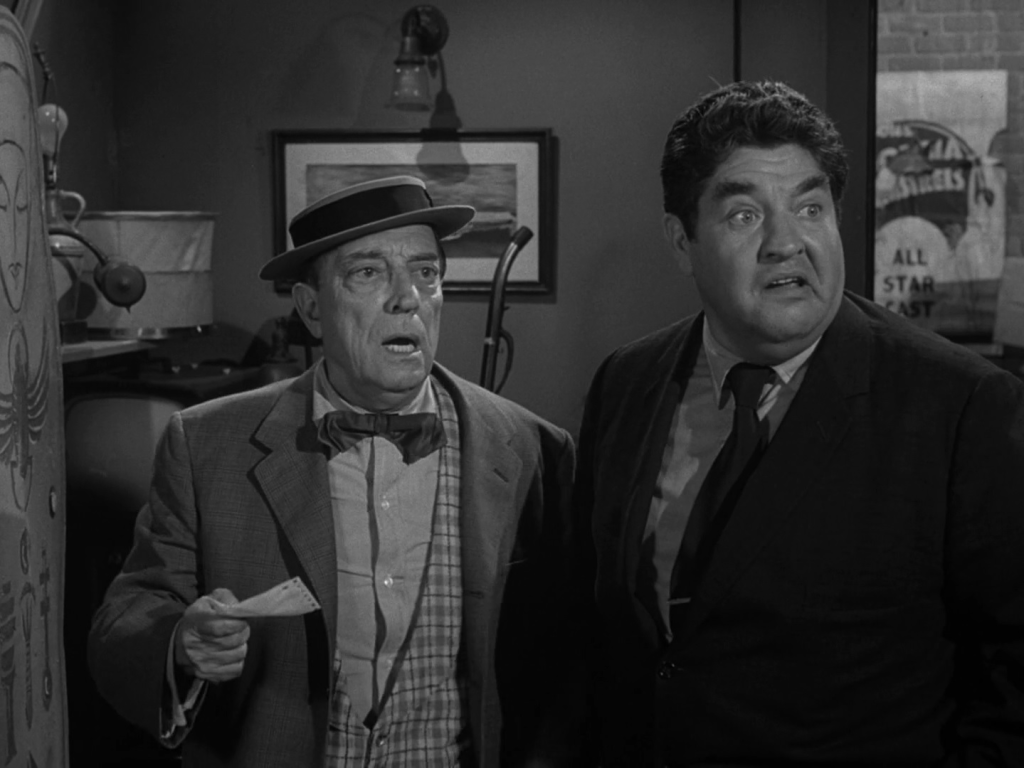
I thought this was a really creative and interesting episode. Featuring Buster Keaton himself, this episode was a tribute to the silent pictures that Keaton made his fame in.
The episode started out in a literal silent picture, following along Keaton as Woodrow Mulligan from the year 1890. It had the background music, the intertitles giving the audience dialogue to read and plenty of slapstick humor that was prevalent in the silent era of Buster Keaton or Charlie Chaplin.
Mulligan worked as a janitor in a laboratory where the head scientist had created a ‘time helmet’ which gave the wearer a chance of going to any year and spend 30 minutes (this time seemed to change throughout the episode. A bit of a plot hole here). Mulligan put it on and was transported to 1961.
In 1961, we get sound, including Mulligan speaking aloud. It was no longer a silent picture. He met up with a man named Rollo and then it felt very much like a ‘Laurel and Hardy’ type film.
I enjoyed this tribute to the era of silent films and the icon Buster Keaton. It felt like one of those ‘very special episodes’ of shows(like “Atomic Shakespeare” for Moonlighting). I love the big swing for the episode.
“Five Characters in Search of an Exit”
Okay, I did not see that coming.
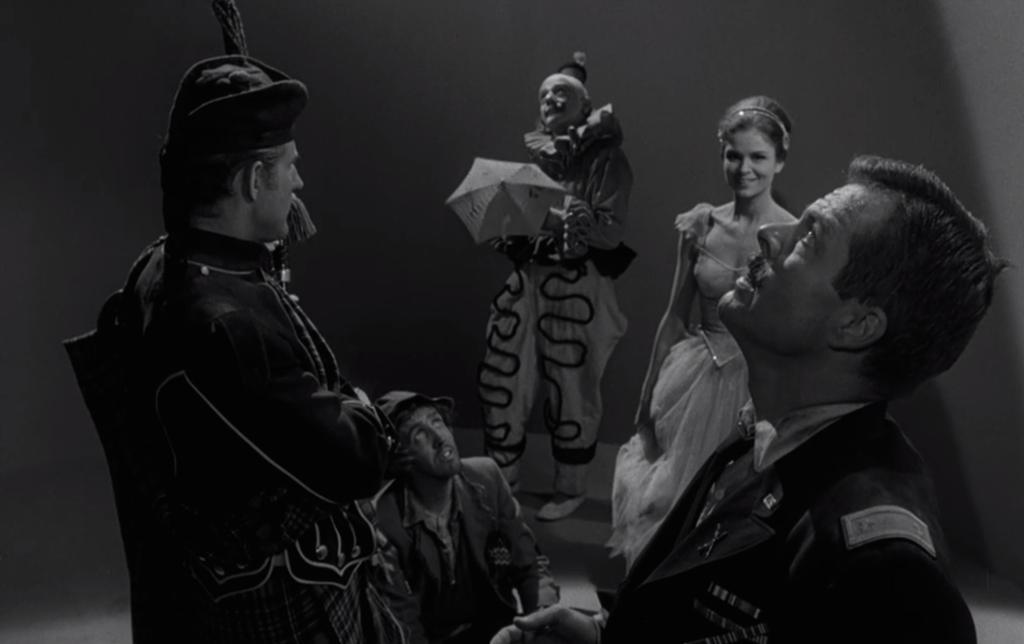
Five characters stuck in a strange circular prison. They could not remember anything. All they knew were what they were: A clown, a bagpiper, a ballerina, a tramp and a major.
The major was the newest arrival and was struggling trying to make sense of what had happened. He desperately tried to find an exit from their prison, trying everything. He would not give up even with the others not supporting him. The clown, in particular, was spending more time taunting him or making fun of him than being useful. The ballerina though seemed to believe in the major.
They stood on each other’s shoulders (in a fun pit of camera work) and tried to climb out, only to fall. The ballet dancer was injured, but that still did not deter the major, who set up a rope with the end of his sword to use as a grappling hook.
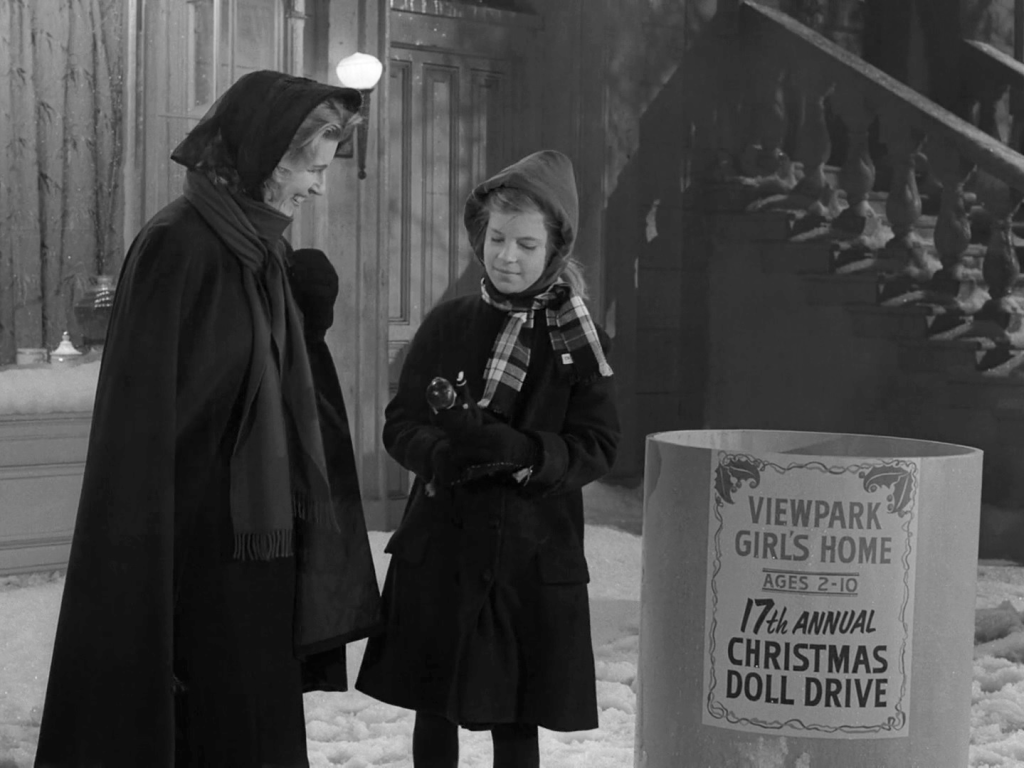
This time, the major makes it to the top and falls into a pile of snow. This is when we find out the truth… they were all dolls in a container during a toy drive for Christmas.
“Just a barrel, a dark depository where are kept the counterfeit, make-believe pieces of plaster and cloth, wrought in a distorted image of human life. But this added hopeful note: perhaps they are unloved only for the moment. In the arms of children, there can be nothing but love. A clown, a tramp, a bagpipe player, a ballet dancer, and a Major. Tonight’s cast of players on the odd stage—known as—The Twilight Zone.”
What a twist that was. No way I saw that coming. The ending took this episode to a much higher level than it had been. This was a top notch pay off. There have been some episodes where they have a great build but the ending is disappointing. This one stuck the landing, big time.
The Twilight Zone returned to the Old West for another story involving Lee Marvin and Roscoe P. Coltrane.
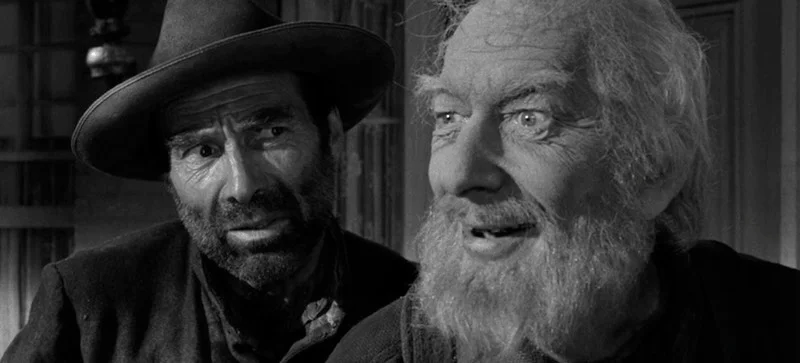
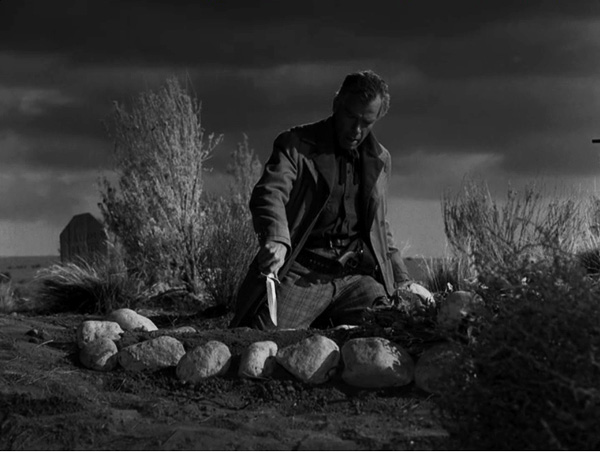
This episode was a creepy tale of fear and revenge. A local rapscallion named Pinto Sykes is gunned down by a crew of townsfolks. The man, Conny Miller, who had been hired by the town to hunt Pinto down, returned to the town to find out that Pinto was already dead and buried.
The townspeople told Conny that Pinto claimed on his deathbed that if Conny ever came to Pinto’s grave, that Pinto would reach up and grab him.
The others in the bar, led by Roscoe (I know his name was not Roscoe, but the actor, James Best, is best known by me for his role as the Sheriff on Dukes of Hazzard), laid wagers that Conny did not have the courage to go and kneel by Pinto’s graveside. Conny made he bet (though honestly, he was not really quick about it).
The next day, Conny was found dead over the grave.
This was very atmospheric and creepy. I liked most of this episode. The only issue I had was that Conny did not end up shooting Pinto, it was someone else in town. We only heard about Conny and Pinto’ relationship and we did not see any of it. Why did Pinto hold such a negative feeling toward Conny? I’m really not sure.
Lee Marvin and Lee Van Cleef appeared in this episode and both men are veterans of Western movies, lending a high level of credibility to the show.
“It’s a Good Life”
A monster story about the worst monster ever… a little boy named Anthony.
“Tonight’s story on The Twilight Zone is somewhat unique and calls for a different kind of introduction. This, as you may recognize, is a map of the United States, and there’s a little town there called Peaksville. On a given morning not too long ago, the rest of the world disappeared and Peaksville was left all alone. Its inhabitants were never sure whether the world was destroyed and only Peaksville left untouched or whether the village had somehow been taken away. They were, on the other hand, sure of one thing: the cause. A monster had arrived in the village. Just by using his mind, he took away the automobiles, the electricity, the machines—because they displeased him—and he moved an entire community back into the dark ages—just by using his mind. Now I’d like to introduce you to some of the people in Peaksville, Ohio. This is Mr. Fremont. It’s in his farmhouse that the monster resides. This is Mrs. Fremont. And this is Aunt Amy, who probably had more control over the monster in the beginning than almost anyone. But one day she forgot. She began to sing aloud. Now, the monster doesn’t like singing, so his mind snapped at her, turned her into the smiling, vacant thing you’re looking at now. She sings no more. And you’ll note that the people in Peaksville, Ohio have to smile. They have to think happy thoughts and say happy things because, once displeased, the monster can wish them into a cornfield or change them into a grotesque, walking horror. This particular monster can read minds, you see. He knows every thought, he can feel every emotion. Oh yes, I did forget something, didn’t I? I forgot to introduce you to the monster. This is the monster. His name is Anthony Fremont. He’s six years old, with a cute little-boy face and blue, guileless eyes. But when those eyes look at you, you’d better start thinking happy thoughts, because the mind behind them is absolutely in charge. This is the Twilight Zone.”
We spent the episode watching the adults cower to this little boy, telling him how his bad behaviors were the right thing and how they were happy that he just killed thee people or created this three headed animal and then killed it.
I really wanted someone to step up and do something about Anthony. There was a time when one of the dinner party members, drunk as he was, tried to get the others to do something about the boy and he wound up getting turned into a jack-in-the-box and eventually sent to the “cornfield” which was a place Anthony sent all people who had negative thoughts.
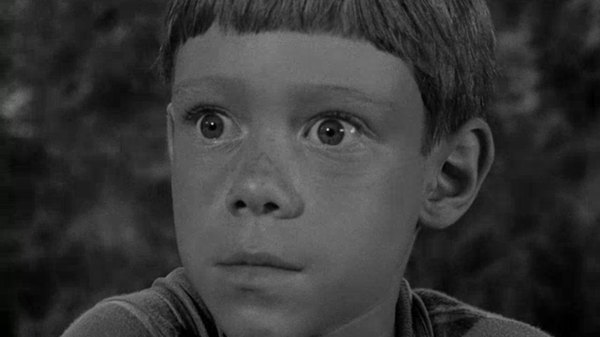
Bill Mumy played Anthony after playing Billy in “Long Distance Call.” He was very sinister and unsettling as the little monster. I wish there was some form of resolution to the episode, but it is a well known, iconic episode.
“Deaths-Head Revisited”
One of the most haunting episodes of The Twilight Zone yet. Deaths-Head Revisited is a comment on the horrendous circumstances behind the concentration camps run by the Nazis before and during World War II.
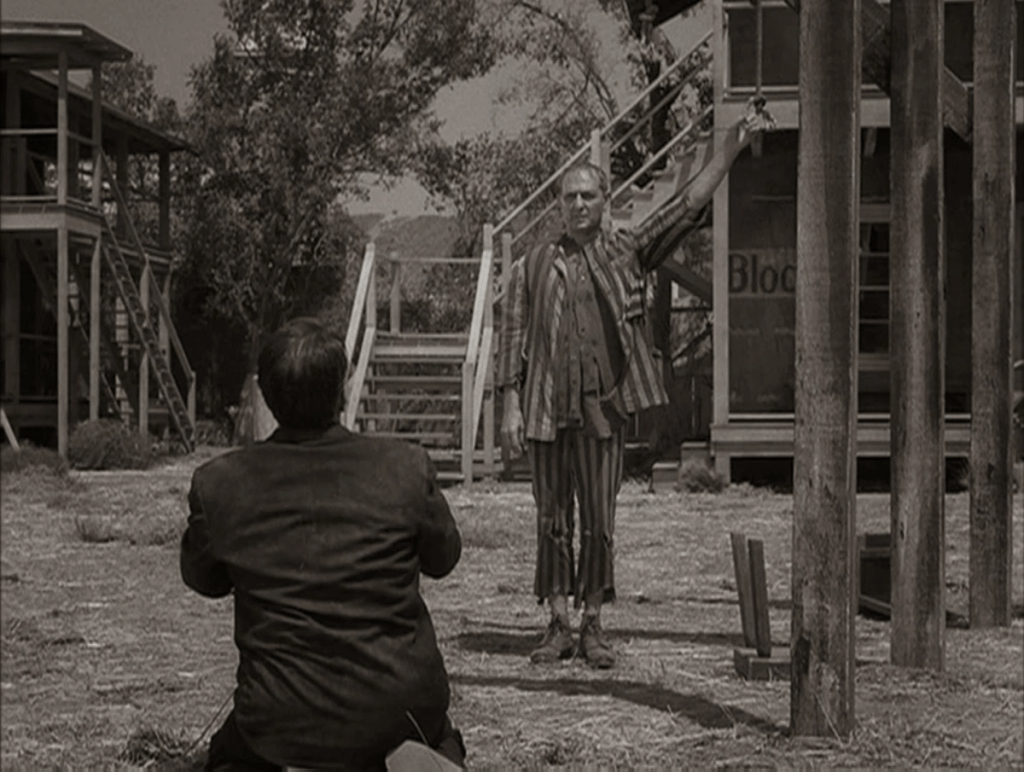
A former Nazi SS captain, calling himself Schmidt, came to Dachau, Bavaria to go back to the Dachau concentration camp, walking around the compound, reveling in the remembrances and nostalgia. He is met by a man whom he takes as a caretaker of the camp. He does recognize the man as Alfred Becker, a former prisoner at the camp.
Becker takes Schmidt around the camp, as frightening sounds continued around. Finally, Becker told him that Captain Lutze (Schmidt’s real name) was to be put on trial for his crimes against humanity. Lutze realizes that Becker had been killed in Dachau years before and that this was a ghost facing him. Lutze wound up going mad, and would end up taken away in the present day to a mnetal instution.
The doctor who examined Lutze said “Dachau. Why does it still stand? Why do we keep it standing?” An answer mentioned in Serling’s closing narration:
“There is an answer to the doctor’s question. All the Dachaus must remain standing. The Dachaus, the Belsens, the Buchenwalds, the Auschwitzes; all of them. They must remain standing because they are a monument to a moment in time when some men decided to turn the Earth into a graveyard. Into it they shoveled all of their reason, their logic, their knowledge, but worst of all, their conscience. And the moment we forget this, the moment we cease to be haunted by its remembrance, then we become the gravediggers. Something to dwell on and to remember, not only in the Twilight Zone but wherever men walk God’s Earth.”
The only criticism I have for this episode, which I found extremely powerful and haunting, was that I wish Lutze was not such a one-note villain. When he returned to Dachau, he was just as sinister, just as sadistic as he had ever been and he was outward about it. I would have like to have seen more than just the mustache-twirling villain that he was. Something with more layers would have made this even more powerful. Even still, this is one of my favorite episodes so far.
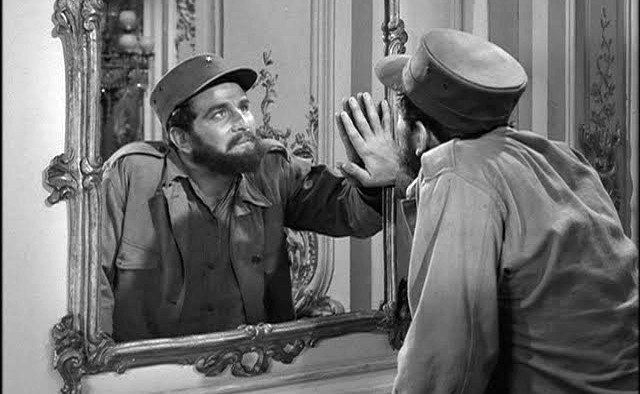
Okay, so not Castro, but a man named General Ramos Clemente. But it is Peter Falk, famously who would become Lt. Columbo- one of the most iconic detectives of all-time, playing this role. I have to say it was distracting. That is not the fault of the episode, but I could not help that.
You see this trend in the time having white actors play the ethnic roles. Someone like Falk playing this character today would be controversial. I do think Peter Falk does a decent job in the role in this episode, but he had several mannerisms that were distracting and did end up pulling me out of the episode.
The episode dealt with the idea of paranoia and of the suspicion of powerful people that those around them have their own motivations. We see the slightest suggestions, in this case a mirror giving the reflections of betrayal, lead to Clemente taking his friends and supporters and executing them all.
“Ramos Clemente, a would-be god in dungarees, strangled by an illusion, that will-o’-the-wisp mirage that dangles from the sky in front of the eyes of all ambitious men, all tyrants—and any resemblance to tyrants living or dead is hardly coincidental, whether it be here or in the Twilight Zone.”






 EYG- Embrace Your Geekness