After a very strong season of episodes, I am afraid that season 1 ended with a couple of clunkers for me.
Spoilers
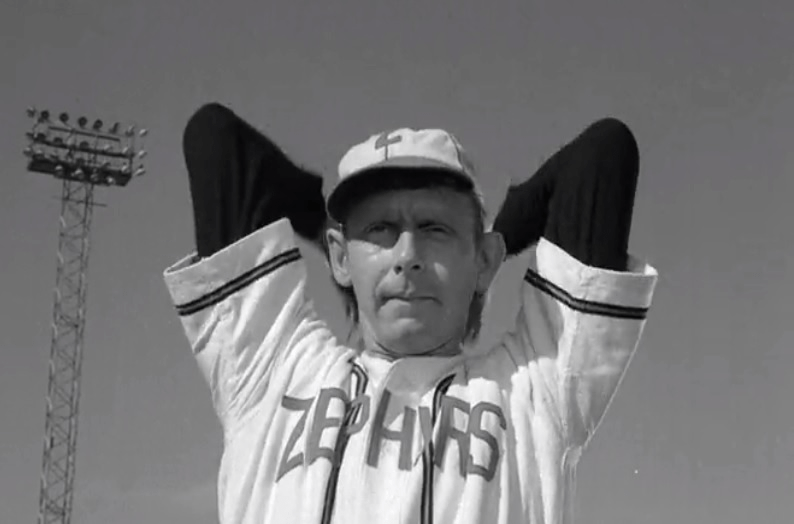
“The Mighty Casey”
A terrible baseball team from New Jersey holds try outs and they wind up with a new pitcher. Casey is a left handed master who was as dominant as he could be. There was only one problem.
Casey was a robot.
When the league found out about the truth, they insisted that Casey was suspended. However, Casey’s creator, Dr. Stillman, said he could give Casey a heart, thus making him human. The surgery was a success, meaning that Casey could continue to pitch. Unfortunately, Casey’s new heart turned him into a pitcher who could not get anyone out.
Jack Warden played manager “Mouth” McGarry.
I found this episode to be my least favorite episode of the season so far. It was a silly premise and the execution was worse yet. When Casey was pitching, they added stupid sound effects to his fastball, slowball and curve ball. The whole episode was just a joke and was a huge step down from anything that I had seen before.
“A World of his Own”
I had always thought that I had seen my share of the episodes of The Twilight Zone, but as I have watched the first season, I did not recognize or was familiar with any of them. That is, until this episode. I remembered parts of this episode as I was watching it so this is the first of the Twilight Zone episodes that I had seen before. It would have been decades ago though.
This was also not a favorite of mine, though better than the baseball one I just watched.
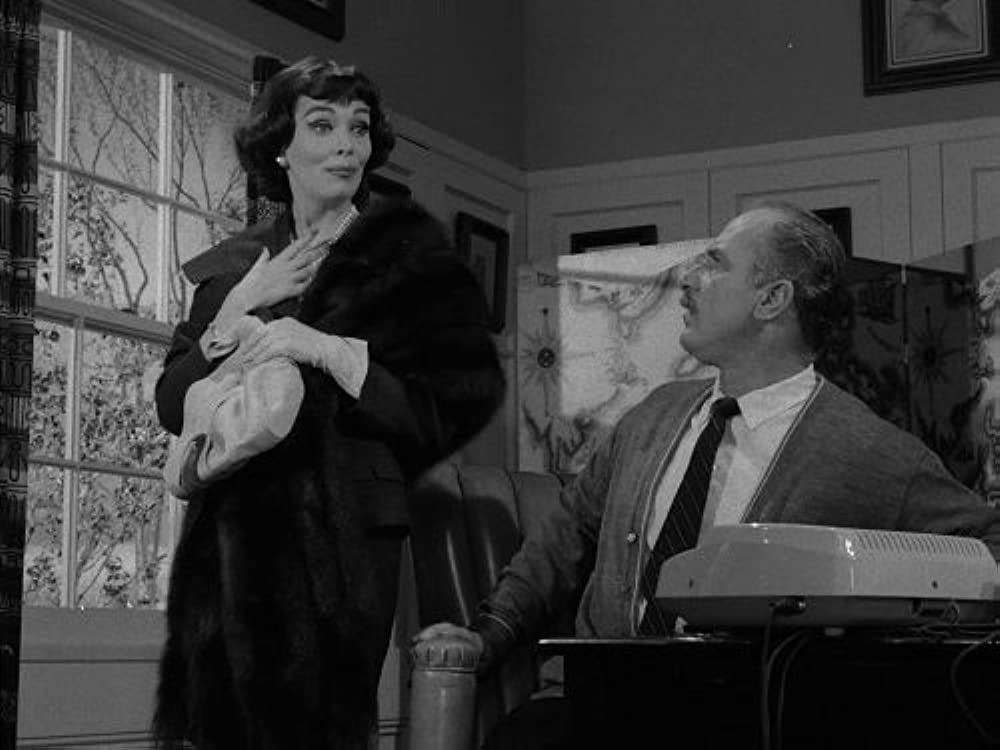
Gregory was a writer who had the power to bring to life characters that he created. All he had to do was speak into his tape recorder and the characters would come to life.
This led to a conflict with his wife Victoria, who came upon Gregory snuggling up with a blonde woman (called Mary). When Gregory explained that she was just a creation of his, Victoria was ready to have him committed.
Gregory could take the tape, cut it out with his scissors and toss it into the fire, which caused the person to disappear.
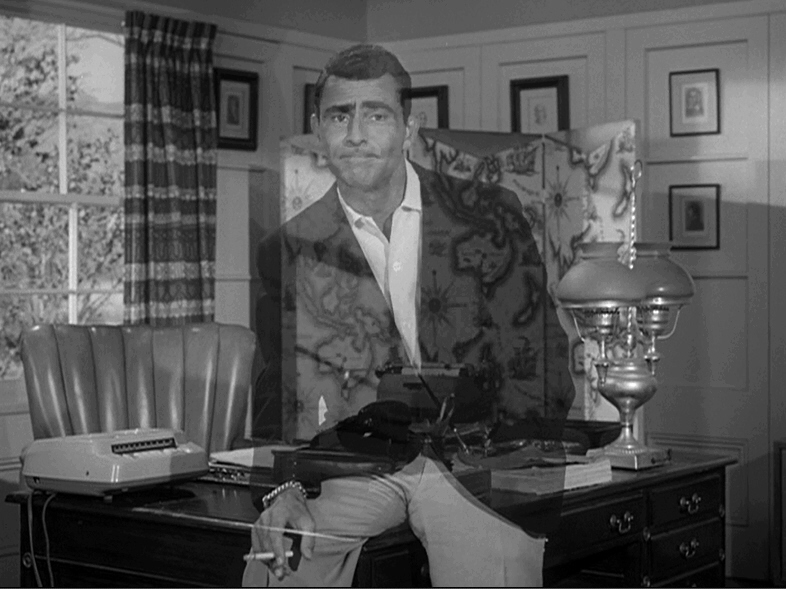
The end of the episode did help save it a bit. Victoria was shown to be a creation as well and she, not believing it, tossed her own tape into the fire. She disappeared. That was fairly obvious as it was happening. The best part was when Rod Serling appeared in the room to narrate the events and Gregory tossed his tape into the fire too, cause Rod to disappear. That was the best part of the episode.
“Leaving Mr. Gregory West—still shy, quiet, very happy… and apparently in complete control of The Twilight Zone.”
This ends the first season of The Twilight Zone. The Daily Zone will be continuing into the second season soon.
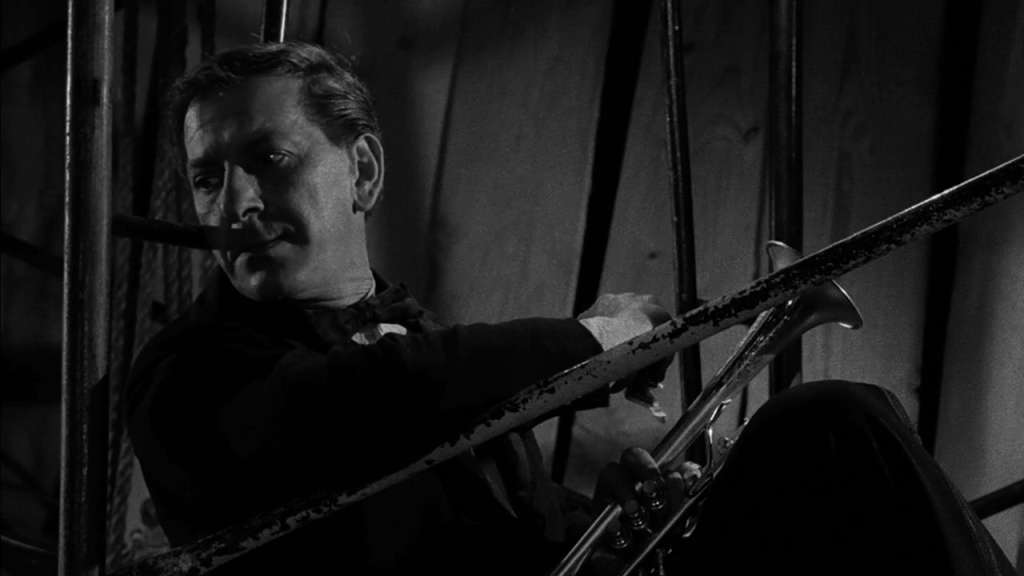
Jack Klugman stars in the thirty-second episode of The Twilight Zone and he carries the episode on his back. Klugman is very strong here, delivering several monologues and playing off other actors that can not or will not respond to him.
“Joey Crown, musician with an odd, intense face, whose life is a quest for impossible things like flowers in concrete or like trying to pluck a note of music out of the air and put it under glass to treasure. Joey Crown, musician with an odd, intense face, who, in a moment, will try to leave the Earth and discover the middle ground – the place we call The Twilight Zone.”
Joey Crown is a depressed trumpet player with an alcohol problem. Life was getting him so down that he decided to commit suicide by stepping in front of a speeding truck. That was when things got weird.
Joey found himself walking around the area, but unable to interact with anyone. Everyone he came across reacted as if they could not see Joey. Joey made the reasonable assumption that he was dead… that he was a ghost.
However, he comes across a man playing the trumpet that lets him know that is not the case. In fact, he says that Joey was in a limbo state and he could choose to go back or remain in the land of shadows. Joey goes back and things get much better.
Klugman was the reason to enjoy this episode. Joey did not seem to mind being in limbo so his choice to return to a world where he tried to leave by suicide did not make much sense. Still, the acting was strong and the message of stick with life is a good one.
“Mr. Bevis”
…with Butthead nowhere to be seen.
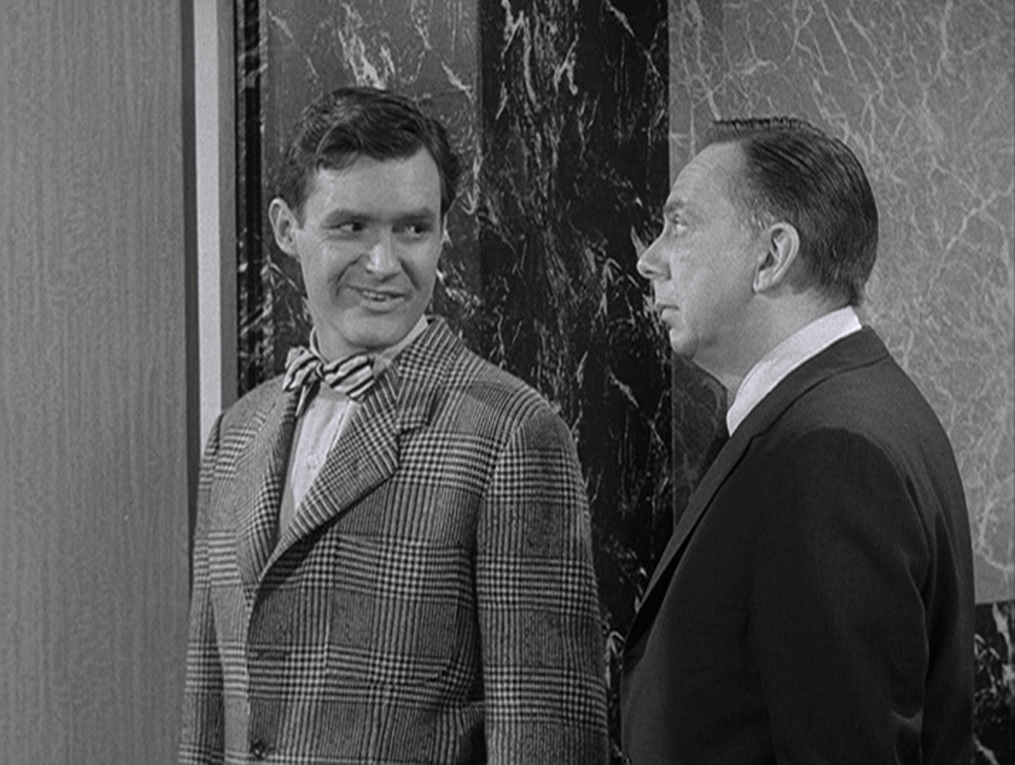
This was a second episode in a row that depended on the lead performance of the actor. This was Orson Bean and his semi-comedic role as Mr. James B.W. Bevis was excellent stuck into an episode that was strange and that had a message that did not feel very well done.
“In the parlance of the twentieth century, this is an oddball. His name is James B. W. Bevis, and his tastes lean toward stuffed animals, zither music, professional football, Charles Dickens, moose heads, carnivals, dogs, children, and young ladies. Mr. Bevis is accident prone, a little vague, a little discombooberated [sic], with a life that possesses all the security of a floating crap game. But this can be said of our Mr. Bevis: without him, without his warmth, without his kindness, the world would be a considerably poorer place, albeit perhaps a little saner.”
Loved the word ‘discombooberated.’
Mr. Bevis is a carefree, kind-hearted, fun-spirited man who could not hold a job because of his idiosyncrasies. We see him go through a day where he loses his job, has his car ruined and ends up in a bar getting drunk.
He is approached by his guardian angel, J. Hardy Hempstead, who has been guardian angelling Mr. Bevis’s family for years.
He told Mr. Bevis that he could redo the day and everything would turn out differently, but he would have to change the way he lived. No more funny suits, no more weird car, no more sliding down the bannister, no more playing on the street with the kids.
When he went through this day with the new way of acting, Mr. Bevis realized that he did not want to have a life where he could not do those things, even if it meant he would not be successful.
So I guess the message is that it is best to be yourself, but get used to failing if you do. The only way to success is by being something you are not, suppressing your true nature. That does not seem like a very positive message.
This was clearly inspired by “It’s A Wonderful Life” but it fails to reach that level of entertainment. Orson Bean does everything he can with what he is given and nearly pulls it off. Unfortunately a disappointing message and a lackluster story derailed this performance.
“The After Hours”
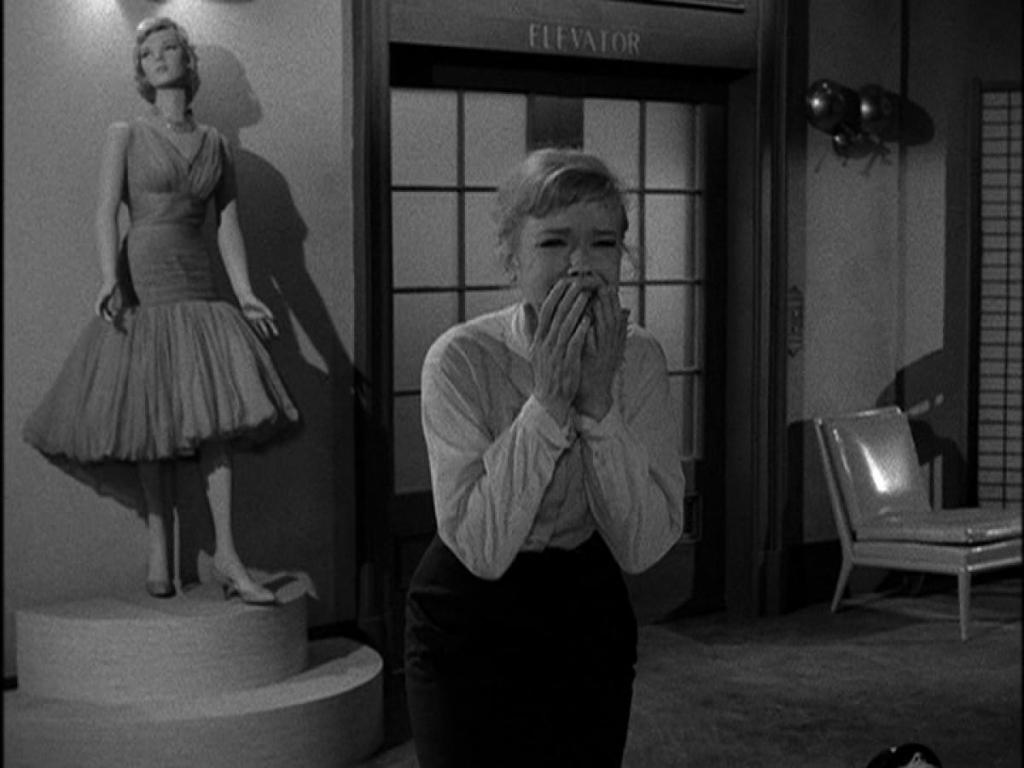
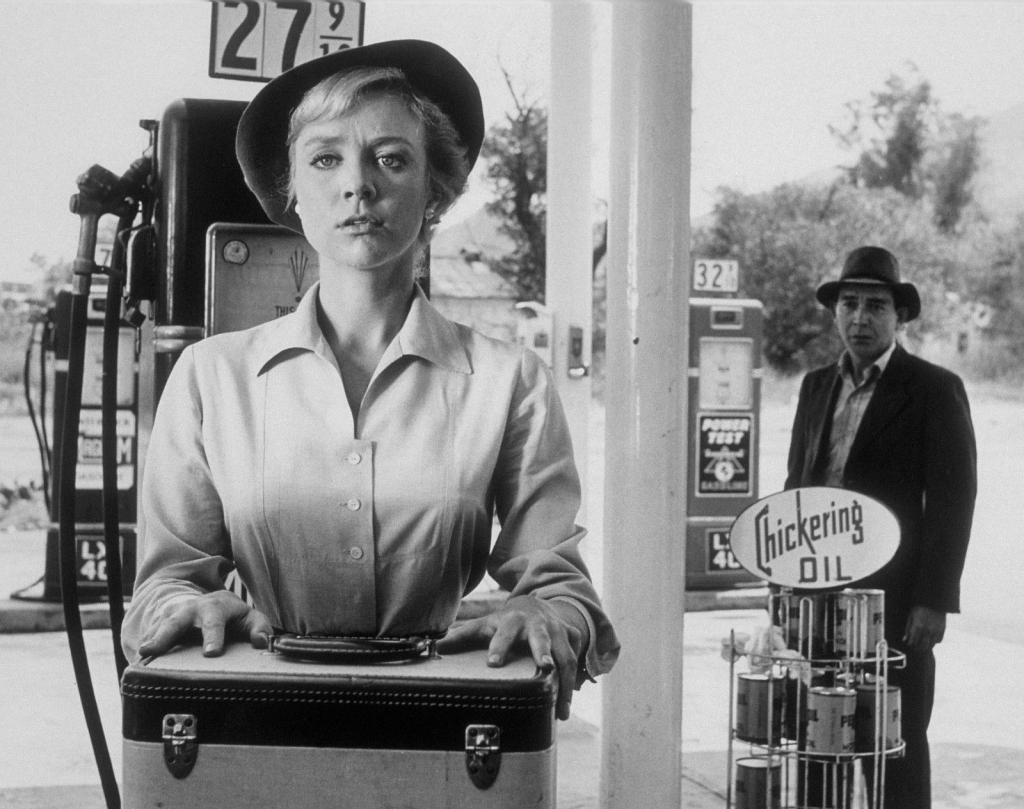
This is probably the most frightening episode of The Twilight Zone to date. There were some really anxiety creating shots as poor Marshal White struggled to remember what was going on.
“Express elevator to the ninth floor of a department store, carrying Miss Marsha White on a most prosaic, ordinary, run-of-the-mill errand.
Miss Marsha White on the ninth floor, specialties department, looking for a gold thimble. The odds are that she’ll find it—but there are even better odds that she’ll find something else, because this isn’t just a department store. This happens to be The Twilight Zone.”
I immediately spotted that there was no 9th floor on the elevator that Marsha White got on and I knew something was going on. What happened from here on out was weird.
Marsha White was here to buy a gold thimble for her mother (which at the end is strange considering the twist). After purchasing the thimble, she realized that it was scratched and dented and tried to return it, but the manager told her there was no 9th floor in the store.
This started Marsha’s psychological problems, afraid of what she saw… especially when she saw the woman who sold her the thimble… as a mannequin.
The twist at the end I did see coming, but that did not make everything around it less creepy. The strong performance by Anne Francis made up for any problems that might have been in the episode and the twist, the fact that Marsha was a mannequin too, was creative and probably very effective for the time.
Strange when you think about it, this whole episode happened because someone needed to use the phone.
“Mr. Roger Shackelforth. Age: youthful twenties. Occupation: being in love. Not just in love, but madly, passionately, illogically, miserably, all-consumingly in love – with a young woman named Leila, who has a vague recollection of his face and even less than a passing interest. In a moment, you’ll see a switch, because Mr. Roger Shackelforth, the young gentleman so much in love, will take a short, but very meaningful journey into the Twilight Zone.”
Roger Shackleforth was desperately in love with Leila. She couldn’t be bothered. Roger was in the phone booth, trying to get Lelia to answer. To get him out of the booth, a man offered him the card of a man whom would be able to fix everything for him. That would make the man desperate to make a phone call the inciting incident. Weird writing.
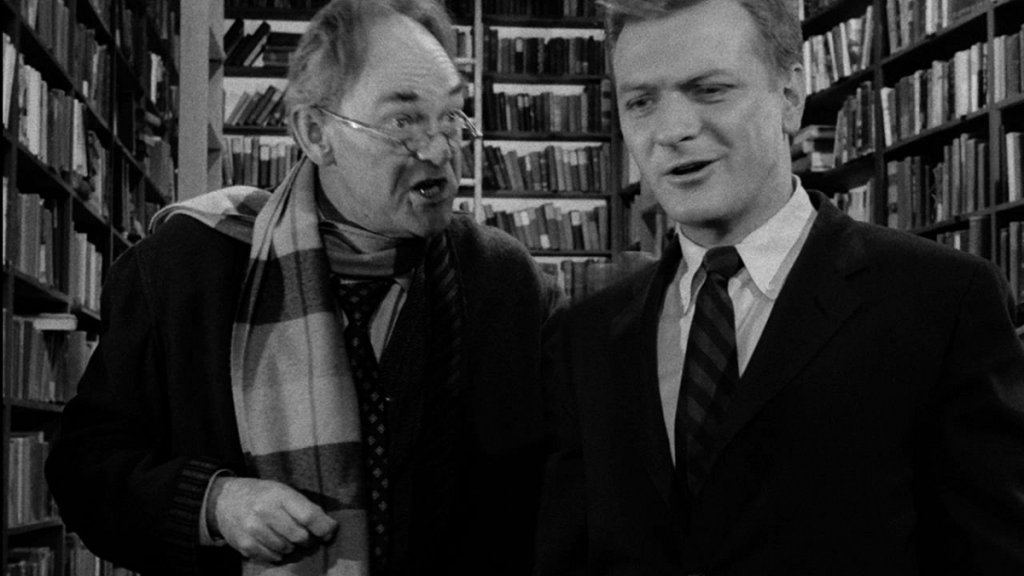
The man whose card was given to Roger was for a man named “A. Daemon,” a professor who was reading and working in what appeared to be a library. The professor tried to get Roger to buy “glove cleaner” but eventually offered him a love potion to help with his troubles. He warned Roger that this potion would make Leila fall hopelessly in love with Roger, and she would dote over him forever.
Roger went to see Leila and immediately gave her the potion in some champagne and, sure enough, she became breathlessly taken with him.
They would marry and she would do everything for him, constantly gazing upon him, back rubs, anything for him. And he was becoming tired of the mindless obsession.
He tried to return to the professor and he purchased the “glove cleaner” to “take care” of the problem. However, Roger could not bring himself to give Leila that potion and he committed to live his life in this way.
I was not a fan of this episode. Leila was quite annoying, but Roger’s use of the love potion is the same as forcing someone to do something that they did not want to do. The idea that he would then murder her to get away from her is a horrible thought.
This was Rod Serling’s favorite episode from the first season of The Twilight Zone, and I can definitely see why.
An ad exec Gart Williams was struggling at his job, getting more stressed and anxious over everything.
“This is Gart Williams, age thirty-eight, a man protected by a suit of armor all held together by one bolt. Just a moment ago, someone removed the bolt, and Mr. Williams’ protection fell away from him, and left him a naked target. He’s been cannonaded this afternoon by all the enemies of his life. His insecurity has shelled him, his sensitivity has straddled him with humiliation, his deep-rooted disquiet about his own worth has zeroed in on him, landed on target, and blown him apart. Mr. Gart Williams, ad agency exec, who in just a moment, will move into the Twilight Zone—in a desperate search for survival“
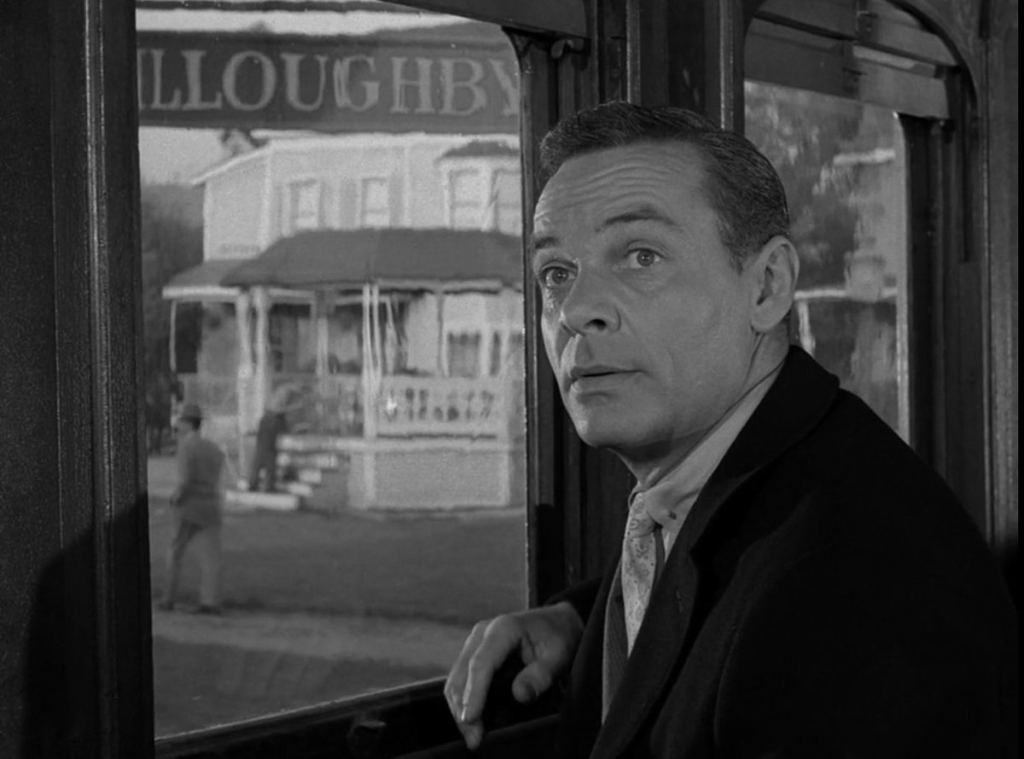
While heading home on a train after a particularly problematic day, Mr. Williams fell asleep and dreamed of a long ago town called Willoughby. A town where everything was peaceful and tranquil, Boys went fishing. Carriages were pulled by horses. Everything seemed to go slower.
Mr. Williams could not get Willoughby out of his mind and, a second time he had the dream on the train, he nearly got off, only to be awakened by the jolt of the train.
His wife had little empathy for him. His boss kept on his back to “PUSH, PUSH, PUSH.” Everything was flying past him. He made the decision to get off the train the next time he dreamed of Willoughby.
And that is exactly what he did. Everything seemed to be peaceful and lovely.
However, this is The Twilight Zone so we were going to get a twist. It seemed that, in reality, Gart Williams, when he thought the train was stopped at Willoughby, in reality, jumped off the moving train, killing himself.
The mortuary company of Willoughby and Son picked up the body.
Great ending to this episode. I expected something magical to happen. Kind of like the Apple TV + series Schmigadoon. Instead, we get a sudden switch to tragedy and we take a sharp turn to the dark. Or is Mr. Williams still there in Willoughby, happy as he could be?
Wonderful episode.
“Willoughby? Maybe it’s wishful thinking nestled in a hidden part of a man’s mind, or maybe it’s the last stop in the vast design of things—or perhaps, for a man like Mr. Gart Williams, who climbed on a world that went by too fast, it’s a place around the bend where he could jump off. Willoughby? Whatever it is, it comes with sunlight and serenity, and is a part of The Twilight Zone.”
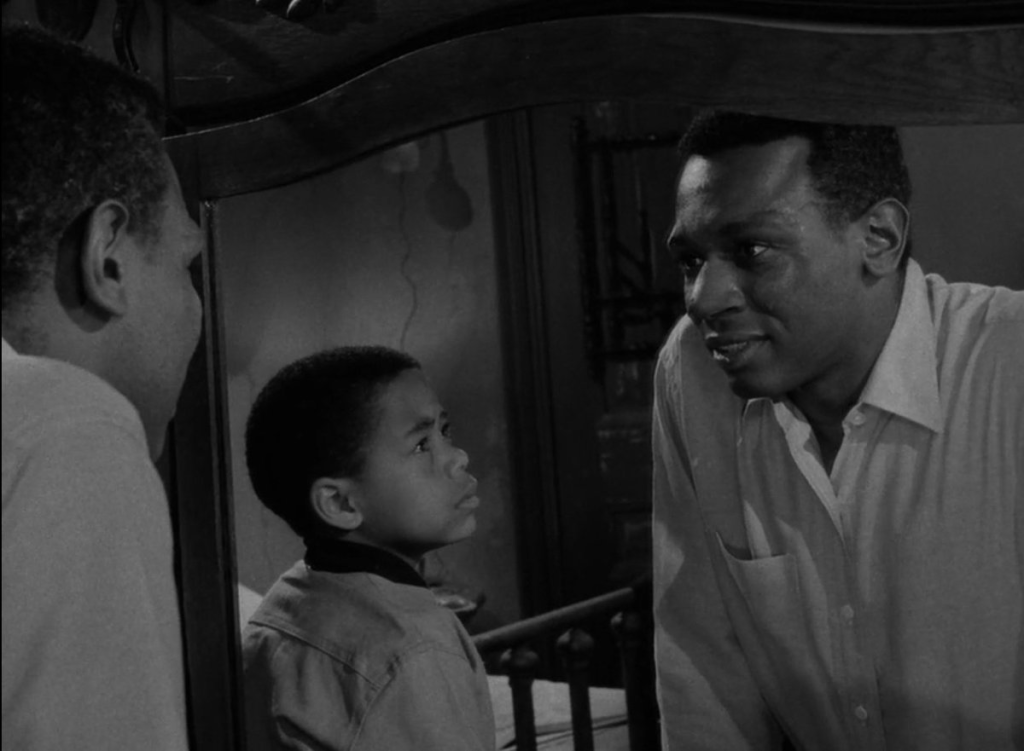
“In this corner of the universe, a prizefighter named Bolie Jackson, 183 pounds and an hour and a half away from a comeback at St. Nick’s Arena. Mr. Bolie Jackson, who, by the standards of his profession is an aging, over-the-hill relic of what was, and who now sees a reflection of a man who has left too many pieces of his youth in too many stadiums for too many years before too many screaming people. Mr. Bolie Jackson, who might do well to look for some gentle magic in the hard-surfaced glass that stares back at him.”
Aging boxer Bolie Jackson looked to get his career back on track against some younger fighters. He was encouraged by a young boy who lives in the same building as he did. They were close and the boy told Bolie that he would wish for him to be able to win.
Things looked badly for Bolie, as he lay on the mat, staring up at the lights, the ref counting to 10. However, the little boy’s wish made everything right, flipping the script.
And all Bolie had to do was believe in magic.
Similar to some ideas found in Peter Pan, magic required that Bolie believed in it, but he couldn’t do it. This sent everything back to the way it was supposed to be.
This was a straight-forward episode that told a basic story. However, the all-black cast was anything but basic at the time of broadcast.
“A Nice Place to Visit”
“Rocky” Valentine was a thief. During a robbery, he wound up in a shoot out with the police and was shot. He awakes with a man who called himself Pip standing over him. Pip insisted that he was there to help him do anything he wanted, and gave him $700 dollars from his pocket.
Pip took Rocky to a hotel room, helped him win at gambling and brought him some beautiful women. Rocky realized that he had been shot to death by the cops and he guessed that he was in heaven and Pip was a guardian angel.
After awhile of never losing at gambling or never failing with the women, Rocky became bored and pressed Pip to find out how he could change things up. Rocky even said that he did not want to be in heaven any longer and wanted to go to the other place. Pip laughed and told Rocky that he was not in heaven, but was already in the other place.
Be careful what you wish for because you might get it feels like the moral of this story.
“A scared, angry little man who never got a break. Now he has everything he’s ever wanted – And he’s going to have to live with it for eternity – In The Twilight Zone.”
I found Rocky extremely annoying and he was difficult to watch. I figured the twist very early as if was obvious that Rocky wasn’t going to heaven. Heck, even Rocky wondered how he was in heaven.
Pip was definitely the highlight of the episode, but I found myself more irritated with the character and even the ironic ending did not rewcue that for me.
“Nightmare as a Child”
So this was the best of the three I watched for this post. I loved the psychological aspect of this episode.
“Month of November, hot chocolate, and a small cameo of a child’s face, imperfect only in its solemnity. And these are the improbable ingredients to a human emotion, an emotion, say, like—fear. But in a moment this woman, Helen Foley, will realize fear. She will understand what are the properties of terror. A little girl will lead her by the hand and walk with her into a nightmare”
When Helen met Markie, things felt odd. Little did we know that Markie was just a figment of her imagination. Something there to help Helen Foley remember the traumatic event of her mother’s murder.
Everything was triggered when she had seen the killer (off screen) by her school where she worked. This led to Markie and those memories returning.
Mr. Seldon, who was the killer, came by her apartment to see what she was remembering. He knew that she was the loose end, the person who witnessed his murder.
I really liked the fact that they did not make something supernatural or magical about this. Instead, they played the little girl as a psychological symptom.
Mr. Seldon did fall into the villain who just explains his plans trope. The audience did not have to have it laid out as such. At least, I figured that he was the killer. I could have had a better wrap up of the episode, but overall, this was decent.
Roddy McDowell is on the way to Mars and what he finds is unexpected.
“You’re looking at a specie [sic] of flimsy little two-legged animal with extremely small heads, whose name is Man. Warren Marcusson, age thirty-five. Samuel A. Conrad, age thirty-one. They’re taking a highway into space, Man unshackling himself and sending his tiny, groping fingers up into the unknown. Their destination is Mars, and in just a moment we’ll land there with them“
Honestly, I have been a fan of every episode of The Twilight Zone so far. Even the ones that were near the bottom of the list had parts that I really enjoyed. That streak is over now. “People Are Alike All Over” is easily my least favorite episode of The Daily Zone so far.
It was just so random. The Martians that appeared before Roddy McDowell were so ridiculous that it was impossible to believe that they were actually Martians. There was nothing that made this feel interesting at all.
That is not to say that Roddy McDowell is a problem. I have always found his work to be great and he does what he can here. It just feels like a slight episode without a lot of worthwhile ideas.
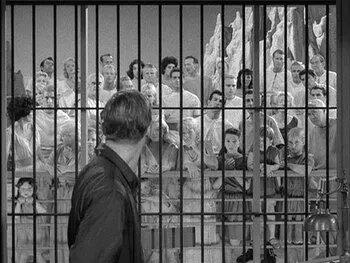
Humans in cages on display will be used better in future moments. From my limited research, it seems as if this episode has its supporters and that it has been an inspiration to many. I am happy for them. I am not one of them.
“Execution”
The second episode in a row that I did not like very much.
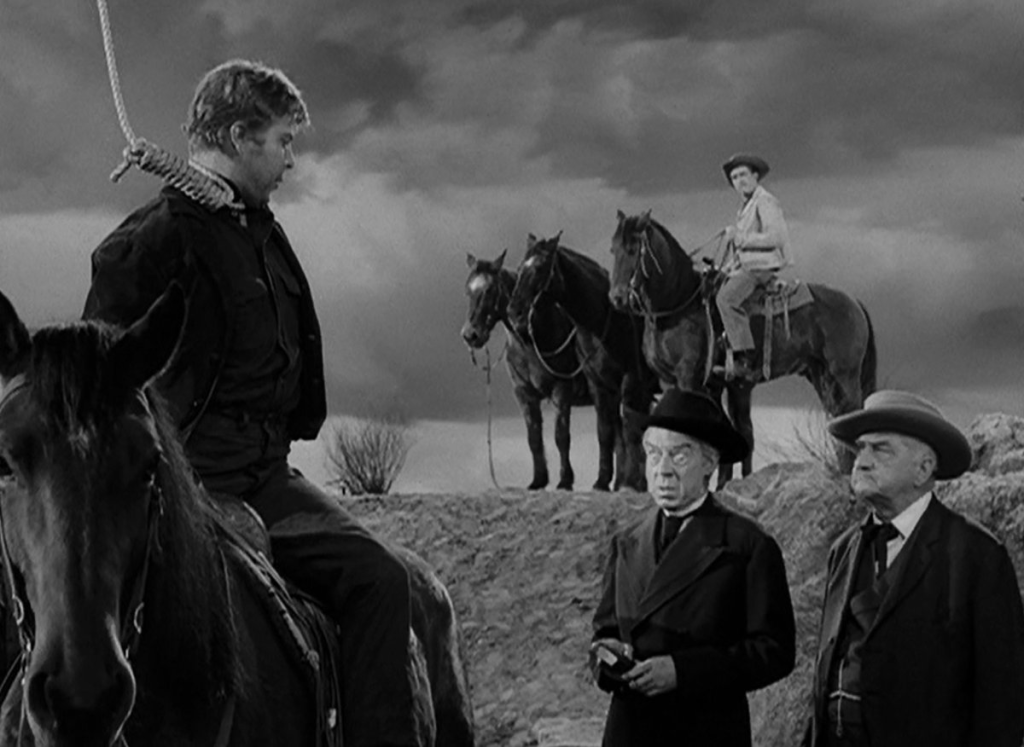
I found this premise intriguing. I did not expect to start with an attempted hanging and the set up was solid. When outlaw and killer Joe Caswell disappeared from the noose, I was certainly enthralled.
However, with his arrival in the future, I lost most of that early excitement.
I’m not sure if the sudden appearance of the Professor from Gilligan’s Island (with nary a coconut to be seen) affected my thoughts on what was happening.
Caswell ran around the future with a gun, attacked a juke box and shot up a TV.
Then, at the end, the story stopped being about Caswell and became the story of another guy, a thief named Paul Johnson. Johnson ends up killing Caswell in a fight and somehow gets himself stuck in the time machine and is sent back to take Caswell’s place in the noose.
While I do like the ending, I do not like how the character of Paul Johnson just appears from nowhere and becomes the center of the story in the final few minutes. I did not find it satisfying.
“This is November 1880, the aftermath of a necktie party. The victim’s name—Paul Johnson, a minor-league criminal and the taker of another human life. No comment on his death save this: justice can span years. Retribution is not subject to a calendar. Tonight’s case in point in The Twilight Zone.“
“You’re looking at a tableau of reality, things of substance, of physical material: a desk, a window, a light. These things exist and have dimension. Now this is Arthur Curtis, age thirty-six, who also is real. He has flesh and blood, muscle and mind. But in just a moment we will see how thin a line separates that which we assume to be real with that manufactured inside of a mind.”
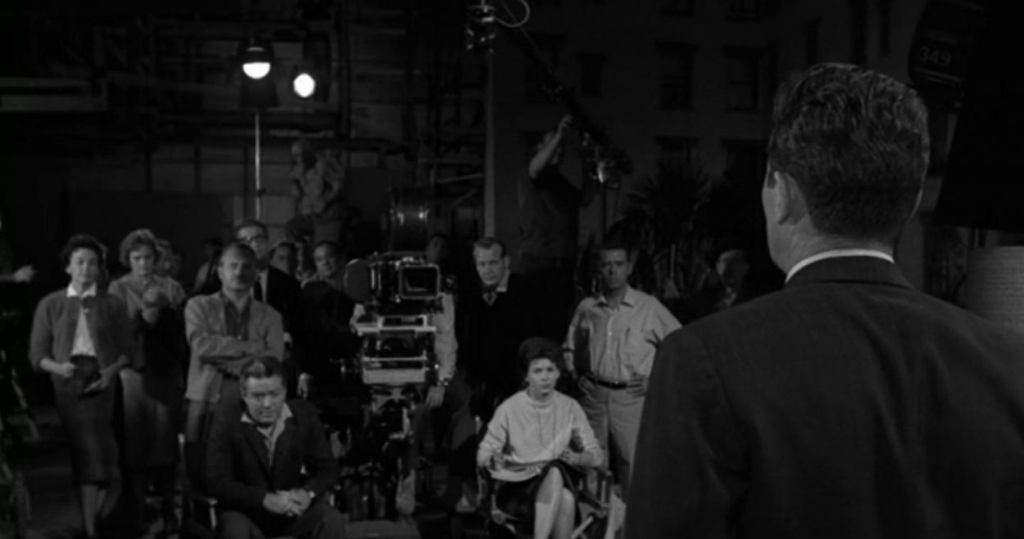
Another winner of an episode as we peek behind the camera of a man’s life. Is he Arthur Curtis? Or instead is he actor Gerald Raigan?
This episode shows a man having a nervous breakdown, believing that he is, in truth, the character that he is playing in a movie. Or does that character really need a vacation from work because he has had some delusion. I do like the even balance the show gives us. Although it does feel as if Gerry is the true personality, there is enough uncertainty to warrant debate.
The episode featured David White, most well known as Larry Tate from Bewitched as Gerry’s agent/friend.
“Long Live Walter Jameson”
Walter Jameson is old. Really old.
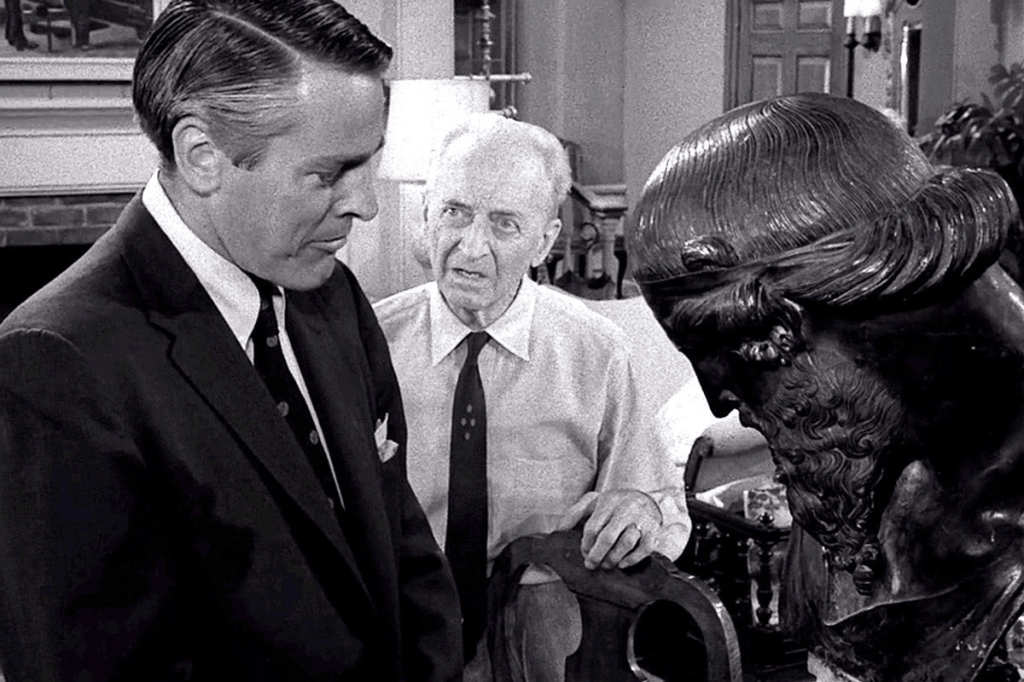
He has fallen in love with a younger woman. However, her father has discovered the truth of Walter’s age. Walter was old enough to have been friends with Plato.
The idea of immortality is revisited here, and the idea that it would not make a person happy is brought back once again. We saw how things could go bad in the episode, “The Escape Clause” and here it takes a slightly different path, but reaches the same conclusion. That death is what makes life so valuable.
The ending of the episode was very well done as we see Walter, shot by a former wife, died slowly, but aging rapidly as he died. He wound up a pile of dust on the floor after we had seen him age from the man that we knew. It was a neat effect.
“Last stop on a long journey, as yet another human being returns to the vast nothingness that is the beginning and into the dust that is always the end.“
“The Monsters are Due on Maple Street” was excellent from beginning to almost end. There was no much in this episode, clearly taking shots at the McCarthy hearing and how people were seeing Communists all over the place.
“Maple Street, U.S.A., late summer. A tree-lined little world of front porch gliders, barbecues, the laughter of children, and the bell of an ice cream vendor. At the sound of the roar and the flash of light, it will be precisely 6:43 P.M. on Maple Street.“
“This is Maple Street on a late Saturday afternoon. Maple Street in the last calm and reflective moment –before the monsters came“
Something flew over Maple Street. The people who lived on this street thought it might have been a meteor. However, everything stopped working. No lights. No cars. No machinery of any kind. Nothing would start or turn on.
Why? No one was sure and they were nervous. When an imaginative child brought up an idea of the ‘meteor’ was in actuality a space ship and that the child had read a story about how monsters from outer space would infiltrate a community to set up for the landing.
The people dismissed the idea at first, but it got inside their minds and the paranoia of the situation started to rot their attitudes. They began blaming individuals on being guilty, with no evidence and even less reality.
It devolves into violence as one of the people is shot because they thought it was a monster coming out of the darkness.
The accidental death did not calm the tensions. In fact, it only triggered the people into chaos. I loved how this episode showed how human beings can react to rumors and innuendo, becoming mob-like.
Now, I am not sure I loved the very end of the episode where we see that this whole situation was being manipulated by aliens from a space ship, what had actually flown over the street. I would have preferred to have left that reveal a mystery. I don’t think that was necessary.
However, that did not take away from how much I loved this episode. It may be my current favorite episode of the series.
“The tools of conquest do not necessarily come with bombs and explosions and fallout. There are weapons that are simply thoughts, attitudes, prejudices… to be found only in the minds of men. For the record, prejudices can kill… and suspicion can destroy… and a thoughtless, frightened search for a scapegoat has a fallout all of its own—for the children and the children yet unborn. And the pity of it is that these things cannot be confined to the Twilight Zone“
I did not expect much from this episode. It was a basic war story… that is, until it took that twist that you can only find in the Twilight Zone.
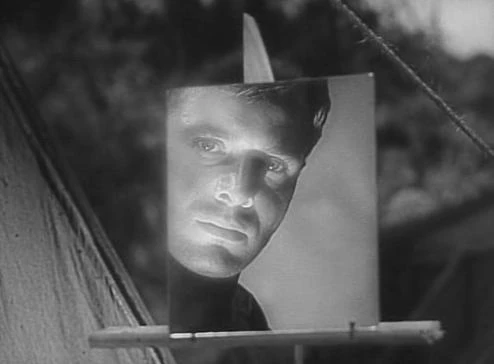
“Infantry platoon, U.S. Army, Philippine Islands, 1945. These are the faces of the young men who fight, as if some omniscient painter had mixed a tube of oils that were at one time earth brown, dust gray, blood red, beard black, and fear—yellow white, and these men were the models. For this is the province of combat, and these are the faces of war.”
Bewitched star Dick York appeared in this episode of The Twilight Zone as a main supporting character. I had seen this fact during my research, but I had forgotten about it so when I saw him, I was shocked. I thought he did a very good job.
Meanwhile, our lead character, William “Fitz” Fitzgerald, developed a strange and disturbing ability. Fitz was able to look at the face of other soldiers in his platoon and he would see a light indicating that they were going to die.
This power clearly upset Fitz, as you would expect. He did what he could to come to grips with his precognition.
I found this episode to be extremely well done. It had a tragic story that brought Fitz into a terrible state of mind. The ending was very powerful. It brought the idea of a failure to be able to prevent death even with foreknowledge is a very sad but relatable theme.
“Elegy”
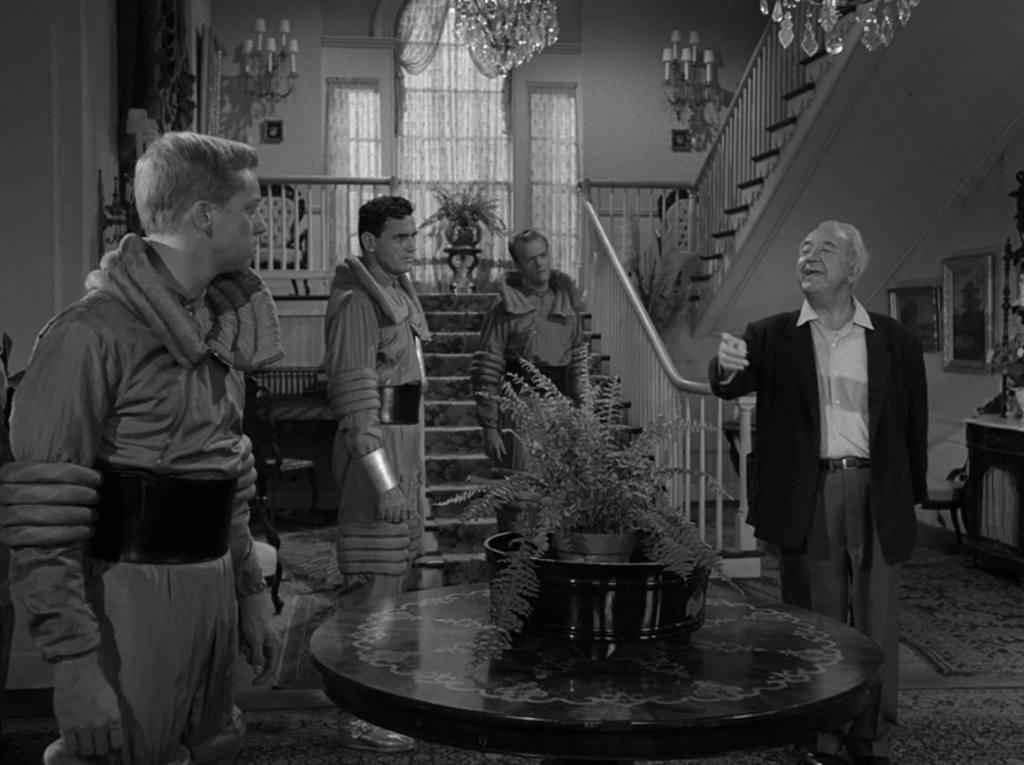
Another example of a spaceship that leads to a breakdown, stranding the pilots somewhere familiar, yet foreign. Much of this episode was bizarre and mysterious. I do think that I was engaged with the story at the beginning. The seemingly frozen people in this location was odd and I was not sure what was going on.
When Jeremy Wickwire, the caretaker of the place, turned to the camera, I actually shouted. I did not expect that.
Unfortunately, the next ten to fifteen minutes or so of the show really felt weak. There was just a ton of enigmatic exposition as Wickwire tried to maintain the mystery of what was going on. The show lost me during this period. However, the ending was extremely dark and intriguing. I loved the final three minutes or so as Wickwire poisoned the three astronauts and set them up in their own “final wish”.
I found the tones of this episode to clash with each other. There was some serious and mysterious feeling early and Wickwire brought a more humorous tone that seemed to undercut what was going on. Then the show ended very darkly and with a great deal of irony and Wickwire showed his true feelings for the human race, and we did not see that prior at all.
It is a real mishmash for me.
“Mirror Image”
One of the more well known episodes (apparently it inspired Jordan Peele’s film Us), “Mirror Image” was one that I was looking forward to, but, though it was interesting, I do not think it quite reached the level that I was expecting.
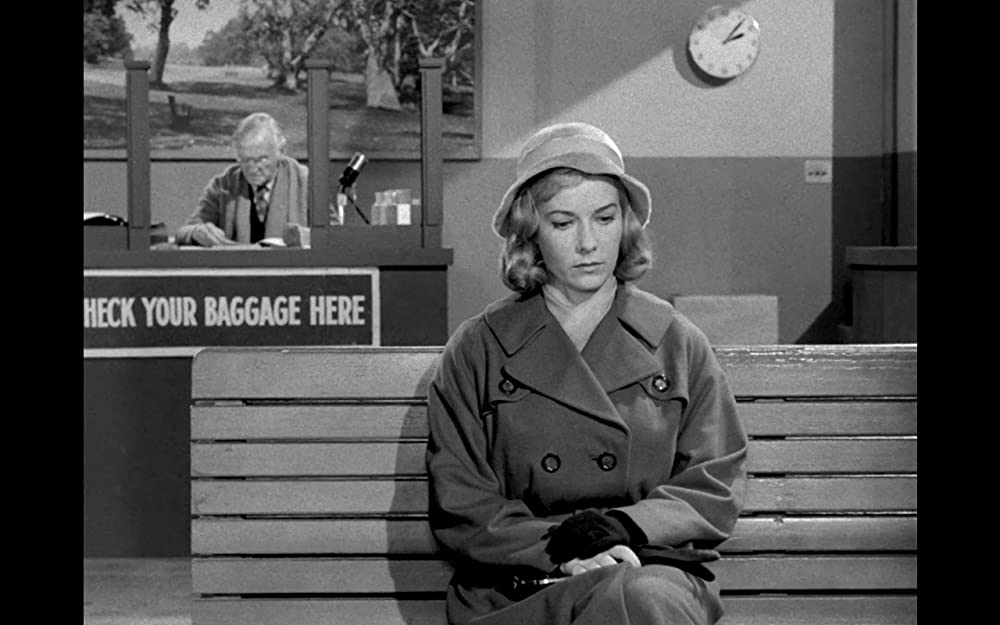
“Millicent Barnes, age twenty-five, young woman waiting for a bus on a rainy November night. Not a very imaginative type is Miss Barnes: not given to undue anxiety, or fears, or for that matter even the most temporal flights of fantasy. Like most young career women, she has a generic classification as a, quote, girl with a head on her shoulders, end of quote. All of which is mentioned now because, in just a moment, the head on Miss Barnes’ shoulders will be put to a test. Circumstances will assault her sense of reality and a chain of nightmares will put her sanity on a block. Millicent Barnes, who, in one minute, will wonder if she’s going mad.”
Strange things are happening for Millicent. People are telling her that she had been asking questions that she had not been. People said she had been places where she was not. She was starting to feel as if she were losing her grip on reality. Could she be delusional?
The arrival of the friendly gentleman, Paul Grinstead, brought her down a bit, but things ramped up again when she started speculating about evil doubles from parallel worlds.
Of course, that is what was going on and she would eventually spy her doppelganger on the bus that she intended to be on. I had a problem here. Why would she not go up and confront this doppelganger with Paul beside her? Instead, she just screamed and ran off, apparently passing out.
Paul called the police to take her for mental help and then he realizes that she wasn’t wrong as the same thing starts to happen to him.
I found this to be way overrated. I still enjoyed a lot the episode, but the fact is the conclusion felt rushed and made little sense. I did not like the way the characters reacted and the ending did not support what was a decent start.
I got four episodes watched this morning, and they were four dang good ones.
“I Shot an Arrow into the Air”
We kick off the four episode run with an outstanding episode about a failed space flight.
“I shot an arrow in the air; it landed I know not where,” said Langford, one of the heads of the mission that saw a crew on board a ship called The Arrow that had disappeared after takeoff.
That was a famous line from a Longfellow poem, but it had been changed by the character, and, looking back, I believe it was changed purposefully. Because the line actually said, ‘I shot an arrow in the air, it fell to earth i know not where.‘
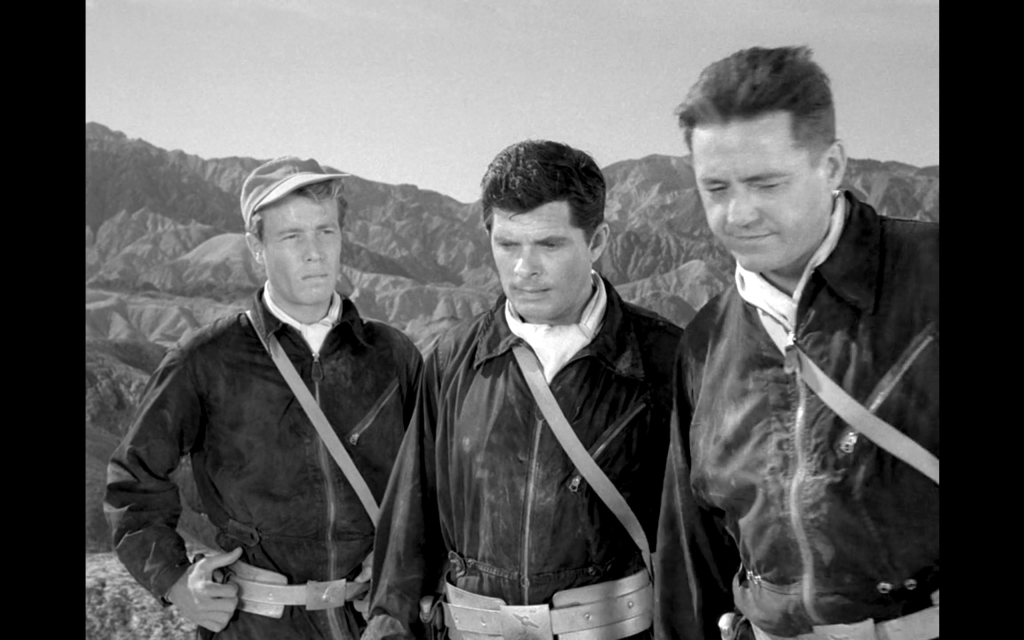
That is exactly what the crew had done, crash landing back on earth in a mountainous desert range outside of Reno, Nevada. Of course, the three surviving crew members believed they had crashed on an asteroid and had no means to be rescued.
The baser instincts of humans took over, with the three men clashing over water, what to do with the injured and other ways to survive.
“Practical joke perpetrated by Mother Nature and a combination of improbable events. Practical joke wearing the trappings of nightmare, of terror, of desperation. Small, human drama played out in a desert 97 miles from Reno, Nevada, U.S.A., continent of North America, the Earth and, of course, the Twilight Zone.“
This idea of crashing back on earth unbeknownst to the crew was used again by series writer Rod Serling when he worked on the 1960s classic Planet of the Apes, where his iconic shock ending made that film a sensation.
“The Hitch-Hiker”
“Her name is Nan Adams. She’s twenty-seven years old. Her occupation: buyer at a New York department store. At present on vacation, driving cross-country to Los Angeles, California from Manhattan. Minor incident on Highway 11 in Pennsylvania. Perhaps, to be filed away under “accidents you walk away from.” But from this moment on, Nan Adams’ companion on a trip to California will be terror. Her route: fear. Her destination: quite unknown.“
The next awesome episode was ‘The Hitch-Hiker’ where Nan Adams was driving across the country, only to be stalked by a mysterious hitch-hiker, whom she seemed to never be able to outrun.
I had an idea early in this episode what exactly had happened. After the guy who was helping Nan after she had the tire blow out said that she was lucky to be alive, I had an idea that maybe she wasn’t. That is another classic trope of sci-fi films where the person involved does not know she was dead. This is a classic example of that and probably an inspiration for many of them.
This is one of the most highly regarded episodes of the first season, with it appearing on a bunch of top 20 lists. It does create an air of mystery with some definite creepy moments involving this mysteriou shitch-hiker.
“The Fever”
The next episode was entitled “The Fever,” which I did not know what was being referenced. Even with the opening narration, I was not sure.
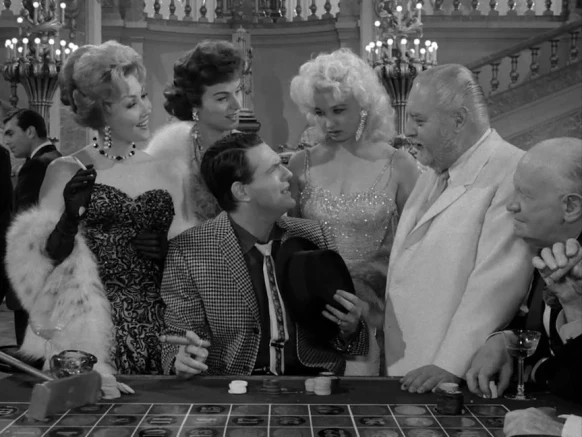
“Mr. and Mrs. Franklin Gibbs, three days and two nights all expenses paid at a Las Vegas hotel, won by virtue of Mrs. Gibbs’s knack with a phrase. But unbeknownst to either Mr. and Mrs. Gibbs is the fact that there’s a prize in their package, neither expected nor bargained for. In just a moment, one of them will succumb to an illness worse than any virus can produce. A most inoperative, deadly life-shattering affliction known as the Fever.”
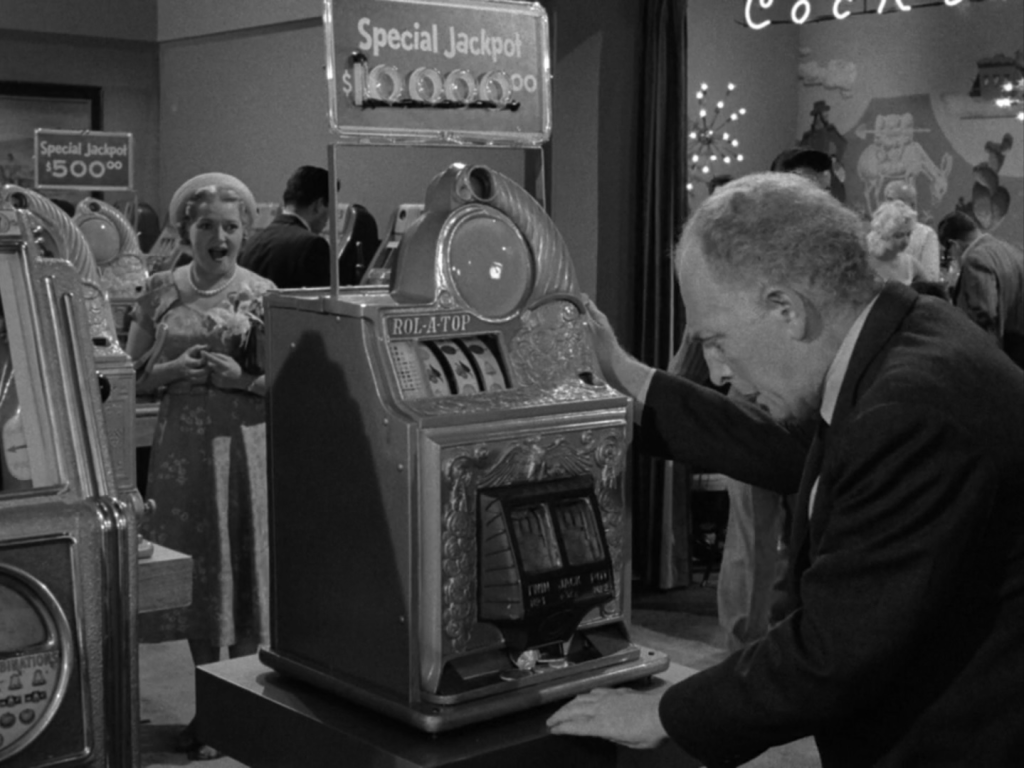
However, as the episode started, I realized that this was not going to be some terrible plague or disease passed through the air. Instead, it would be gambling fever that wound up grasping Franklin Gibbs.
The episode does a great job of setting up to show how easily it is for somebody, even someone opposed to gambling, to fall victim to the obsession of those ‘one-armed bandits.’ Franklin, who spent most of the beginning of the episode chastising Vegas and the people who brainlessly put coin after coin into the slot machines in the desperate hope to win. And yet, through fate, Franklin wound up glued to one of the machines himself.
Oh yeah, the machine was calling him by name. This, of course, was the way to illustrate the beacon call of those people cursed with a gambling addiction. This episode does a tremendous job showing how tragic this obsessive addiction can become, as Franklin fell to his death out a window.
“Mr. Franklin Gibbs, visitor to Las Vegas, who lost his money, his reason, and finally his life to an inanimate, metal machine, variously described as a “one-armed bandit”, a “slot machine”, or, in Mr. Franklin Gibbs’ words, a “monster with a will all of its own.” For our purposes, we’ll stick with the latter definition because we’re in the Twilight Zone.”
Apparently, this episode was inspired by a time when Rod Serling himself wound up enslaved by a slot machine on a trip to Vegas.
“The Last Flight”
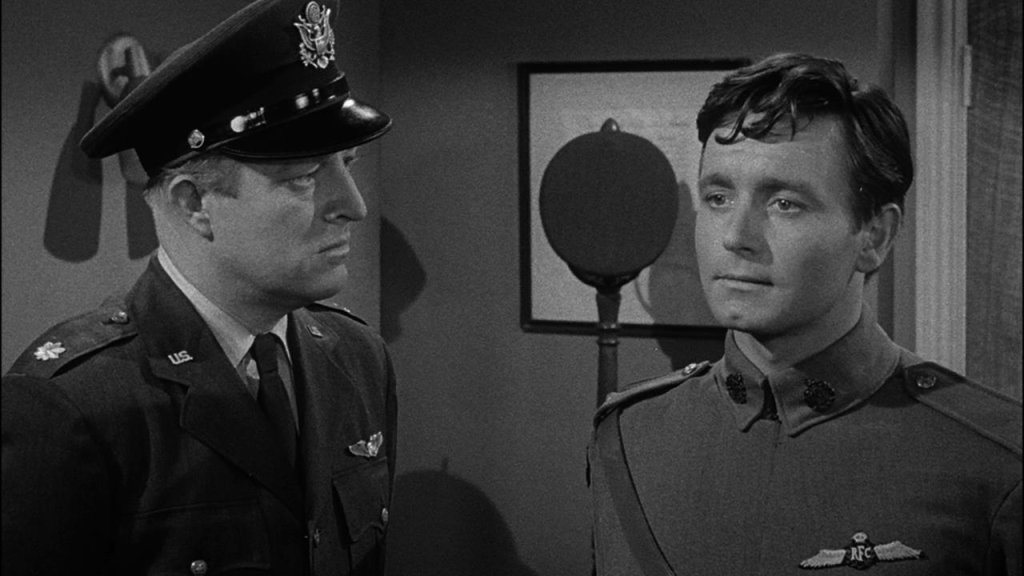
Time travel is a classic sci-fi trope and we get an intriguing one in this episode where a pilot from World War I suddenly finds himself flying to an American military post in 1959.
There were many cool concepts in this film, including the way they pieced back together what actually happened to the pilot.
“Witness Flight Lieutenant William Terrance Decker, Royal Flying Corps, returning from a patrol somewhere over France. The year is 1917. The problem is that the lieutenant is hopelessly lost. Lieutenant Decker will soon discover that a man can be lost not only in terms of maps and miles, but also in time—and time in this case can be measured in eternities.“
At first, I was afraid that several of the awesome ideas brought up in the beginning of the episode was going to be swept under the rug because of the shortness of the episode, but I was very pleased with they way the episode concluded. The idea that Terry Decker had to fly his plane back through the mystical cloud and go back to save the pilot he had deserted is a fun way to bring the story around. The closing section of the show with the British Air Vice Marshal Mackaye, the very pilot that Terry had returned to save, realizing that something magical had occurred was great.
Just like all time travel shows, the mind reels about what happened and how it happened. When Terry was in 1959, he had thought that Mackaye was dead, but when the Americans told him that Mackaye was coming to that very base for an inspection, that meant he had survived. Would he have survived if Terry had not returned to save him? Terry was in 1959, but he had not saved his friend yet.
This is one of those time is a flat circle ideas. The events from 1959 happened and would always happened because Terry was always the person to save Mackaye. This way, time is not a straight line, as explained in Back to the Future. Its more like everything is happening at the same time and you can’t change things.
Time travel is always tough. This works pretty well and I really liked the character of Terry Decker.
Four very solid episodes right in a row during the inaugural season of The Twilight Zone.
Shape shifting takes center stage in the Twilight Zone.
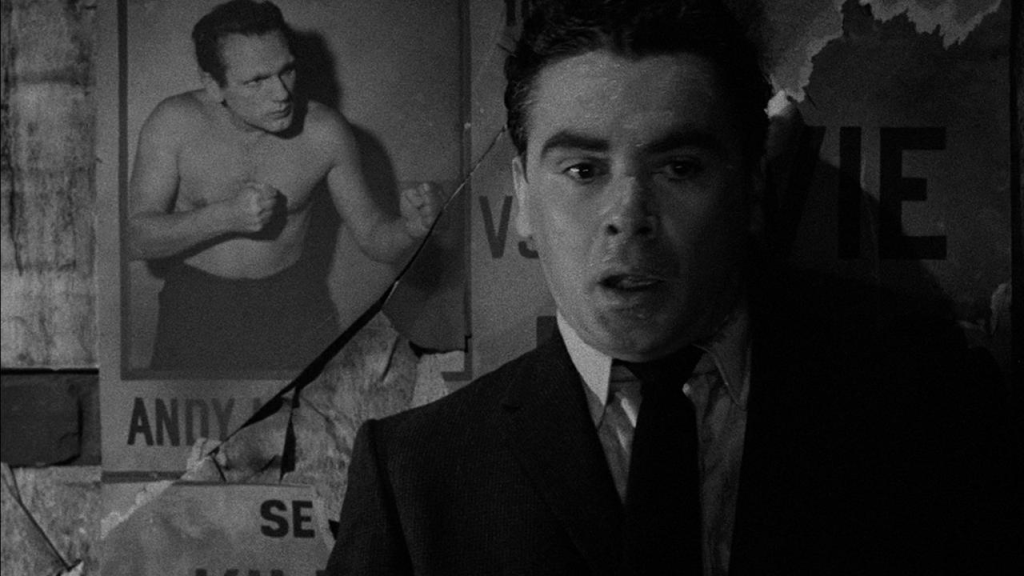
His name was Arch Hammer and he could change his face to look like someone else. He decided to use this ability to do some rotten things. He impersonated a deceased trumpet player to try and score with the woman the trumpet player loved. He made arrangements to run away with her. I didn’t know if he then intended to keep that face for the rest of time or if he was just messing with her and would dump her when he was tired of her. Either way, playing on her grief was a terrible thing to do.
Then he impersonated a gangster and threatened the head gangster that had had him killed. He was able to rip off a bunch of money.
Then, as he was being pursued, he switched to a random face he saw on a poster in an alleyway. He was a boxer. He avoided the thugs chasing him, but, coincidentally, he ran into the boxer’s father. The father was angry with his son and Hammer shoved him to the ground.
The old man would come back into play later when he shot Hammer dead outside of his hotel thinking it was his son.
“He was Arch Hammer, a cheap little man who just checked in. He was Johnny Foster, who played a trumpet and was loved beyond words. He was Virgil Sterig, with money in his pocket. He was Andy Marshak, who got some of his agony back on a sidewalk in front of a cheap hotel. Hammer, Foster, Sterig, Marshak—and all four of them were dying.“
This was very much of a noir episode, with the music from Jerry Goldsmith and all of those Dutch Angles. This episode was okay, at best.
“Third from the Sun”
This was a much different episode from the previous one. Here we had some government researchers/scientists involved in research on H-bombs and other weapons. Nuclear war was imminent.
“Quitting time at the plant. Time for supper now. Time for families. Time for a cool drink on a porch. Time for the quiet rustle of leaf-laden trees that screen out the Moon. And underneath it all, behind the eyes of the men, hanging invisible over the summer night, is a horror without words. For this is the stillness before storm. This is the eve of the end.”
The story featured Will Sturka and his family, along with his friend and co-worker Jerry Riden. They made a plan to steal an experimental spaceship and fly off the doomed planet and relocate to another planet that they discovered that also had people and was much like the planet they lived on.
One of their co-workers, Carling, was suspicious of them and he was hanging around, looking to cause trouble.
As they tried to get to their ship, Carling confronted them with a gun, hoping to take them to the police. They were able to overpower him and got to the ship.
As they were in the ship, they talked about the new planet they were heading towards… and it was called earth.
I liked the unexpected twist at the end of the episode with them heading TO earth instead of escaping from earth. There was some good tension built in the episode as the worry of nuclear war was a major worry that people of the time had to deal with.
Who really knows the future? Well, in the Twilight Zone, it is apparently a little old man named Pedott. This is a talent that down-on-his-luck scoundrel, Mr. Fred Renard needed.
“You’re looking at Mr. Fred Renard, who carries on his shoulder a chip the size of the national debt. This is a sour man, a friendless man, a lonely man, a grasping, compulsive, nervous man. This is a man who has lived thirty-six undistinguished, meaningless, pointless, failure-laden years and who at this moment looks for an escape—any escape, any way, anything, anybody—to get out of the rut. And this little old man is just what Mr. Renard is waiting for.”
This was another main protagonist in an episode of The Twilight Zone that was really unlikable. Renard did not look to have much of a character arc either. He just wanted something to go right for him and when he realized that Pedott could tell him specifically what he needed, meaning he had a gift to see in the future, Renard was ready to cash in.
We got some nice inclusion of a story of a baseball player named Lefty whose arm was ruined. This was to show the ability of Pedott, and it looked as if the story was going to be a happy one. However, the use of Renard as a greedy creep who wanted to become Pedott’s partner guaranteed that this tale would take the typically ironic end.
This episode was fine. I was happy to see Renard get his comeuppance at the end of the episode. There is nothing here specifically deep or complex, unlike many other Twilight Zone episodes. It was a nice watch.
“Her name: X-20. Her type: an experimental interceptor. Recent history: a crash landing in the Mojave Desert after a thirty-one hour flight nine hundred miles into space. Incidental data: the ship, with the men who flew her, disappeared from the radar screen for twenty-four hours… But the shrouds that cover mysteries are not always made out of a tarpaulin, as this man will soon find out on the other side of a hospital door.”
The eleventh episode of the first season of The Twilight Zone was a great episode. Three military pilots flew an experimental spaceship called the X-20. After disappearing for a 24-hour period, they crashed in the desert.
Major William Gart had a broken leg and had to stay in the hospital. When we ick it up, we see Colonel Clegg Forbes came back to the hospital to see Gart, and he was in a panic. It seemed as if his best friend, Colonel Ed Harrington, the third man of the pilots, was missing and no one remembered him.
Forbes told Gart about the trip to the bar the night before when Harrington disappeared. The people in the bar, who had been interacting with Harrington moments before, were now confused by Forbes’ behavior.
Watching Forbes try to wrap his mind around the fact that his longtime friend had been figuratively erased from existence was fascinating and the mystery of what was going on had me glued to the screen.
As the other two pilots eventually disappeared without a trace as well, I realized that there would not be any answers forthcoming, and it did not bother me at all. I liked how the episode left us uncertain about what was happening. We, the audience, were just like the three pilots. We knew that they were there, but we did not know what happened to them.
“Her name is the S.S. Queen of Glasgow. Her registry: British. Gross tonnage: five thousand. Age: Indeterminate. At this moment she’s one day out of Liverpool, her destination New York. Duly recorded on the ship’s log is the sailing time, course to destination, weather conditions, temperature, longitude and latitude. But what is never recorded in a log is the fear that washes over a deck like fog and ocean spray. Fear like the throbbing strokes of engine pistons, each like a heartbeat, parceling out every hour into breathless minutes of watching, waiting and dreading… For the year is 1942, and this particular ship has lost its convoy. It travels alone like an aged blind thing groping through the unfriendly dark, stalked by unseen periscopes of steel killers. Yes, the Queen of Glasgow is a frightened ship, and she carries with her a premonition of death.”
This episode is a ghost story. It starts off as a mystery. How did Carl Lanser wind up on the S.S. Queen of Glasgow? Who is he? Why is he having a premonition of doom happening at 1:15 AM?
I have to say that what was happening on this episode was confusing and was not clear. However, I will admit the episode cleared up the mystery rather quickly. Everything wrapped up with a nice little bow.
I did not love this episode. It was fine, but it all felt so rushed. This felt like an episode that could have benefited from a longer run time.
It had some pretty decent ideas in it and I liked the eventual reveal, but it just did not work in the overall.
This episode of the first season of The Twilight Zone was adapted from a short story by author Lynn Venable and starred Burgess Meredith as poor Henry Bemis, a put upon man who just wanted some time to read the newspaper or some classic literature. His boss and his wife reacted negatively to his wish, going to dramatic steps to stop him from engaging in his hobby.
I related to Henry Bemis immediately. All he wanted was to be able to read and, as a reading teacher, I wish more people would be so motivated.
However, Bemis’s tale took a drastic switch as he was hidden away at the bank that he worked at inside a vault when an H-bomb exploded, destroying evrerything around him, killing all of the people of his city. I was happy that he did not have to deal with his horrible wife any longer. Henry was upset and lonely, unsure of what his life was going to be until he found the reminensce of the public library. Books, books, books everywhere and nothing but time to read them.
I was happy for him until the show pulled one of the crueler tricks that it has done as Henry’s glasses fell and broke, leaving him in a constant blurry world.
The hatred shown by several characters in this episode really relates to the current day as many books are being banned around the country. It really is sad that Henry was denied his one major love, something that had saved him from his near suicide earlier in the episode.
“The best-laid plans of mice and men…and Henry Bemis, the small man in the glasses who wanted nothing but time. Henry Bemis, now just a part of a smashed landscape, just a piece of the rubble, just a fragment of what man has deeded to himself. Mr. Henry Bemis, in the Twilight Zone.“
“Perchance to Dream”
Episode nine of The Twilight Zone was the first episode of the series not written by Rod Serling. This episode, “Purchance to Dream” was written by Charles Beaumont.
Edward Hall needed help and he went to psychiatrist Dr. Eliot Rathmann looking for it. Edward had not slept for several days because of a dream that he was having. Dr. Rathmann had Edward lay down on his couch to rest, but Edward bolted up, afraid to succumb to sleep.
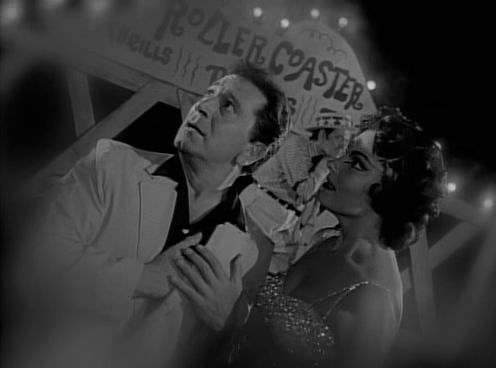
He told the psychiatrist that he had a bad heart condition and could not handle stressful situations or being startled. He then told the doctor that he had been having a dream of a carnival and a Cat Girl named Maya and he was sure that his heart could not handle the dream.
He told about the terrors at the carnival and the stress of the roller coaster. He said that he was sure that Maya was trying to scare him to death and that if he fell back asleep, she would succeed.
When he was leaving the office, he noticed that Rathmann’s receptionist resembled Maya. Frightened by this, Edward ran back into the office and leapt through the window, falling to his death.
However, we discover that he had not done any of this and that he was still on the psychiatrist’ couch, having never awakened. Dr. Rathmann checked Edward’s pulse, realizing that he had died in hi sleep, ironically stating that “At least he died peacefully…”
“They say a dream takes only a second or so, and yet in that second a man can live a lifetime. He can suffer and die, and who’s to say which is the greater reality: the one we know or the one in dreams, between heaven, the sky, the earth – in the Twilight Zone.“
This was a very intriguing episode and ending was extremely satisfying. When we come out of the dream where Edward had killed himself was very surreal. This felt very appropriate for The Twilight Zone.







 EYG- Embrace Your Geekness