One of the summer projects that I have going on at EYG is watching at least one episode daily of the EYG Hall of Fame classic series, The Twilight Zone. I got interested after reading a graphic novel on Rod Serling’s life. I have started the fifth and final season today and I thought this would be a good day to rewatch the movie from 1983. I watched this years ago and I remember not being a huge fan of it. Things may have changed.
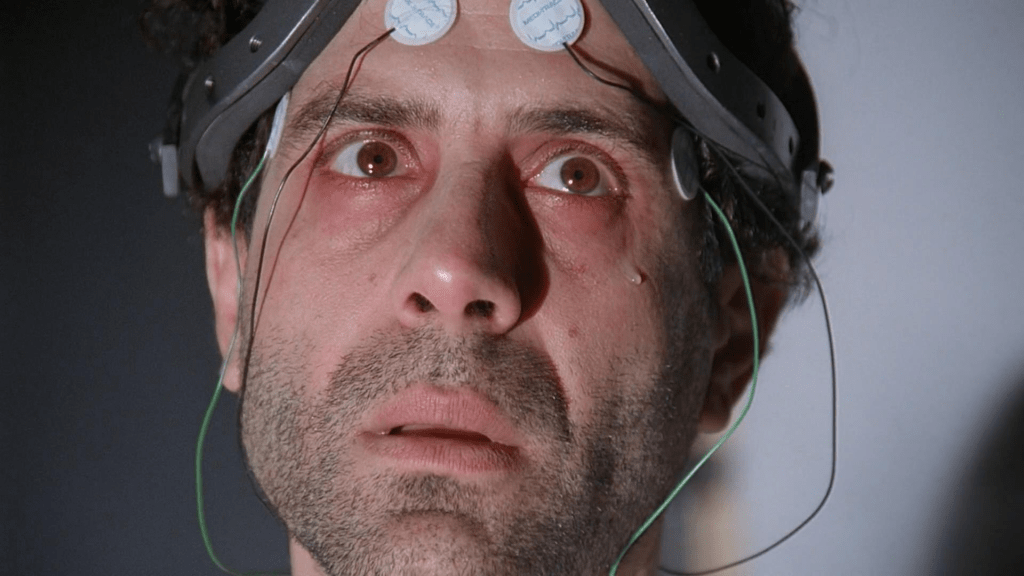
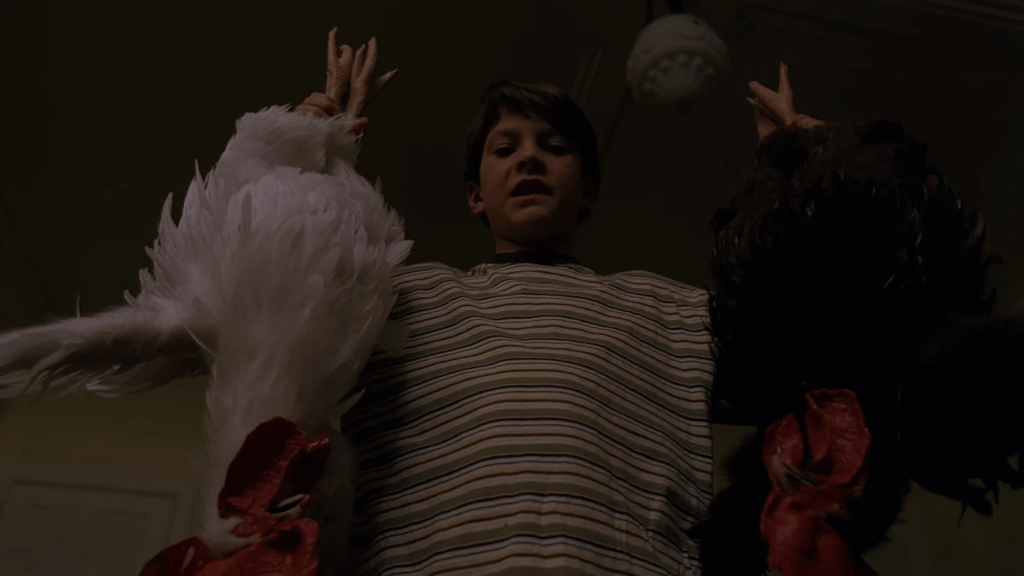
Twilight Zone: The Movie is an anthology film featuring several stories based on episodes from the original series which ran from 1959-1964 on CBS. The four separate stories were directed by John Landis, Steven Spielberg, Joe Dante and George Miller. Quite a murderer’s row of directors, for sure.
There was a prologue featuring Albert Brooks and Dan Aykroyd. They were two men driving in a car, trying to get by without any radio or music.
The four stories included section one “Time Out” which is a remake of the season five episode (one that I have yet to arrive at in my Daily Zone watch) called “Back There.” Vic Morrow starred as a bigoted man who was passed over for a job and was out to blame every minority imaginable. However, he learns a lesson as he bounces around time and finds himself in other minority bodies.
The second story is a remake of the Twilight Zone episode “Kick the Can.” I actually like this version, with Scatman Crothers as Mr. Bloom, much better than the episode of the series. There was much more magical of a situation here and ends with more of a choice from the old people who had been made young.
Story number three has some mash up involved in it, but is basically a remake of “It’s A Good Life.” At first I thought this was going to be Hitch-Hiker, but then they mentioned Willoughby (a town in a classic episode), but once we get Kathleen Quinlan’s Helen Foley to Anthony’s house, we see that Anthony (Jeremy Licht) is the powerful kid who can make any wish come true. He did not send anyone to “the cornfield” as in “It’s A Good Life” but Anthony seemed to have even more power. Jeremy Licht was a former General Hospital kid actor so it was fun to see him again. I thought parts of this was better than the original too, though perhaps not overall. This felt a little too cartoony.
The final story was the remake of “Nightmare at 20,000 Feet” with John Lithgow taking the William Shatner role. I just watched that episode today so it was fresh in my mind. This felt way too hectic and Lithgow, who I usually love, feels just too over-the-top. Perhaps since I saw the outstanding Shatner performance today this one just did not measure up.
This had ups and downs as many anthology films have. I found it a much richer experience after watching the episodes that this movie used as inspirations. Twilight Zone: The Movie was good fun. It was great to hear Burgess Meredith, who was one of the most valuable actors from the original series, get to do the Rod Serling narration voice over and I liked how the ending circled back to the beginning with Dan Aykroyd. A fan of the Twilight Zone should find a lot here to enjoy.
Welcome back to EYG Comic Cavalcade, our fortieth edition. This past NEW COMIC BOOK DAY was the largest pile of new comics that I have ever gotten in a single day. There are still seven books and a trade paperback that I have yet to get to since Wednesday afternoon. I have completed 24 books for this edition of EYG Comic Cavalcade.
UPDATE: The Independent Conspiracy of the Missing #3s seemed better this week. I received the missing Hairball #3, and Deep Cuts, Ghostlore, Something Epic, and Star Signs all had third issues out this week and I got them all. I am still missing Neighbors #3 (and 4), Blue Book #3, and No/One #3. Here’s hoping that the Issue three curse is now over.
This is the second week of the Knight Terrors books from DC Comics. I have committed to purchasing all 46 issues of this event series and we are now about a quarter of the way through it. So far I have enjoyed it for the most part. I have never been a huge DC fan despite liking most of their characters. This was quite the commitment for me. This week we had Knight Terrors #1, Knight Terrors: Robin #1, Knight Terrors: The Flash #1, Knight Terrors: Zatanna #1, Knight Terrors: Shazam #1 and Knight Terrors: Green Lantern #1. Of these books, my favorite this week is probably the Knight Terrors#1 since they have focused in on Deadman and I have always liked that character.
I did enjoy Shazam, Robin and Zatanna quite a bit. Green Lantern would have been next and Flash was the low of the week, but they were all enjoyable. I do like the Insomnia villain that is behind the trouble and I have found this very creative and visually stunning.
Six more next week.
Other books in this massive pile…
Fallen Friend: The Death of Ms. Marvel #1. Writers included G. Willow Wilson, Mark Wai & Saladin Ahmed. Artists included Takeshi Miyazawa, Humberto Ramos and Andrea Di Vito. Kaare Andrews was the cover artist. This was a beautiful issue featuring a service for the loss of Ms. Marvel and Kamala Khan. Yes, they are the same person, but they have separate khatam ceremonies for them keeping the secret identity intact. There is a QV code on the last page that takes you to another comic page, featuring Cyclops, who is late to the ceremony and he implies there is a reason. My guess is that he is working on a way to use the X-Men resurrection ability to bring Kamala back. Despite that I have no doubt whatsoever that she’ll be back alive sooner than later, this was a lovely issue with some real emotion.
Fishflies #1. Written and drawn by Jeff Lemire. I loved this issue. I saw this during Free Comic Book Day and I have been a big fan of Jeff Lemire, so I have been anticipating this new book. And this just knocked it out of the park. It has beautiful art, a story that moves at a perfect clip and a mystery that is totally compelling. This one was a great read.
Antarctica #1. Written by Simon Birks and art by Willi Roberts. Hannah Curtis loved her father but when he was lost somewhere in the Arctic, her life took a distinct change. This was another awesome new book with a story that was so easy to read and beautiful to look at. If not for Fishflies, this would be the best new book of the week.
Groo In the Wild #1. Written by Sergio Aragonés and Mark Evanier and drawn by Sergio Aragonés. Groo is back with Rufferto in search of food to eat while everyone who comes in contact with him immediately panics and is afraid that Groo is going to cause their lives to be destroyed. While Groo is always fun, the plot of this book seems to be similar to all of the other Groo books out there. Still love him though.
Amazing Spider-Man #29. Written by Zeb Wells and penciled by Ed McGuinness. Doc Ock’s old arms are looking to bond with Spider-Man and, since Otto and his new arms have captured Norman Osborn and this is the only way Peter can come up with to find Norman, he is going to let them. However, Otto may have another horrible idea involving Norman Osborn.
Dark Ride #7. Written by Joshua Williamson and drawn by Andrei Bressan. Joshua Williamson is the main mind behind the Knight Terrors series at DC and he brings the horror vibe to the front here at Devil Land the amusement park. Arthur Dante and his children have a big time conflict and things get heated. Dark Ride continues to be an excellent read each issue.
Haunt You to the End #2. Written by Ryan Cady and drawn by Andrea Mutti. The investigation into the haunted house begins on the mysterious Isla Lodo. This book does an excellent job of creating a mood and keeping the reader a little shaky. Horror comics are hitting some great strides recently and this one fits right in to the club.
Moon Knight #25. “Danse Macabre.” Written by Jed MacKay and illustrated by Partha Pratim, Alessandro Cappuccio and Alessandro Vitti. The cover was drawn by Rachelle Rosenberg. Listed as “Enormous 25th issue” this Moon Knight book is very large. It includes Black Spectre (at least the new one), Zodiac, 8-Ball among others. Moon Knight has been outstanding in this series and this 25th issue continues that excellence.
Scarlet Witch #6. Written by Steve Orlando and featuring art by Lorenzo Tammetta & Sara Pichelli. Russell Dauterman did the cover art. Wanda takes a monk of the Archsisterhood named Ganymede to see her son Wiccan and his husband, Teddy aka Dorrek-Vell, the King of the Skrull/Kree alliance.
Hairball #3-4. Written by Matt Kindi and art by Tyler Jenkins. This story concluded with Anna first trying her best to murder the cat Bestie because she believed it was a demon and then trying to find it again when she believed it was not dead and was an ancient demigod. This series took a weird twist, but I loved it.
Miles Morales: Spider-Man #8. “Spun Out Part One.” Miles and Starling come across and get into a battle with the Hobgoblin. Miles has been taking a beating lately, coming out of the Carnage storyline and this is the worst time to come across a goblin. The cover pays homage to the classic Amazing Spider-Man #238.
Blue Book #2. Written by James Tynion IV and art by Michael Avon Oeming. This cover art (which is the B cover) was done by Josh Hixson. Betty and Barney and their UFO encounter takes center stage again as we see how this alien encounter affected their lives. I do love Tynion’s work.
Something Epic #3. Written and illustrated by Szymon Kudranski. Something Epic continues to live up to its name every issue. This book looking at the life and imagination of Danny is utterly gorgeous and may have the best art work on the market currently. There is also a time shift near the end of the book, taking the series into a darker path. Love this book.
The Great British Bump-Off #4. Script by John Allison and art by Max Sarin. This is also Cover B so the art on the cover is from Benjamin Dewey. This extremely fun and funny series comes to a close as we discover that Shauna is actually a better detective than we thought. Good thing too because she is not a good chef.
Ghostlore #3. Written by Cullen Bunn and illustrated by Leomacs. Harmony and her father are trying to use their ability to talk to the dead to talk to Emily, her mother and his wife, who died when they gained this ability. No luck, but there are other spirits that come to talk t them. Harmony is more ready to listen and help than her father is. But there is something horrible coming…
Loki #2. “The Liar: Chapter Two.” Loki survived last issue’s apparent decapitation but finds HERself in trouble again. Loki heads off in search of the rest of the pieces of the cursed ship Nagliar. The ship is apparently the narrator of this story too.
What If…? Dark: Loki #1. Written by Walter Simonson and penciled by Scot Eaton. Walter Simonson & Laura Martin did the cover art. This definitely felt like an old school What If…?. Dark and tragic, with characters dying that would never actually die in the actual Marvel Universe. Loki brings about the destruction of everything in this issue.
We have finally arrived at an episode that is arguably the most iconic, most well known episode of The Twilight Zone of all-time.
“Nightmare at 20,000 Feet” starred William Shatner and featured the fate of a man who had just recovered from a nervous breakdown and who was the only person to be able to see a gremlin on the wing of the airplane that he and his wife were flying upon.
“Portrait of a frightened man: Mr. Robert Wilson, thirty-seven, husband, father and salesman on sick leave. Mr. Wilson has just been discharged from a sanatorium where he spent the last six months recovering from a nervous breakdown, the onset of which took place on an evening not dissimilar to this one, on an airliner very much like the one in which Mr. Wilson is about to be flown home—the difference being that, on that evening half a year ago, Mr. Wilson’s flight was terminated by the onslaught of his mental breakdown. Tonight, he’s traveling all the way to his appointed destination, which, contrary to Mr. Wilson’s plan, happens to be in the darkest corner of the Twilight Zone.”
The set up is brilliant as Mr. Wilson certainly seems to be losing his mind. The fact that he had six months before had already suffered a nervous breakdown centered around an airplane makes everyone doubt what he was claiming. Clearly he was acting like a raving lunatic.
William Shatner knocked this out of the park. His continued descent into a crazed panic, though not insanity, was awesome to watch and the frustration of the gremlin disappearing every time he tried to get someone else to see it was as unbalancing for the audience as it was for him.
The way that Shatner played this made the audience wonder exactly whether or not he was actually seeing something or if it was all in his head. When he wound up stealing the gun and shooting the gremlin by leaning out the emergency window was truly nuts. Shatner showed that he was a damn good shot too considering.
The only drawback is that the gremlin did not look very good. It was comical in appearance, obviously a man in a big furry outfit. Of course, this was 1964 and you have to be understanding about what they were capable of at the time.
I also loved how the damage to the airplane was shown at the very end, proving that Mr. Wilson was not crazy and that he actually had seen the gremlin on the wing of this airplane. Even more, his crazy efforts with the stolen gun potentially saved the entire plane and everybody on it.
Richard Donner, who would be the director of Superman: The Movie, The Goonies, Lethal Weapon, directed this episode. Donner would go ahead and direct five total episodes of The Twilight Zone in season five.
I had seen this episode when I was younger, but this time, I truly appreciated the excellent work done by everybody involved. Sure, the gremlin was not the most frightening looking creature I have ever seen, but the anxiety it created was real. There is a reason this is considered one of the greatest episodes of the show and is remembered decades later.
Season five of the original Twilight Zone kicked off with an emotional banger.
Jack Klugman returned for his fourth installment of the anthology series after being featured in “Death Ship,” “A Game of Pool,” and “A Passage for Trumpet.” All three of these episodes are very solid to excellent, but, in my opinion, “In Praise of Pip” is the best episode of the series featuring Klugman. It is certainly the most powerful performance from the actor.
“Submitted for your approval: one Max Phillips. A slightly-the-worse-for-wear maker of book, whose life has been as drab and undistinguished as a bundle of dirty clothes. And though it’s very late in his day, he has an errant wish that the rest of his life might be sent out to a laundry, to come back shiny and clean. This to be a gift of love to a son named Pip. Mr. Max Phillips, homo sapiens, who is soon to discover that man is not as wise as he thinks. Said lesson to be learned in the Twilight Zone.”
Max’s son, Pip, is in the Vietnam War and is wounded badly, so badly that they believe that he is dying. The sent a telegram to Max, a lowly bookie who cons young people into making poor gambling bets, that told him that his son was dying. Jack Klugman’s performance for the rest of this episode was heart-breaking.
The young kid who had been conned by Max was being roughed up by the loan shark, Max’s boss Mr. Moran’s goons. Max, after hearing the sad news about Pip, insisted that Moran return the money to the kid he had conned and Max attacked Moran and his henchman, being shot in the gut in the process.
Max wondered about the streets after killing Moran, clutching his wound. He arrived at a closed amusement park, one where he had taken Pip when he was a kid. He saw 10-year old Pip at the park and the pair spent the next hour having fun and spending time together. However, it was time for Pip to leave, telling his father that he was dying. Max prays to God to not take Pip and to take him instead. Max then died on the ground of the amusement park.
Later that year, Pip returned to the amusement park, having survived the surgery that would save his life, thinking about his father.
Admittedly, the story may not have had a classic Twilight Zone ending, but the performance by Jack Klugman, and also Billy Mumy, who also appeared in “It’s a Good Life” and “Long-Distance Call,” does a great job as young Pip.
“Steel”
Rock’em, Sock’em Robots arrive in The Twilight Zone.
“Sports item, circa 1974: Battling Maxo, B2, heavyweight, accompanied by his manager and handler, arrives in Maynard, Kansas, for a scheduled six-round bout. Battling Maxo is a robot, or, to be exact, an android, definition: ‘an automaton resembling a human being.’ Only these automatons have been permitted in the ring since prizefighting was legally abolished in 1968. This is the story of that scheduled six-round bout, more specifically the story of two men shortly to face that remorseless truth: that no law can be passed which will abolish cruelty or desperate need—nor, for that matter, blind animal courage. Location for the facing of said truth: a small, smoke-filled arena just this side of the Twilight Zone.”
Starring Lee Marvin, their boxing robot broke down just before a fight he desperately needed. Marvin decided to take the place of the robot and pretend to be one himself. The robot he wound up facing beat the crap out of him and he gets knocked out in the first round, meaning he only got half of the money he needed.
That was about it. Not sure what the episode’s purpose was. Boxing had been banned in this “near-future” episode, set ten years after its initial release. The story lacked any real oomph and the boxing scenes were not very well executed.
And nobody’s head popped off their shoulders like they should in Rock’em, Sock’em Robots!
“The Bard” is currently my least favorite episode of The Twilight Zone.
“You’ve just witnessed opportunity, if not knocking, at least scratching plaintively on a closed door. Mr. Julius Moomer, a would-be writer, who if talent came 25 cents a pound, would be worth less than car fare. But, in a moment, Mr. Moomer, through the offices of some black magic, is about to embark on a brand-new career. And although he may never get a writing credit on the Twilight Zone, he’s to become an integral character in it.”
There are a ton of issues in this episode. First, the character of Julius Moomer is just as unlikable as any character we have seen in this series. I couldn’t stand listening to this idiot and his overbearing and obnoxious attitude. Second, the comedy was being overlaid with a series of weird sound effects and silly music that made the whole thing feel cartoony and childish. Third, the whole ‘black magic’ section of the plot made no sense and had little, if any, effect on the plot, outside of bringing Shakespeare to the present, a story beat that we see a ton in a series like Bewitched.
We do see an early appearance by Burt Reynolds, playing an actor in the play written by Shakespeare but plagiarized by Julius Moomer. Reynolds is clearly doin an imitation of Marlon Brando, even going as far as referencing ‘Cat on a Hot Tin Roof’ and other recent work from playwrights.
The episode had a message about how people not involved in the creative part of TV can change things with their simple say so. They include an advertiser in the scene who made a bunch of changes to the script, even going as far as saying that his wife didn’t like something. Rod Serling had famously had this very trouble and is using this episode to satirize the situation.
This is the final episode of season four. Season four has been up and down with some really strong parts and other episodes that are just horrendous. The Bard falls into that latter category as this episode is a huge clunker. This also marks the final episode of the hour format as season five returned to the half hour episodes. There were considerably more episodes that were hurt by the longer time than episodes that was helped by it.
Tomorrow, I will begin season five, the final season of the original run of The Twilight Zone. There are 36 episodes remaining in the classic EYG Hall of Fame series.
This week’s Secret Invasion week was outstanding, but just too short for me. I have to say that there are some awesome scenes in this series, but I feel the six episode format does not allow for them to really go into depth enough on what they have done. That’s a shame.
Of course, they only have six episodes so we have to take what we get.
This week, to no one’s surprise, Emilia Clarke turned out to be not dead. She had given herself the power of Extremis and she healed from the bullet hole from Gravik is episode three. We do not get much more with G’iah this week though, a short scene with her father was about all there was.
Her father, Talos, had a much more impactful episode and the shock ending where Gravik,
apparently, killed Talos as he and Nick Fury were rescuing the President of the United States from Skrull attack was shocking. Nick Fury leaving Talos’s body on the ground and taking off with the President in tow was also shocking.
The action of that ending scene with the Skrulls, led by Gravik, who showed off his Super Skrull-Groot powers, was some excellent action. Much of it felt practical which is a nice change of pace. The explosions sending the cars of the presidential motorcade flipping were well done. Talos’s apparent sacrifice to help save the President was well done too.
This episode revealed for certain that Rhodey was indeed a Skrull. We have no idea how long he has been a Skrull, but this Skrull was absolutely becoming cocky and filled with the power that he has. His hotel room conflict with Fury showed how overconfident this Skrull has become. Watching Fury play with Skrull-Rhodey was fun.
The best scene of the episode came between Fury and Priscilla. As they meet in a church, we see Rhodey instruct Priscilla to kill Fury and, when she arrived home, there Fury was, waiting for her. He had bugged her and he knew of the instructions coming form Rhodey so their tête-à-tête at the table became more intense.
This scene provided us with more of an insight into the relationship between Fury and Priscilla than we have gotten to this point and we can see the love between them even though both knew that something drastic was about to happen.
The scene where both of them fired their guns was extremely well done. I really thought Priscilla was doomed here so when it was revealed that they both had fired past their other, I was very pleased.
As I said earlier, this episode was just over 30 minutes long and it felt way too short. With just two episodes remaining, I hope they provide enough time for the show to sufficiently stick the landing. Plus, no Olivia Colman this week and that is unacceptable.
I swear that I thought this was a young Nick Nolte for the entire episode. When I saw the credits at the end of “The Incredible World of Horace Ford,” I realized that Horace Ford was not played by Nick Nolte, but by Pat Hingle (who would be Commissioner Gordon in the 1989 Batman movie).
“Mr. Horace Ford, who has a preoccupation with another time, a time of childhood, a time of growing up, a time of street games, stickball and hide-‘n-go-seek. He has a reluctance to check out a mirror and see the nature of his image: proof positive that the time he dwells in has already passed him by. But in a moment or two he’ll discover that mechanical toys and memories and daydreaming and wishful thinking and all manner of odd and special events can lead one into a special province, uncharted and unmapped, a country of both shadow and substance known as the Twilight Zone.”
I did not enjoy this episode much and the main reason was the way in which the character of Horace Ford was portrayed. He was loud, childish, and yelled all the time. He had very little rooting factor. Just a few minutes in, I wanted to be done with the character.
That should show what a saint Horace’s wife was. She showed amazing patience and love for this man-child.
The repeating moments on Randolph Street with Horace did not seem to be very important and certainly not vital enough to create such chaos in the lives of Horace’s family. The whole story was quite a mess overall.
“On Thursday We Leave for Home”
This is one of the best episodes for the fourth season, which has had its ups and downs.
“This is William Benteen, who officiates on a disintegrating outpost in space. The people are a remnant society who left the Earth looking for a millennium, a place without war, without jeopardy, without fear, and what they found was a lonely, barren place whose only industry was survival. And this is what they’ve done for three decades: survive; until the memory of the Earth they came from has become an indistinct and shadowed recollection of another time and another place. One month ago a signal from Earth announced that a ship would be coming to pick them up and take them home. In just a moment we’ll hear more of that ship, more of that home, and what it takes out of mind and body to reach it. This is the Twilight Zone.”
William Benteen, who is called Captain Benteen by his people, kept his people alive for 30 years. He kept them thriving on this barren planet and told them hyperbolic stories about the earth that many of them did not remember. He seemed to be a great guy.
However, when that ship arrived to return them to the earth after all these years, Benteen began to show some cracks in his motives. He did not want to give up his power, his control over this group of people and so he began to try to manipulate them into either staying together on earth or, when that did not work, staying on their planet.
Benteen was shown almost to the point of a cult leader, who sees himself as the god of his followers. James Whitmore brought a true panic to the performance of a man who was used to being everything to his people only to find that he was about to lose it all.
“Passage on the Lady Anne”
We now see Alfred from the Batman ’66 series. We recently had Catwoman as the devil one episode and a couple of episodes prior we have Batman ’89’s Jim Gordon. Lots of Bat-folks around the Twilight Zone.
“Portrait of a honeymoon couple getting ready for a journey – with a difference. These newlyweds have been married for six years, and they’re not taking this honeymoon to start their life but rather to save it, or so Eileen Ransome thinks. She doesn’t know why she insisted on a ship for this voyage, except that it would give them some time and she’d never been on one before – certainly never one like the Lady Anne. The tickets read ‘New York to Southampton,’ but this old liner is going somewhere else. Its destination – the Twilight Zone.”
The way to save a marriage, to rekindle your love is to get aboard a ghost ship. I guess that is the overall lesson of this episode. Perhaps the Lady Anne was not yet a ghost ship when the Ransomes get on board, but that was the destiny of the ship.
This episode was filled with romantic characters and those who have suffered losses. Meanwhile the Ransomes are going through plenty themselves while everyone else on the boat was trying to get them to get off.
There were a few holes in the story or things that happen that did not make sense. Eileen Ransome disappeared in the story and was missing for a good chunk of time only to show back up with little explanation. I assume this was done to make her husband Alan worry that something had happened to her and that he would miss her terribly if she had fallen over the side of the ship. This felt very overdramatic for no pay off.
This is another example of a story that had to be bloated out to fit the hour format that should have been in the original half hour one. Too much meat on this bone.
“The Lady Anne never reached port. After they were picked up by a cutter a few hours later, as Captain Protheroe had promised, the Ransomes searched the newspapers for news – but there wasn’t any news. The Lady Anne with all her crew and all her passengers vanished without a trace. But the Ransomes knew what had happened, they knew that the ship had sailed off to a better port – a place called the Twilight Zone.”
We are down to just one more episode of Season 4, which we will watch tomorrow morning.
The Twilight Zone returns to the world of genies with the season four episode “I Dream of Genie.” I did enjoy the first genie episode with “The Man in the Bottle,” but, unfortunately, this second genie-centric episode really missed the mark.
“Meet Mr. George P. Hanley, a man life treats without deference, honor or success. Waiters serve his soup cold. Elevator operators close doors in his face. Mothers never bother to wait up for the daughters he dates. George is a creature of humble habits and tame dreams. He’s an ordinary man, Mr. Hanley, but at this moment the accidental possessor of a very special gift, the kind of gift that measures men against their dreams, the kind of gift most of us might ask for first and possibly regret to the last, if we, like Mr. George P. Hanley, were about to plunge head-first and unaware into our own personal Twilight Zone.”
George Hanley can not make up his mind about what to wish. He ran through several options and had daydreams about each of them… he was married to a famous actress, had all the money in the world, he was the President of the United States… and none of them made him happy.
None of them made me happy either as they were all pretty dull and did not do much for the story. And the ending, George choosing to be a genie himself to help people, came out of nowhere.
I guess he did not understand that the life of a genie was “phenomenal cosmic powers, itty bitty living space.”
“The New Exhibit”
“Martin Lombard Senescu, a gentle man, the dedicated curator of murderers’ row in Ferguson’s Wax Museum. He ponders the reasons why ordinary men are driven to commit mass murder. What Mr. Senescu does not know is that the groundwork has already been laid for his own special kind of madness and torment found only in the Twilight Zone.”
I liked this one. I have always been a fan of Jack the Ripper and his inclusion in the wax exhibits was cool for me. Honestly though, he was the only ‘murderer’ in the murderer’s row of wax figures that I recognized. The wax figures looked great, really creepy for the 1960s.
I also love the twist at the end with Martin being the true killer and just imagining that the wax killers had done it. It was really dark when his wife dies and he buries her in the basement, covering her with concrete. This was a very dark and creepy episode.
Martin Balsam was excellent as the wax figures-obsessed man, who apparently loved these wax figures over anyone else in his life. I did think it was odd that he was more upset about the murder of Ferguson than he was with the murder of his wife.
I enjoyed the ending, as poor old Martin wound up just another wax figure in a new museum with his five murderer friends.
“Of Late I Think of Cliffordville”
The best part of this episode? Easy. It was Julie Newmar! Catwoman herself. This was the first and only version of the Devil on Twilight Zone played by a woman, and they could not have found a better woman to fill that role.
“Witness a murder. The killer is Mr. William Feathersmith, a robber baron whose body composition is made up of a refrigeration plant covered by thick skin. In a moment, Mr. Feathersmith will proceed on his daily course of conquest and calumny with yet another business dealing. But this one will be one of those bizarre transactions that take place in an odd marketplace known as the Twilight Zone.”
I was not a fan of Mr. Feathersmith. I know that I was not supposed to like him as he was a rotten individual and the episode was put together just to mess with him. I have to say, I laughed out loud when Ms. Devlin (Julie) rebuked Feathersmith’s attempt to sell his soul in payment. She said that they already had his soul years ago. That was great. Plus, then she hit him with the blow that would hurt him the most… making him pay his bill… with money.
Then, she still screwed him over even more as every plan he had when he arrived back in time in Cliffordville flopped.
I was not a huge fan with the ending. It did not make a lot of sense even though it was a nice ironic end.
Julie Newmar was exceptional here and she really carried the story.
Last night, a friend of mine messaged me with a comment about the new film Sound of Freedom. He called it worth the watch. I told him I did not know if I was going to see it and that it depended on my schedule. This led to a debate between us.
He shared with me a YouTube video stating that the movie was trying to be buried by the woke Hollywood media and it used a series of negative reviews of the movie to prove their case. I called this a clickbait video, which I still believe. I did watch the video and saw that they were using a series of reviews that had QAnon in the headlines. Yet, Rotten Tomatoes had the film at a 74%, which did not seem to match the narrative the YouTuber was saying.
I wanted to have as much knowledge as possible so after I watched the video, I read some of the negative reviews listed on it. These included Rolling Stone, The Guardian, and Jezebel, and, to be fair, these reviews did focus more on the QAnon aspect than the movie itself. However, I do not think that is uncommon as there were several critics who recently panned The Flash because of the controversy surrounding its star Ezra Miller. So I wondered why the reviews were targeting Qanon in these reviews.
It does seem as if the lead actor of Sound of Freedom, Jim Caviezel has made the rounds in promotion of this movie and has made some comments that are out of the QAnon playbook, insinuating some things about the collection of adrenochrome at some QAnon conventions and he mentioned some other conspiracy theories on far right programs. When an actor of the movie makes comments in the media like this, I do think it is fair to include that criticism in a movie review.
I find QAnon to be a horrible thing and that this has given a place for the bigots, racists and white supremists to get together. However, I want to be fair to the movie and I have been doing my best to not judge anything that I am reviewing because of an artist involved. My philosophy is look at the art not the artist. That way, I can enjoy or dislike a film by Mel Gibson, Ezra Miller, Woody Allen, Jonathan Majors or others because of what I see on the screen, not what happens behind it. It is a difficult chore at times, but I am constantly working on it.
So with a lot on my mind, I found a showing this morning at Cinemark for Sound of Freedom and I went with as open of a mind as I could have.
The film tells the true story of Tim Ballard (Jim Caviezel), a former government agent whose job investigating the world of child sex trafficking was tearing him down. He became involved in a case that led him to rescue a young boy (Lucás Ávila) from the sexual predators. The boy told Tim about his sister Rocío (Cristal Aparicio), who had also been taken the same time that he was. The little girl becomes a driving force behind Tim’s choices, deciding to head to Columbia in an attempt at a rescue.
Jim Caviezel does a very good job as Tim Ballard. Caviezel’s use of his expressive eyes is very effective showing you what the man is feeling and thinking about without a lot of dialogue. Tim’s connection in Columbia, a character named Vampiro (Bill Camp) was one of the most interesting characters in the film and his reactions with Tim were strong. When Vampiro told the story of why he now spends his time buying children and helping to free them from the sex slave life was probably the best moment of the movie and Camp was outstanding in that scene.
I would also like to shout out Lucás Ávila and Cristal Aparicio, who both did an excellent job portraying these abused children. I believed everything that they did and their performances felt very real and sincere.
The music of the film, scored by Javier Navarrete, was wonderful. Each use of music did a great job of spotlighting the emotions of the scene.
I was not a fan of the third act, where Tim went into the jungle to try and find Rocío who had been purchased by the leader of a group of rebels. This entire section of the film felt hard to believe and seemed to be exaggerated for the film.
Some of the dialogue of the film was weak, but I do think that the strong performances helped to elevate the material.
Sound of Freedom was heavy and dark, difficult to watch at times and filled with a horrendous truth about the evil of human trafficking going on in the world. This is a real problem facing people across the planet and should not be used as a political talking point. Even though I do not believe that the Hollywood media is having a meltdown over this movie’s success, I do wish the movie could be judged on its own merits and not on its adjacent connection to QAnon. That is because Sound of Freedom is a solid thriller on its own.
I was one of the lucky ones who was able to see an early screening of the seventh film in the Mission Impossible franchise. I will say it right now. I have enjoyed the Mission Impossible franchise so far, especially the last three or four films, but Mission Impossible: Dead Reckoning, Part One is the best Mission Impossible movie yet.
This is nothing but a thrilling ride, chocked full of adrenaline-rushes and edge of your seats action that enthralls the audience, hoping that the heroes can survive the impossible situation that they are placed in.
Ethan Hunt (Tom Cruise) is on a globe spanning adventure chasing the film’s McGuffin, a key that unlocks… something… that will give the user the power over an AI called The Entity. Of course, there are a bunch of people after this key which leads to a bunch of unbelievable action and stunts.
Ethan’s team members return for the film which include Simon Pegg as Benji Dunn, Ving Rhames as Luther Stickell and Rebecca Ferguson as Ilsa Faust. Also returning is the slimy former head of the IMF Kittridge, played by Henry Czerny.
The film added a new character, thief Grace, played by the exquisite Hayley Atwell. Atwell and Cruise share a ton of chemistry and some wonderfully written banter as they are being chased through a city and struggling to survive while stabbing each other in the back. Atwell was one of my favorite parts of the seventh Mission Impossible installment.
The action was out of this world. Everybody has seen the motorcycle/cliff jump sequence in the trailer and advertising for the film. I really wish they had kept this stunt under wraps and debuted it in the film, but it is hardly the only example of amazing stunt work. There is a train sequence that is utterly breath-taking and several chases that make beautiful use of the setting. There is also a bomb scene that is as tense as you are going to get.
This is also one of the funniest editions of Mission Impossible so far. The dialogue is very funny and the quips hit almost every time.
The cast is packed full with amazing actors. Besides those already mentioned include Pom Klementieff as a new antagonist femme fatale, Vanessa Kirby returning as The White Widow, Esai Morales as main antagonist with a link to Ethan’s past, Gabriel, Cary Elwes as Director of National Intelligence Denlinger, and Shea Whigham as an enforcer for the Community who was chasing after Ethan.
Though there were a limited use of the villainous A.I. The Entity, (I expect there will be much more in Part Two), what we got with this A.I. was truly terrifying. There is a scene with The Entity in a club that brought chills to me.
It is a long film, but the pacing is outstanding and you do not feel the length. You are too busy holding your breath, gasping at the incredible imagery of the skilled filmmakers. Writer/director Christopher McQuarrie seems to have a real grasp on this franchise as he is signed up to direct the next film as well as this one. Though this is a part one, the film has a perfect ending, allowing it to feel like a complete film.
I was totally gripped throughout the entire film, laughing, gasping, and thrilling to the adventure. Tom Cruise is excellent as Ethan Hunt (and runs all over the place), having a true understanding of the character and Cruise and Atwell are charming as the day is long. There are some surprisingly emotional moments that are totally earned and surprise the audience.
Mission Impossible: Dead Reckoning, Part One is a huge success and everybody should go out and support this film. It is exceptional. I can’t wait for Part Two!
Who could have guessed that a movie about the creation and promoting of a smart phone would be so compelling?
The film tells the story of the rise and eventual fall of the first smartphone, the BlackBerry, and the men behind the product. Mike Lazaridis (Jay Baruchel), his best friend Doug (Matt Johnson) tried to pitch their new phone idea to Jim Balsillie (Glenn Howerton), whose ambition has gotten him into trouble with his company. Seeing the possibilities in the phone, Jim goes back to Mike and Doug and offers to help them if they make him CEO.
Mike eventually makes the deal with Jim and they begin to work on building the first major smartphone, the BlackBerry. However, things turn on BlackBerry quickly as well.
This is a very engaging and entertaining movie, even though you wouldn’t think that it would be. The subject matter did not sound like a winner, much like the Apple TV+ film Tetris from earlier this year. Like Tetris, BlackBerry far exceeded the pleasing potential and provided a story that grabbed the audience’s favor.
Jay Baruchel does a phenomenal job as Mike. He started out as a shy, timid technician trying to create a company to become a power leader of a company that caused him to drop some of his personal morals.
It was fascinating to watch this movie, knowing that BlackBerry the phone would be eaten up by Apple’s iPhone. Every moment that you wanted to root for Mike, you would realize that this company was doomed. Meanwhile, Jim was consistently shown as a jerk who knew how he could work around problems, even if he had to bend the law to do it.
I rented BlackBerry on Vudu and I found it to be engaging and thrilling. It does not sound like a captivating story, but it absolutely is.
The early days of the space race provided plenty of story ideas for a sci-fi show such as The Twilight Zone. Here was an episode that did a solid job of taking that idea and doing something new.
As I have stated before, some of the ideas from The Twilight Zone may seem well used to me, but when it was being made in the early 1960s, these concepts had to feel much more original. The idea of a parallel universe with minor differences has been used plenty of times such as Star Trek and Marvel & DC Comics, but it was not as common as it is today with all the use of multiverses in movies.
“In the vernacular of space, this is T minus one hour. Sixty minutes before a human being named Major Robert Gaines is lifted off from the Mother Earth and rocketed into the sky, farther and longer than any man ahead of him. Call this one of the first faltering steps of man to sever the umbilical cord of gravity and stretch out a fingertip toward an unknown. Shortly, we’ll join this astronaut named Gaines and embark on an adventure, because the environs overhead—the stars, the sky, the infinite space—are all part of a vast question mark known as the Twilight Zone.”
I did like much of this episode, but a lot of what was different was dealt with by talking about it and I think it would have been more effective by showing it on the screen. Like when Gaines’ daughter became upset when he had said that he never took sugar in his coffee, that little example is more effective than Gaines going through an encyclopedia and telling us what he found.
I have to say that I kept waiting for another twist at the end of the episode. When Gaines asked who the president of the US was, and they responded Kennedy, I kept waiting for them to say at some point that the president was Bobby Kennedy or something like that to show that Gaines was in yet another parallel universe. That never came and, instead, they had some communication with the other “Colonel” Gaines from the universe where “Major” Gaines had been living for the last week proving that he was not just having a breakdown. This was too pat of an ending for a Twilight Zone episode.
Overall it was an episode that had the potential to be sensational, but only was good.
“Exit one Paul Driscoll, a creature of the twentieth century. He puts to a test a complicated theorem of space-time continuum, but he goes a step further, or tries to. Shortly, he will seek out three moments of the past in a desperate attempt to alter the present, one of the odd and fanciful functions in a shadowland known as the Twilight Zone.”
Paul uses his time machine to go back into the past in an attempt to stop some terrible tragedies of history: he tries to warn the people of Hiroshima, he tries to assassinate Hitler, and he tries to save the Lusitania from being sunk to start WWI. He failed at all of them.
This is where this episode went off the time travel rails.
He came back to the present to his friend and colleague Harvey. He told him that he failed at his attempts and Harvey then stated that time was unable to be changed. It made me think that this episode was going to go along the theory of LOST with the “Whatever Happened, happened” style of time travel.
However, almost immediately after stating that the past was immutable, when Harvey discovered Paul’s plan to go back to 1881 and take up residence in a small town in Homeville, Indiana, Harvey immediately warned him that he could cause terrible dangers by changing even one little thing. This was in direct opposition to the immutable comment that Harvey made barely a sentence before.
This type of contradiction derails the concept of time travel immediately. There may have been ways to build tension without hinting that Paul could change the past. The very idea that nothing could be changed would create a distinct problem for one who knows everything. Unfortunately, I could not get past the implication that Paul ‘could have’ changed the past.
When Paul is trying to Paul the school house from burning, he wound up causing the problem himself, which does follow the LOST philosophy of time travel. However, it was so dumb because Paul knew the fire was being caused by a runaway wagon ejecting a lantern to the school. Paul tried to unhitch the horses from the wagon to prevent it from being able to move, and I am sitting watching this supposedly smart man do such a stupid thing. Why not just casually remove the small lantern from the back of the wagon. It was just hanging there. Or just blow out the flame. Both of those would have been a much easier attempt than unhitching the wagon from the horses.
The first act of this episode was pretty decent, but it really went downhill after that.
Patrick Wilson starred in and directed the fifth and supposedly final installment of the horror franchise Insidious, this one subtitled The Red Door.
Josh Lambert (Patrick Wilson), who split with his wife Renai (Rose Byrne), is taking his son Dalton (Ty Simpkins) to college. Their relationship was strained from the events of their past. Dalton meets a girl named Chris (Sinclair Daniel) who was accidentally assigned to the same dorm room.
Dalton’s art class encourages him to dive deep into the depths of his memories, causing him to question a time when he believed he was in a coma.
Strange things happen, and he eventually finds his way back into The Further.
Insidious: The Red Door is basically a bunch of jump scares with attempts to be shocking for the audience. There is not much to the story. It felt like a lot of retread from previous Insidious installments.
Ty Simpkins was fine as Dalton, but I am not sure what he did not remember the events of his father trying to murder him when he was a kid. He had some nice chemistry with Sinclair Daniel.
There was an idea that could have been developed more, involving the reaction from these kids whose father, though possessed, tried to kill them. How did that affect their lives and relationships? This was in the film, but it was nowhere near as developed as it should have been. Instead, we just try and solve the mystery that we already knew.
The things from The Further were unremarkable and seemed to have little reason for being. There were some downright silly moments too. Plus, I hate puke scenes and there were a couple here.
Lin Shaye’s Elise Rainer is shoehorned into the film too in a seriously dumb manner. I guess they felt as if they needed her in the Insidious franchise, but how they did it was barely worth the time.
Insidious: The Red Door felt as if the franchise had run out of ideas and was just revisiting the past to try and find something new. It failed at that. Keep the door shut.
We recently had a solid comedy film that leaned toward the raunchy side of the spectrum in No Hard Feelings. Typically, I have never been much of a fan of this type of comedy, but No Hard Feelings exceeded my expectations. Joy Ride is the next film that falls into the same category. It was the second one in a row that I really enjoyed.
Audrey (Ashley Park) was a lawyer assigned by her agency to go to complete a deal in China. Audrey was a Chinese-American who had been adopted as a child by an American couple. She could not speak Chinese so her lifelong friend Lolo (Sherry Cola) was going to go along too. Lolo brought her sister Deadeye (Sabrina Wu) and Audrey was meeting her actress friend she met in college, Kat (Stephanie Hsu), who worked on a TV show in China.
The four of them started on their big adventure in China, which would lead Audrey to look for her birth mother.
As I mentioned, this movie is extremely raunchy and I typically have not be a huge fan of this style of comedy, and, honestly, a lot of the raunchy aspects of the film were the parts that I was not a huge fan of. I am not sure that a lot of the humor worked as well as I wanted, though there were some funny bits. Yet, I enjoyed the film because there was more than just the vulgarity involved.
In fact, the film had four main characters in Audrey, Kat, Lolo and Deadeye and they all were real, well-developed characters that had motivations and were relatable. None of them were just Chinese stereotypes and the interactions between the four of them were outstanding. The cast is easily the main reason for this film to be as successful as it is,
And the movie did not only give us the raunchy humor. There were a ton of character moments that really worked well. Even then, a lot of the bawdy humor really fit with the characters as well, informing us who these people were and their hopes and dreams for their lives.
No spoilers, but I also loved the cameo by Daniel Dae Kin, who played Jin on LOST. It was awesome seeing him once again.
Joy Ride was much more than just a comedy with a lot of swear words and sexual innuendo. It is actually a smart, clever, witty film with the heart centered with the main four characters.