
It is a shame more people do not know who Groo the Wanderer is. A creation from EYG Hall of Famer Sergio Aragonés, Groo is just finished a comic crossover with Tarzan.
Did I err?

It is a shame more people do not know who Groo the Wanderer is. A creation from EYG Hall of Famer Sergio Aragonés, Groo is just finished a comic crossover with Tarzan.
Did I err?

DailyView: Day 205, Movie 291
During the pandemic when we were isolated at home with little else to do, I started a watch of the Studio Ghibli films. I had purchased a DVD set of the whole group of shows, but it was a little skippy at times. I was enjoying the watch for the most part. After I arrived at Spirited Away though I lost my inspiration because it was so good, I just did not find it as vital to continue on after this.
Enter HBO Max. The streaming service had the entire catalog of Studio Ghibli films available to stream without any of the DVD troubles. Because of this, I decided to add some of the Studio Ghibli films to the DailyView. I chose to start with The Secret World of Arrietty.
Based on a novel called The Borrowers by Mary Norton, The Secret World of Arrietty was directed by the debuting Hiromasa Yonebayashi and was written by the iconic Hayao Miyazaki.
Arrietty was a Borrower, a group of tiny people just taller than a tree leaf, who would “borrow” items from the larger humans that they would not miss. It was said that if any Borrower was seen by a human, they needed to leave their home and find a new place to live because the human’s curiosity would never be satisfied.
On her way home one day, Arrietty was seen by the human boy, Shō, who was staying for the summer with his great aunt, Sadako. Shō was weak and frail as he had a heart defect and was preparing for surgery soon. He spotted Arrietty, who was on a “borrow” mission with her father Pod. She was stealing a sugar cube. When she realized that Shō had seen her, Arrietty dropped the sugar cube and she and her father left as quickly as they could.
Shō found the sugar cube and laid out another one as a replacement to hopefully show Arrietty that he was friendly. She was confused by the offering which seemed to be opposite what her parents had been saying about the humans. She went to see Shō several times, eventually befriending the boy.
The unlikely friendship is put to the test when the housemaid Haru realized what was happening and discovered Arrietty’s mother borrowing from the doll house that had been designed years ago as a hopeful present for the little people.
As always with Studio Ghibli, the animation is gorgeous. The hand drawing is so precise and intricate in every scene that the accomplishment is off the charts. There is a beauty contained in the artistry of this animation that many other animation studios just can never hope to reach.
I had a English voice cast and it was a significant group, including Will Arnett, Amy Poehler, Bridgit Mendler, David Henrie and EYG Hall of Famer Carol Burnett.
The Secret World of Arrietty was a beautiful story of friendship and being able to put aside differences for the betterment of everyone.


This was actually last month… but I love it anyway.

The 1984 Ghostbusters is one of my favorite films of all time. I remember seeing it in the theater downtown with my friends. My friend Darin made the “They go up” joke about the stairs before Bill Murray did. I’ve rewatched it a ton of times and love it every time.
Now, the sequels and reboots have not been as great, although I do believe that Ghostbusters 2 is better than people remember. It is not up to the first film, for sure, but if you are not comparing it to the original, Ghostbusters 2 is not bad. I also did not hate the 2016 Ghostbuster reboot that received so much hate for the sin of casting a whole team of female Ghostbusters that it barely had a chance. It was okay.
So when the announcement came about a new Ghostbusters movie, Ghostbusters: Afterlife, I was happy, but cautious. Then the pandemic pushed the film back several times and there were moments when it seemed as if we would never see the new film, a sequel to the original films, set in the 1984 universe.
I am happy to announce that Ghostbusters: Afterlife, directed by Jason Reitman, the son of the first two Ghostbusters movies, Ivan Reitman, is a lot of fun and takes the series in a new direction while showing love to the original film and the characters from within it.
Life has been hard for Callie (Carrie Coon), as she is having money problems and faces eviction. She then discovered that her father, who had deserted her when she was but an infant, had passed away and left her an old, spooky house in Oklahoma. Callie packed up her son Trevor (Finn Wolfhard) and daughter Phoebe (Mckenna Grace) and headed for the small town in Oklahoma.
Turned out that Callie’s father was Egon Spengler and he had apparently deserted his friends and family and retreated to this farm where nothing ever grew, a place where people around town called his the Dirt Farmer. Although, as it always was with Egon, there was more to what was happening than we saw, and supernatural occurrences once again began to occur.
Phoebe went to summer school, where she met teacher Gary Grooberson (Paul Rudd) and they hit it off over the strange happenings of earthquakes in a city where there should not be earthquakes. Gary was also a fan of the 80s Ghostbusters and geeked out over a ghost trap that Phoebe had discovered in her grandpa’s house.
Ghostbusters: Afterlife felt like the Star Wars: The Force Awakens of the Ghostbusters franchise. There are several beats that are similar or homages to the original Ghostbusters movie. tweaked just a little with the new cast of kids that are now involved. There are plenty of returning things/story elements in Afterlife, which I thought might bother me, but honestly felt nicely organic in its uses.
Mckenna Grace absolutely carries the new film on her shoulders. Her Phoebe is a wonderful character, the outcast girl who has trouble making friends but loves the ways of science. She could have easily been a cliché but the film takes it time introducing us to Phoebe, her quirks and her personality. Later in the movie, you totally believe in every minute of her story because you care so much about her.
I also loved her new friend, Podcast (Logan Kim), who is making his feature film debut, and he does a tremendous job. He is very funny and works with Phoebe beautifully.
Finn Wolfhard was fine too, but he was honestly the one who had the least to do as Phoebe’s older brother Trevor. He does maximize his screen time and does what he can to build his character. He has some chemistry with Celeste O’Connor, playing on screen potential girlfriend Lucky. They do not get enough time together to really focus the film around them, but Afterlife does not push them to the forefront.
I loved the Paul Rudd character in the first half of the film, but he becomes a stand in for the Rick Moranis role.
This was an example of the film trying to recreate too much of the same beats as the first film. There are some things that I don’t mind about reusing the ideas, but this almost felt like Paul Rudd doing an imitation of Rick Moranis, and that betrayed the interesting character that he was at the beginning.
The tone of Ghostbusters: Afterlife is somewhat different than the original. This played more serious in many ways, with less straight up comedic bits as the first one did. I did not mind that either, since there were some solid humor involved. And yes, the dad jokes by Phoebe neve failed to get a sincere laugh out of me.
The final half hour or so was utterly fantastic and surprisingly emotional. I never expected to get misty-eyed in a Ghostbusters movie, but I did experience some “feels” in that third act. Something happened in the third act that could have felt desperate, but worked surprisingly well. No spoilers.
Ghostbusters: Afterlife looks great, with some fantastic CGI. It is filled with moments that border on nostalgia for the original Ghostbusters film. It has some wonderful moments of fan service that goes extremely well with the story that they were telling.
At this point, Ghostbusters: Afterlife is my second favorite Ghostbusters movie and I hope that there is more of this to come.
4.2 stars
DailyView: Day 204, Movie 290
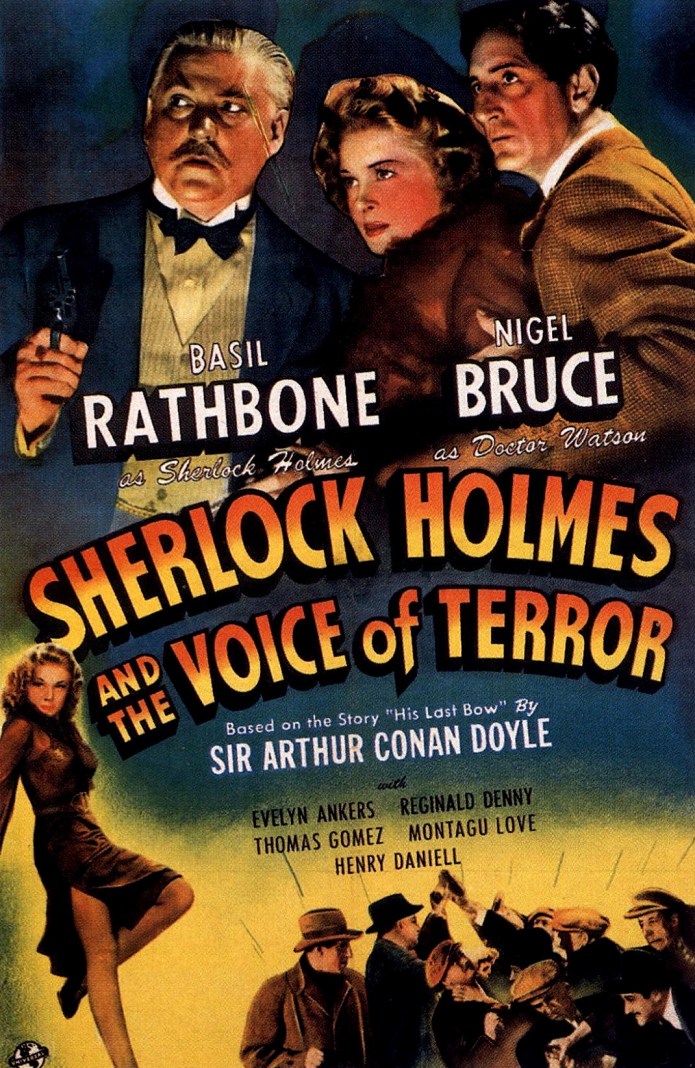
Sherlock Holmes is called in to help the war effort of World War II in Sherlock Holmes and the Voice of Terror, one of the classic Basil Rathbone Sherlock Holmes series of films from the 1940s, the first produced by Universal Pictures.
Nazis always make great villains, and it was a real life concern at the time of this movie’s release. The Voice of Terror was the name of a broadcast sent over the radio broadcast, claiming responsibilities for acts of terror being perpetrated by Third Reich saboteurs against Britain.
In desperation, Sherlock Holmes (Basil Rathbone) and his trusty doctor sidekick Dr. Watson (Nigel Bruce) were called in by the “Inner Circle” in an attempt to do something about the broadcasts.
As with all of these Sherlock Holmes films, Basil Rathbone and Nigel Bruce are solid in their roles and provide an excellent pair. This film moves Holmes and Watson ahead in time, into more of a present day situation of the 1940s instead of the late 19th century/early 20th century as it had been before.
These have all been solid and fun so far.


I love the reactors on YouTube. I spend a lot of time watching their reviews, reactions, riffs and all around fun content. From The Geek Buddies to pReview’d, the Reel Rejects to Settle the Score, the Schmoedown to John Campea, Dan Murrell to Jeremy Jahns… YouTube provides a great forum for me to see these entertaining and engaging personalities. It may not be perfect for the content producers, but I am grateful to have their skills at my fingertips.

DailyView: Day 203, Movie 289
Tonight’s DailyView is taking us into the world of Disney + for a 1947 package film from Disney that featured two animated films. During the forties (in particular during the war), Disney produced these package films to save money. Fun and Fancy Free included two animated shorts connected by Pinocchio’s Jiminy Cricket.
Film number one in the package was entitled “Bongo” and it included the narration of Dinah Shore. Bongo, based on a tale by Sinclair Lewis, tells the story of a circus bear cub who wanted to be free from his situation. Escaping from the train, Bongo found himself in the wilderness, facing the dangers and uncertainty of a bear cub who had never been outside the circus.
Bongo meets a female bear cub named Lulubelle and instantly fall in love. However, with Bongo unable to understand a custom of bears in the wild, loses her to a brutish rival. Thankfully, Bongo comes across a song and dance routine that explained the very confusing ritual, whihc was when bears are in love, they express it with a slap.
Who knew?
Bongo was unremarkable. The Dinah Shore narration and songs felt lacking and there was just not the energy one would expect in a Disney animation.
Film number two is much more classic Disney fare than Bongo. “Mickey and the Beanstalk” placed Disney’s three main characters: Mickey Mouse (voiced by Walt Disney, himself), Donald Duck and Goofy in the iconic fairy tale, Jack and the Beanstalk.
This version was narrated by Edgar Bergen with his ventriloquist dummies, Charlie McCarthy and Mortimer Snerd in a live action section mixed with the animated tale. Jiminy Cricket was involved in this as well. Bergen was telling the story to child actress Luana Patten’s birthday party.
Seeing Mickey, Goofy and Donald together in the classic fairy tale is fun and certainly has more going for it than Bongo did.
Kids might enjoy Bongo more than I did, but you can’t go wrong with the Disney triumphant trio.

DailyView: Day 202, Movie 288
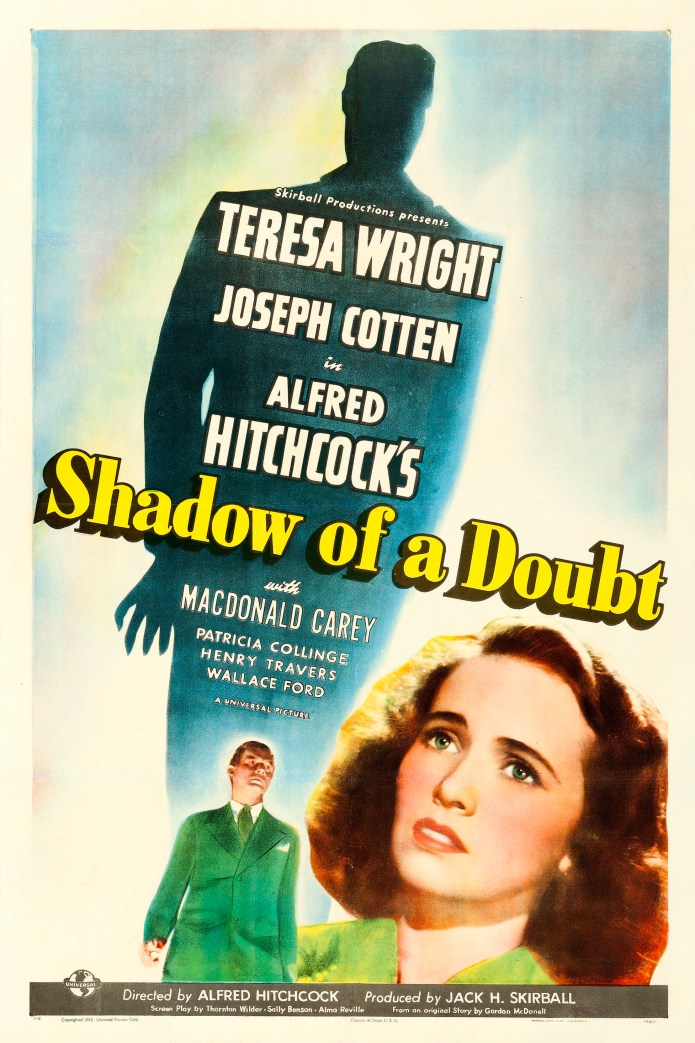
The iconic director Alfred Hitchcock claimed that “Shadow of a Doubt” was his favorite movie in his list of classic films. I had never seen this black and white noir before and I do love Hitchcock, so I was looking forward to adding this to the list of DailyView.
Charlotte “Charlie” Newton (Teresa Wright) was becoming tired of her boring life in the small town in which she lived. So when her beloved Uncle Charlie Oakley (Joseph Cotten) announced that he was coming for a visit, she was thrilled that her namesake was joining them. Little did she know that Uncle Charlie was bringing more with him than she expected.
When two men, Jack (Macdonald Carey) and Joseph (Henry Travers), come to town interested in Uncle Charlie, Miss Charlie starts to doubt the sincerity of her uncle’s story and life.
Alfred Hitchcock is a master of suspense and building tension throughout a movie and he does so brilliantly with Shadow of a Doubt. The audience is aware of Uncle Charlie’s background early in the film, although there is still a question of exactly what he had done. We could see the shenanigans he was pulling on his family members who clearly adored him, making them much easier to manipulate. Who wants to see the worst in someone you love?
With Miss Charlie slowly putting the pieces together, even after refusing to believe what Jack had told her, you could see how the secret was tormenting the young woman, making her uncertain about what she could do.
The conclusion of the film was great and satisfying. The story was well constructed and took steps that continued to build to the eventual end. The scenes with the stairs and the car in the garage were exceptional, clouding what the expectations were for what was going to happen.
The performances were solid, especially from Joseph Cotten as the dark and brooding Uncle Charlie. It was fun to see Macdonald Carey, whom I knew for decades as Dr. Tom Horton on Days of out Lives, in a role that was different from what I was used to from him. Patricia Collinge, Hume Cronyn, Wallace Ford, and Edna May Wonacott all had important roles in the ensemble and they all provided memorable moments.
Hitchcock may have flashier and more well-known films in his oeuvre, but Shadow of a Doubt is certainly one to consider as one of his sleepers.

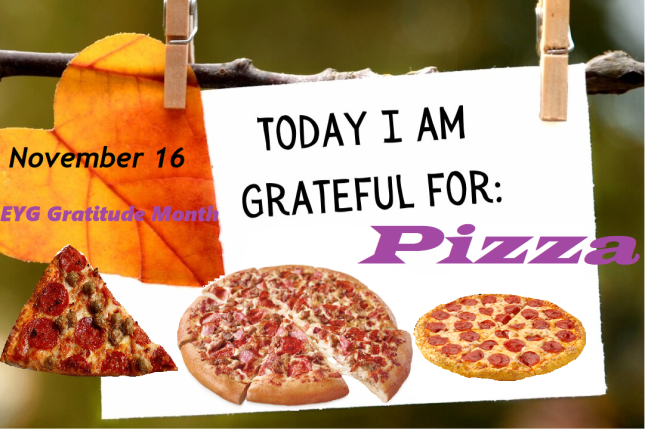
EYG Hall of Fame food, PIZZA!!!!
I love pizza. I could eat it constantly. But only with meat and cheese. None of that horrible stuff like pineapple or fungus or green things.
Canadian Bacon! Pepperoni! Some sausage. Ham! Bacon! Beef!
That’s what I want. YUM!
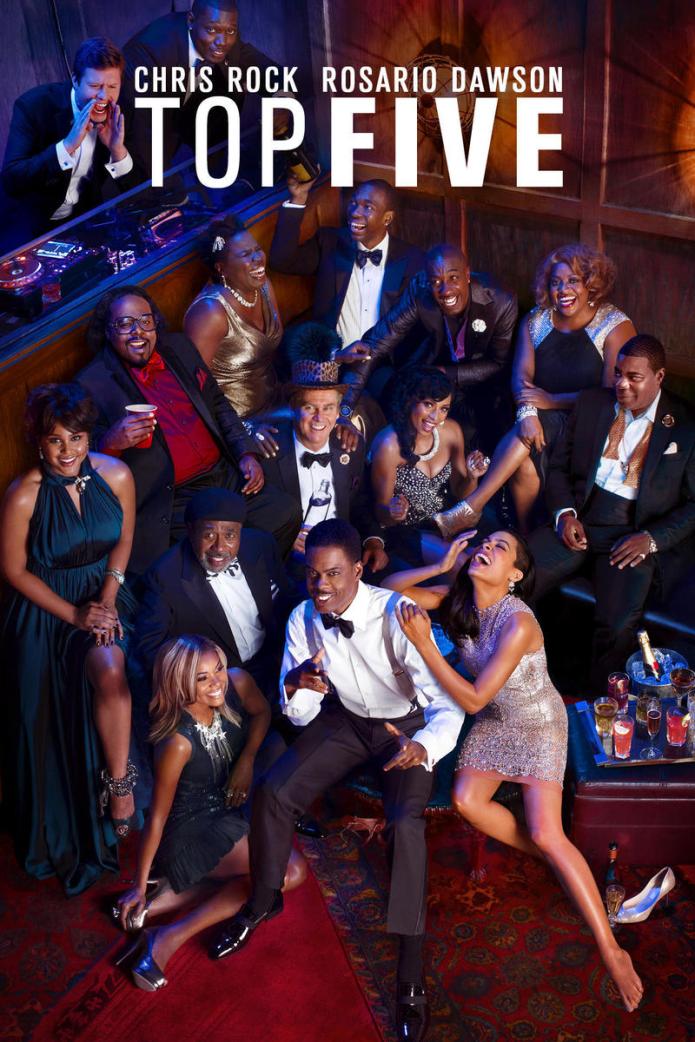
DailyView: Day 201, Movie 287
I remember when the trailers for this movie was coming out and I was interested in seeing it. However, Top Five, the film written and directed by Chris Rock, never came to any theater in my general area and then it disappeared. Earlier during the DailyView, I was looking for a copy of this to watch, and I was not able to find it then either.
Finally, I was able to find it on Vudu today so I rented it and got a chance to watch it. It was very funny and was a deep character drama with some intriguing characters.
Andre Allen (Chris Rock) was a former stand up comedian who had a huge franchise film series that was incredibly popular. Andre wanted to be taken seriously and wanted to be away from the fandom of that movie series. He made a much more serious film and was on promotion for it before he would head off and get married to Bravo reality star Erica Long (Gabrielle Union).
During one of his days of promoting the film, he was joined by New York Times writer, Chelsea Brown (Rosario Dawson), who brought an honesty to the interview that appealed to Andre.
Top Five is raucous, at times obscene, very funny film with some top notch dialogue. Chris Rock and Rosario Dawson have great chemistry and are fantastic together.
There is an amazing cast involved including Cedric the Entertainer (involved in one of the most lewd scenes in the film), Leslie Jones, Kevin Hart, J.B. Smoove, Anders Holm, Kevin Barnett, Ben Vereen, Whoopi Goldberg, Jerry Seinfeld, Adam Sandberg, Michael Che, Sheri Shepherd, Tracy Morgan, Taraji P. Henson, DMX, Gabourey Sidibe and Charlie Rose.
Top Five was absolutely worth the wait. It was a really fun movie and, although there may have been a few of the scenes that made me uncomfortable and they used the N-word a whole bunch, it was funny and surprisingly deep.
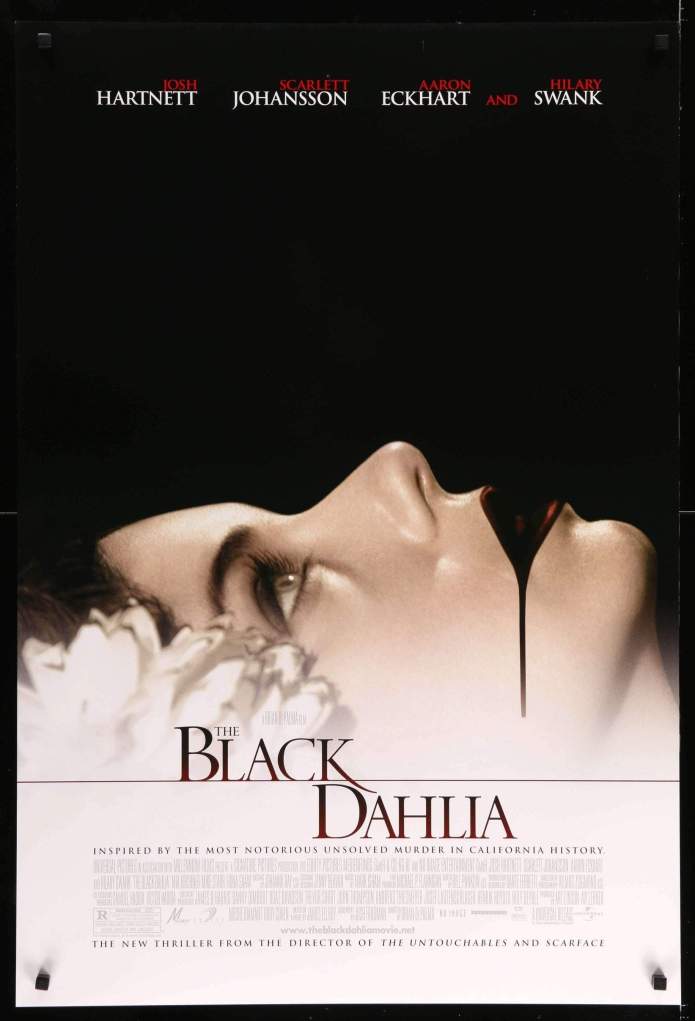
DailyView: Day 201, Movie 286
Sick day. So I am able to lounge around on the couch and try to feel better. Unfortunately, the film I chose to help that along was The Black Dalhia.
The Black Dahlia is a 2006 film noir centered around the infamous murder case of Elizabeth Short in the 1940s. Former boxers Dwight “Bucky” Bleichert (Josh Hartnett) and Lee Blanchard (Aaron Eckhart) are now policemen who wind up assigned to the Dahlia case. Lee becomes obsessed with the case, to the fear of his girlfriend Kay Lake (Scarlett Johansson), while Bucky becomes involved with Madeleine Linscott (Hilary Swank), who has a tie to the victim.
The film has a definite feel of a 1940s noir, and looks great. However, the story itself is needlessly confusing and tosses away some great actors in some miscast roles. I am still not 100% sure what Scarlett Johansson was doing in this movie.
The Black Dahlia started with a whole different storyline that felt very foreign to what the plot of the film was. Character motivations were inconsistent and confused at best and totally nonsensical at the worst.
Who knew one of the most sensational murders of the 20th century could turn out a film this boring?


When he died, it hit me hard. I loved Robin Williams from when I was a kid watching Mork and Mindy. There was never anyone like him and never will be again.
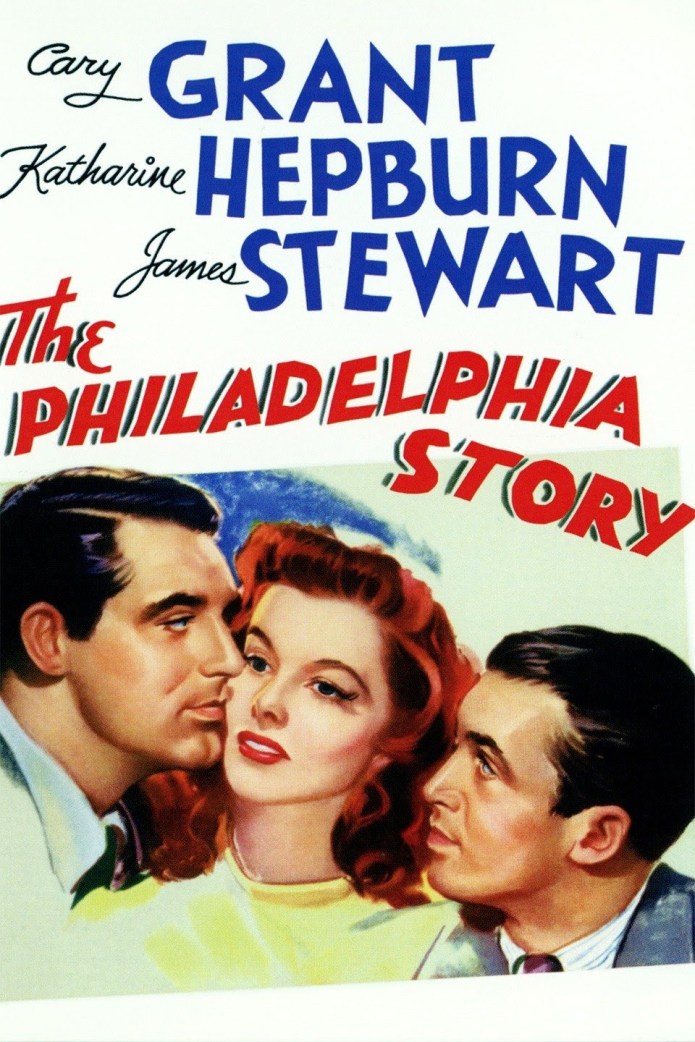
DailyView: Day 200, Movie 285
The third film today on day 200 of the DailyView is an old Hollywood classic, The Philadelphia Story starring Cary Grant, Katharine Hepburn and Jimmy Stewart and produced by Joseph L. Mankiewicz.
The film started off with a break up, as C.K. Dexter Haven (Cary Grant) was storming out of the house, followed by an equally angry Tracy Lord (Katharine Hepburn). She broke his golf club and he pushed her to the ground. It was clear that their marriage was on the rocks.
Flashing forward, Tracy was engaged to George Kittredge (John Howard) and scheduled to have a large wedding. Spy Magazine publisher Sidney Kidd (Henry Daniell) wanted the story so he sent writer Macaulay “Mike” Connor (Jimmy Stewart) and photographer Liz Imbrie (Ruth Hussey) to the Lord home pretending to be friends of the absentee brother. They were to get the story of the marriage and any other specific morsels they could find.
C.K. Dexter helped get the pair into the house and he hung around to see what other trouble he could cause.
I have to say, I was supposed to be rooting for C.K. Dexter Haven but when he shoved Tracy to the ground, I immediately took a dislike to him. There was an implication that he “socked” her (as said by the little sister) and so I pictured an abusive husband, especially since he was portrayed as a drunk. After this, C.K. was supposed to have sobered up, but I still never saw any reason to cheer for him outside of the fact that he was Cary Grant.
Katharine Hepburn was a very confused character, never being sure exactly what she felt or what she should do. People around her were always telling her that she carried herself like a goddess or that she saw herself above others and all of that played against her confidence.
The film had plenty of comedic elements to it, and the finale is played with a lot of unexpectedness. I like Jimmy Stewart quite a bit and I enjoyed his character here too. There was too much use of alcohol to push the plot ahead, but 1940 was a different time for sure.
The Philadelphia Story was enjoyable, but the romantic relationships were a little shaky. It had some messaging about class as well, but it slid aside for the main plot.

DailyView: Day 200, Movie 284
Awakenings was a movie that I was aware of, but that I had never seen before which I find odd, being such a fan of the late, great Robin Williams. My guess is that, since this was such a departure of a role for Williams when it first was released, I was not ready to watch it. There was none of the typical Robin Williams chaotic energy that we were so used to in Awakenings so I did not watch it and it was one that sort of slipped away over the decades since.
This was really a film that showed the range of the actors, Robin Williams. He was more than Mork. He was more than Captain My Captain. He was an actor that could stand beside Robert DeNiro and not lose a step.
Awakenings was directed by Penny Marshall and featured both Robin Williams and Robert DeNiro in a true story of a doctor hired as a clinical physician at a local hospital in the Bronx where most of the patients were unresponsive and semi-catatonic. Dr. Malcolm Sayer (Williams) began to notice certain hints that made him believe that the patients were still inside these unresponsive shells and that there was a way to bring them back.
Convincing the head doctor (John Heard) was not easy, but Dr. Sayer was able to get approved the use of the experimental drug, usually used for Parkinson’s patients, on one patient, Leonard Lowe (Robert DeNiro). The drug led to the revival of Leonard from his 30-year catatonia and brought him back to life, a metaphorical ‘awakening.’
Williams and DeNiro are the backbone to this movie. Both are amazing performances with DeNiro scoring an Academy Award nomination for Best Actor.
There are many emotions scattered throughout the movie as we see more of the patients at the hospital awake after taking the drug and seeing how their lives were now in a world that was very different than when they originally caught their disease.
The movie shows just how important it is to cherish life and the time given to you. Life is too short and it will go by in a blink of an eye and you must take every opportunity to make your time worthwhile. This theme is ripe throughout the script and the characters in the hospital.
This was Penny Marshall’s middle film in her best period of her directorial career. Big came in 1988, Awakenings in 1990, and A League of Their Own in 1992. RIP Penny.
Awakenings is an emotional tearjerker and shows off the acting skills of two of our generations finest actors. If youhave not had a chance to see this, I would absolutely recommend that you do.

